

One of the questions I get asked quite regularly by buyers is, "How much below asking price should we offer on this property?"
And surprisingly, it's a question that comes up a lot, even though I don't think it's really the right question to be asking.
People will look at the market and see that properties in Squamish have been selling for an average of, say, 5% below their asking prices. They then assume that when they find a property they like, they should offer 5% below the asking price.
But that's not how real estate works.
There is no standard percentage below asking price that you should offer on a home in Squamish. The amount you should offer depends on what the property is actually worth, not what the seller happens to be asking for it.
And those two numbers can be very different.
Why Offering 5% Below Asking Price Doesn't Make Sense
Let's imagine you've been following the Squamish real estate market and you've noticed that a number of properties have recently sold below their asking prices.
You might look at the sales statistics and see that homes are selling for an average of 95% of their asking price.
It's tempting to take that information and apply it to the next property you want to buy.
If a house is listed for $1.2 million, you might decide that offering $1.14 million makes sense because that's 5% below asking.
But what if the property is actually worth $1.3 million?
In that situation, the seller might already be asking considerably less than the property is worth. Offering another 5% below that number could mean you're missing an opportunity to buy a well-priced home.
Now consider the opposite situation.
What if the same property is listed for $1.2 million, but the comparable sales suggest it's only worth $1.05 million?
Offering 5% below asking would put you at $1.14 million, which could still be substantially more than the property's market value.
In both situations, you've used exactly the same negotiating strategy, but the result is completely different.
That's why I don't think looking at the average percentage below asking price is a particularly useful way to decide what you should offer.
It tells you something about the relationship between asking prices and selling prices across a group of properties. It doesn't tell you what an individual property is worth.
Every Seller Has a Different Pricing Strategy
One of the biggest reasons that asking prices can be misleading is that sellers don't all price their properties the same way.
Some sellers deliberately list their properties below market value.
They might be trying to attract a lot of attention, generate multiple showings and encourage competing offers. Their expectation may be that the property will ultimately sell above the asking price.
If you come across one of those properties and decide you're going to offer 5% below asking because that's what the market averages suggest, there's a good chance your offer won't be competitive.
Other sellers take a completely different approach.
They might list their property above what the comparable sales suggest it's worth because they're not particularly motivated to sell.
Perhaps they're happy living in the property. Perhaps they'll only move if somebody is prepared to pay a price that makes it worthwhile for them.
Those sellers may be willing to leave the property on the market for a long time.
Eventually, they might receive an offer considerably below their asking price that they're prepared to accept.
That doesn't necessarily mean the buyer got an extraordinary bargain. It might simply mean the asking price was unrealistic in the first place.
Then there are sellers who price their properties very close to market value, hoping to attract a buyer without a prolonged negotiation.
All three strategies can exist in the same market at the same time.
So when you see one property selling above asking, another selling at asking and another selling substantially below asking, you can't assume that one buyer negotiated brilliantly and another paid too much.
You need to understand the value of each property relative to its asking price.
A Property Selling Below Asking Doesn't Automatically Mean It Was a Good Deal
This is something I think buyers sometimes misunderstand.
They see a property listed for $1.3 million that eventually sells for $1.15 million, and they think the buyer got an incredible deal because they negotiated $150,000 off the asking price.
But what if that property was only worth $1.15 million in the first place?
In that situation, the buyer may simply have paid fair market value.
The $150,000 discount looks impressive, but it doesn't necessarily represent $150,000 in savings.
Now imagine another property is listed for $1.1 million and sells for $1.15 million.
A buyer looking only at asking and selling prices might think somebody overpaid by $50,000.
But what if the property was actually worth $1.2 million?
That buyer may have purchased the property for less than its market value, despite paying above asking.
That's why the relationship between asking price and selling price can be so misleading.
A good purchase isn't defined by how much you negotiated off the asking price. It's defined by what you paid relative to the property's actual market value.
BC Assessment Doesn't Tell You What to Offer Either
Another thing buyers sometimes look at is the BC Assessment value.
They'll see that a property is assessed at a particular amount and compare that number with the asking price.
If the property is listed well above its assessed value, they might assume it's overpriced.
If it's listed below its assessed value, they might think they're getting a bargain.
But BC Assessment isn't a substitute for determining current market value.
Assessment values are prepared for property taxation purposes, using a specific valuation date and a mass-appraisal process. They aren't individual, up-to-the-minute appraisals of what each property would sell for today.
And in a market where conditions can change, the difference between the assessment date and the date you're making an offer can be important.
Individual properties can also have characteristics that aren't adequately reflected by simply looking at their assessed value.
Condition, renovations, layout, views, sunlight, privacy and the particular location of a property can all influence what buyers are prepared to pay.
So I wouldn't determine an offer price by applying a percentage above or below BC Assessment any more than I would apply a percentage below the listing price.
Neither number answers the question we actually need to answer.
The First Question Should Be: What Is This Property Worth?
When I'm helping a buyer evaluate a property in Squamish, the first thing I want to establish is its likely market value.
And the way we do that is by looking at comparable properties.
We want to understand what similar homes have actually sold for, what competing properties are currently available and how the property we're considering compares with those alternatives.
That involves more than simply finding another house with the same number of bedrooms and a similar square footage.
We need to look at location, lot size, age, condition, layout, renovations and all the other characteristics that influence value.
A property with an excellent layout and good sunlight may be more desirable than another property of similar size that feels dark or has an awkward floor plan.
A house with a functional secondary suite may appeal to a different group of buyers than one without a suite.
And two houses on the same street can have quite different values depending on their condition, orientation and individual features.
The objective is to establish a reasonable value range based on the available evidence.
That isn't always easy, particularly when there haven't been many recent comparable sales.
But it's still a much more useful exercise than simply deciding to offer a particular percentage below asking.
Once You Know the Value, You Can Decide How Aggressively to Negotiate
Once we've established what I believe the property is worth, the conversation with the buyer becomes much more useful.
Now we're not asking, "How much below asking should we offer?"
We're asking, "What are we prepared to pay for this property, and how should we approach the negotiation?"
Those are very different questions.
Let's say we've reviewed the comparable sales and determined that a property is probably worth around $1.1 million.
If the seller is asking $1.2 million, we know there's a meaningful difference between the asking price and our assessment of value.
We can then discuss an offer strategy based on that information.
But if the property is listed at $1.05 million, we have a completely different situation.
The asking price may already be attractive relative to the market, and the buyer needs to understand that before deciding to offer less.
Of course, buyers don't always want to pay what a property is worth.
Sometimes a buyer is specifically looking for a bargain. They might be willing to make a number of low offers, knowing that most sellers probably won't accept them.
There's nothing inherently wrong with that strategy, provided the buyer understands what they're doing.
If a property is worth $1.1 million and the buyer wants to offer $950,000, that's their decision.
But they need to understand that they're not necessarily making a reasonable market-value offer. They're testing whether the seller might be prepared to accept substantially less than the property is worth.
The seller may reject the offer immediately, counter at a much higher price or simply decide not to negotiate.
And the buyer needs to be comfortable with the possibility of losing the property.
That's very different from believing that an offer is appropriate simply because it's a certain percentage below asking.
Market Conditions Still Matter
Now, none of this means we should ignore the broader Squamish real estate market.
Market conditions absolutely influence how we approach negotiations.
If there are a lot of properties available and relatively few buyers, sellers may have to be more flexible.
If a particular type of property is in short supply and several buyers are interested, there may be less room to negotiate.
But even in a slower market, not every property is overpriced.
And even in a strong market, not every asking price is justified.
You can have a property that's attracting a lot of attention because it's priced well, while another property in the same neighbourhood sits on the market because the seller's expectations are too high.
That's why I think it's important to look at both the broader market and the individual property.
The market tells us about the general negotiating environment. The comparable properties help us establish value. And the seller's circumstances and pricing strategy help us decide how to approach an offer.
All of those factors matter.
But none of them produces a universal percentage that every buyer should offer below asking.
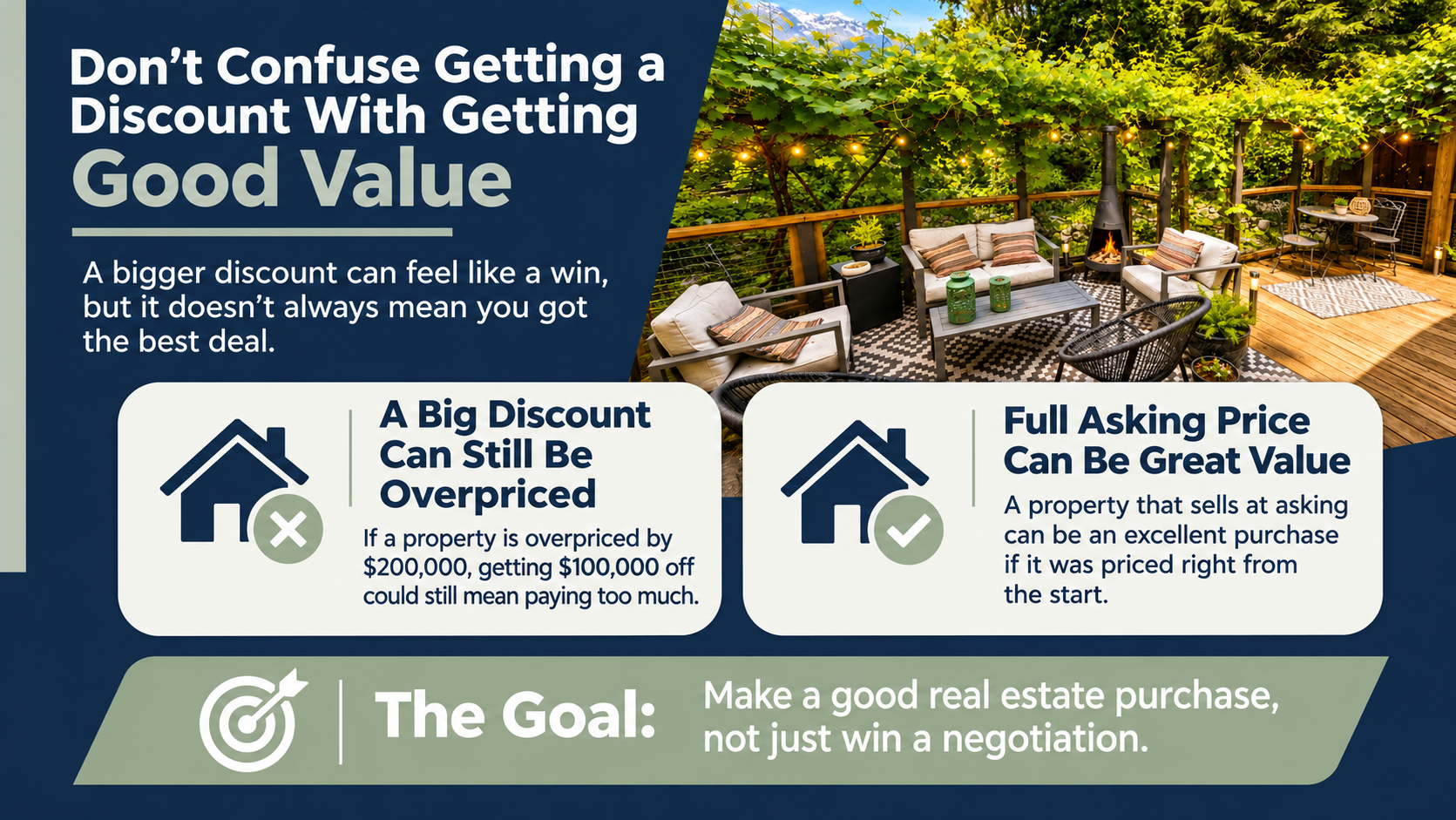
Don't Confuse Getting a Discount With Getting Good Value
I think there's a psychological element to this as well.
Buyers naturally like the feeling that they've negotiated a good deal.
If somebody manages to get $100,000 off the asking price, that can feel like a significant achievement.
And sometimes it is.
But the size of the discount doesn't tell us whether the buyer made a good purchase.
If the property was overpriced by $200,000, negotiating $100,000 off might still leave the buyer paying too much.
On the other hand, a property that sells at full asking price could represent excellent value if it was priced attractively from the beginning.
That's why I try to keep the focus on what the property is worth.
I would much rather help somebody buy a well-priced property at asking than encourage them to purchase an overpriced property simply because they managed to negotiate a large discount.
The objective is to make a good real estate purchase, not to win a negotiation based on an arbitrary number.
So, How Much Below Asking Price Should You Offer in Squamish?
My answer is that you shouldn't start by deciding how much below asking price you want to offer.
You should start by determining what the property is actually worth.
Look at the comparable sales. Understand the current market conditions. Consider how the property compares with other homes available to you. And try to understand why the seller has chosen that particular asking price.
Once you've done that, you can decide what you're prepared to pay and how aggressively you want to negotiate.
Sometimes the right offer will be substantially below asking price.
Sometimes it will be exactly at asking.
And sometimes paying above asking price may still represent good value.
The asking price is simply the seller's starting point. It isn't necessarily the property's market value, and it shouldn't automatically become the starting point for your offer.
When I'm helping buyers purchase property in Squamish, my job is to show them the relevant comparable properties, explain how I assess the value and help them understand their options.
Once they have that information, they can make an informed decision about what they're prepared to offer.
And that's a much better way to buy real estate than applying a blanket 5% or 10% discount to every property you see.
Simon Hudson | Team Hudson, Macdonald Realty | Squamish, BC
 The data relating to real estate on this website comes in part from the MLS® Reciprocity program of either the Greater Vancouver REALTORS® (GVR), the Fraser Valley Real Estate Board (FVREB) or the Chilliwack and District Real Estate Board (CADREB). Real estate listings held by participating real estate firms are marked with the MLS® logo and detailed information about the listing includes the name of the listing agent. This representation is based in whole or part on data generated by either the GVR, the FVREB or the CADREB which assumes no responsibility for its accuracy. The materials contained on this page may not be reproduced without the express written consent of either the GVR, the FVREB or the CADREB.