

One of the questions I was asked recently by a buyer was, "How much should we be worried about what's being built next door?"
It's a great question, and it's something we come across regularly when helping people buy property in Squamish.
My answer is that you should absolutely be paying attention to what's happening around a property. But I think the bigger issue is something that many buyers don't consider carefully enough.
It's not just what is being built next door today. It's what could potentially be built there in the future.
Squamish is going through a significant period of development and change. We're seeing densification, redevelopment and changes to the way land is being used. Areas that were traditionally made up of lower-density housing are being reconsidered as the community grows.
And that means buyers need to think beyond what they can see when they're standing in the backyard or looking out of the living room window.
A property might have excellent privacy, beautiful views and good sunlight today. But depending on the surrounding zoning, future planning decisions and the direction of development in that neighbourhood, those characteristics could change considerably over the years.
That's why I think understanding potential future development should be a fundamental part of buying real estate in Squamish.
Don't Just Worry About the Empty Lot Next Door
Most buyers understand that if they're purchasing a property beside an empty lot, they should investigate what might eventually be built there.
The same applies if they're looking at a condo beside an active construction site or a parcel of land with a development application already underway.
Those are fairly obvious situations.
But what about buying a house next to another house?
Or purchasing a condo that currently looks over a low-rise commercial building?
Or buying a property where the surrounding neighbourhood appears relatively settled?
Those situations deserve investigation too.
The fact that a neighbouring property has a particular use today doesn't mean it will have that same use ten years from now.
The land might already be zoned to permit something more substantial than what's currently there. Or the property owner might eventually apply to change the zoning to allow a different use or greater density.
That's an important distinction.
When I'm looking at a property with a buyer, I don't want to understand only what exists around it today. I also want to know what the current rules permit and whether there are reasons to think those rules could change.
Current Zoning Is Only Part of the Picture
One of the first things to investigate is the zoning of the surrounding properties.
Zoning helps establish what types of buildings and uses are currently permitted on a particular parcel of land, along with requirements and restrictions that can affect how the property is developed.
But it's important to understand that zoning isn't necessarily permanent.
Municipalities can amend their zoning bylaws, and property owners can apply for changes where a proposed development requires different permissions.
In Squamish, that matters because the community is growing and the District is planning for additional housing and development.
So I think buyers should be asking two different questions.
The first is, "What could be built next door under the zoning that exists today?"
The second is, "What could realistically become possible if that zoning changes?"
Those aren't the same question.
The first involves reviewing the current rules. The second requires a broader understanding of planning policy, development patterns and the direction the municipality is taking.
And while nobody can predict every future zoning decision, there are often indications of where additional density may be contemplated.
Start With the Squamish Development Showcase
One of the most useful resources available to buyers is the District of Squamish's Development Showcase.
The District provides an online map of active development applications, allowing people to investigate projects in different parts of the community.
You can use it to see whether there are applications in the area surrounding a property you're considering buying.
That is particularly important if you're purchasing near vacant land, an older commercial property, a larger parcel or an area where redevelopment is already occurring.
The District also provides land development application information that can help buyers understand the status and details of projects under review.
For me, checking these resources is the absolute minimum level of investigation a buyer should be doing.
If you're considering making a substantial investment in a property, you should know whether there are active applications nearby that could affect how you use or enjoy it.
But I wouldn't stop there.
The Development Showcase helps you investigate applications that have entered the public development process. It doesn't tell you everything that could potentially happen in the future.
A property owner may not have submitted an application yet. A future rezoning proposal might not exist. And broader planning changes can create development possibilities that aren't represented by a specific application today.
That's why we need to look further.
The Official Community Plan Can Tell You Where Squamish Is Heading
Another important document is the District of Squamish's Official Community Plan, commonly referred to as the OCP.
The Official Community Plan establishes the municipality's broader vision for growth and land use.
It helps identify how different parts of the community are intended to develop over time, including areas where additional housing or different forms of development may be supported.
This is particularly important in a community like Squamish, where the development pattern has been changing.
If you're looking at a property in an area where the District is contemplating additional density, that should be part of your purchasing decision.
It doesn't necessarily mean the neighbouring property will be redeveloped. And it certainly doesn't mean every possible development will receive approval.
But it gives you a better understanding of what might be considered in the future.
I think that's a much more useful approach than simply assuming that because a property looks a certain way today, it's going to stay that way.
The current OCP, any proposed amendments and relevant neighbourhood or sub-area plans all deserve attention when evaluating a property.
Squamish's Building Heights Have Been Changing
One of the reasons I think buyers need to be particularly careful about future development is that expectations around building height and density can change over time.
If you look back over roughly the last ten to twelve years, a lot of the development people associated with Squamish involved buildings in the three- to four-storey range.
We've since seen proposals and approvals for taller buildings, including developments in the six- and seven-storey range.
That represents a meaningful change in the type of development occurring in parts of town.
And I think it's reasonable to consider whether that trend could continue.
Could we see proposals for eight- or nine-storey buildings in appropriate locations in the coming years? I wouldn't rule that out.
I'm not suggesting that the District has approved those heights everywhere, or that every neighbourhood is going to see buildings of that size. Specific permissions depend on the location, applicable planning policies, zoning and approval process.
But I wouldn't make a purchasing decision based on the assumption that today's building heights represent a permanent maximum.
Imagine buying a condo on the seventh floor because you believe nothing taller could ever be built in front of you.
That's a potentially expensive assumption.
Even if the land in front of you currently permits a lower building, planning policies and zoning can change.
If the view is one of the main reasons you're buying the property, you need to understand that possibility before deciding what you're willing to pay.
A New Council Can Influence the Direction of Development
There's another reason this conversation is particularly relevant right now.
Squamish has just held its October 2026 municipal election, and a new council has been elected.
Municipal councils have an important role in shaping planning policy, considering rezoning applications and establishing the direction of future development.
That doesn't mean everything changes immediately following an election. Existing bylaws, planning processes and provincial requirements continue to matter.
But council priorities can influence how a community approaches density, growth and redevelopment over time.
I think buyers should pay attention to that.
It's worth understanding the direction the District is taking, what planning changes are being considered and how council's priorities may affect future land use.
That doesn't mean trying to predict the outcome of every future decision.
It means recognizing that the development rules we have today aren't necessarily the rules we'll have in ten years.
And if you're purchasing a property with the expectation that the surrounding area will remain unchanged, that's something you should think carefully about.
Look at Where Densification Is Already Moving
One of the practical things I like to consider is how development is progressing through a particular area.
If you're looking at a property and you can see that neighbouring blocks have already started to redevelop, that may tell you something about the longer-term potential of nearby parcels.
Perhaps older buildings are being replaced by larger developments. Perhaps several properties are being assembled for redevelopment. Or perhaps the District's planning documents identify the area for additional density.
Those are all pieces of information worth considering.
It's not enough to look at one property in isolation.
You want to look at the surrounding area and understand the broader pattern.
Where has densification already happened? Where are applications being submitted? What types of projects are being proposed? And does the planning framework suggest that development could continue toward the area where you're buying?
None of that guarantees that a particular property will be redeveloped.
But it can help you assess whether future development is a realistic consideration or a relatively remote possibility.
And that distinction matters when you're deciding how much to worry about it.
What Could Future Development Actually Change?
When people think about development next door, they often focus on losing a view.
And that's certainly a legitimate concern, particularly in Squamish, where views can be a major part of a property's appeal and value.
But I think there are several other things buyers should consider.
A taller neighbouring building might change how much sunlight reaches your home or backyard. Additional windows and balconies could affect privacy. A larger development might change traffic, parking demand or the general character of the surrounding area.
Construction itself can also create temporary disruption, sometimes over an extended period.
On the other hand, not every nearby development is necessarily negative.
Redevelopment can bring improved streetscapes, new amenities, commercial services or other changes that make an area more attractive.
So I wouldn't automatically advise a buyer to avoid a property simply because development is possible nearby.
The important thing is to understand the likely implications and decide whether the property still represents good value.
We Include Development Due Diligence in Our Buyers' Offers
This is something we take seriously when representing buyers.
In our buyers' offers, we generally include a subject condition that gives the buyer an opportunity to review and approve relevant development and planning information affecting the surrounding area.
That includes investigating development applications, zoning and other information that could influence the buyer's decision.
I think that's an important protection.
It means the buyer has an opportunity to do the necessary research before committing unconditionally to the purchase.
Of course, the exact wording and suitability of any subject condition need to be considered for the individual transaction.
And the condition itself doesn't guarantee that every possible future development can be identified.
But it provides an opportunity to investigate what's publicly available, ask questions and decide whether the risks are acceptable.
If we discover that a neighbouring property has an active redevelopment application, that's information the buyer should know.
If we identify planning policies that suggest additional density could be considered in the area, that should also be part of the conversation.
And if the buyer is paying a substantial premium for a particular view, sunlight exposure or privacy, I think we need to be especially careful about understanding what could change.
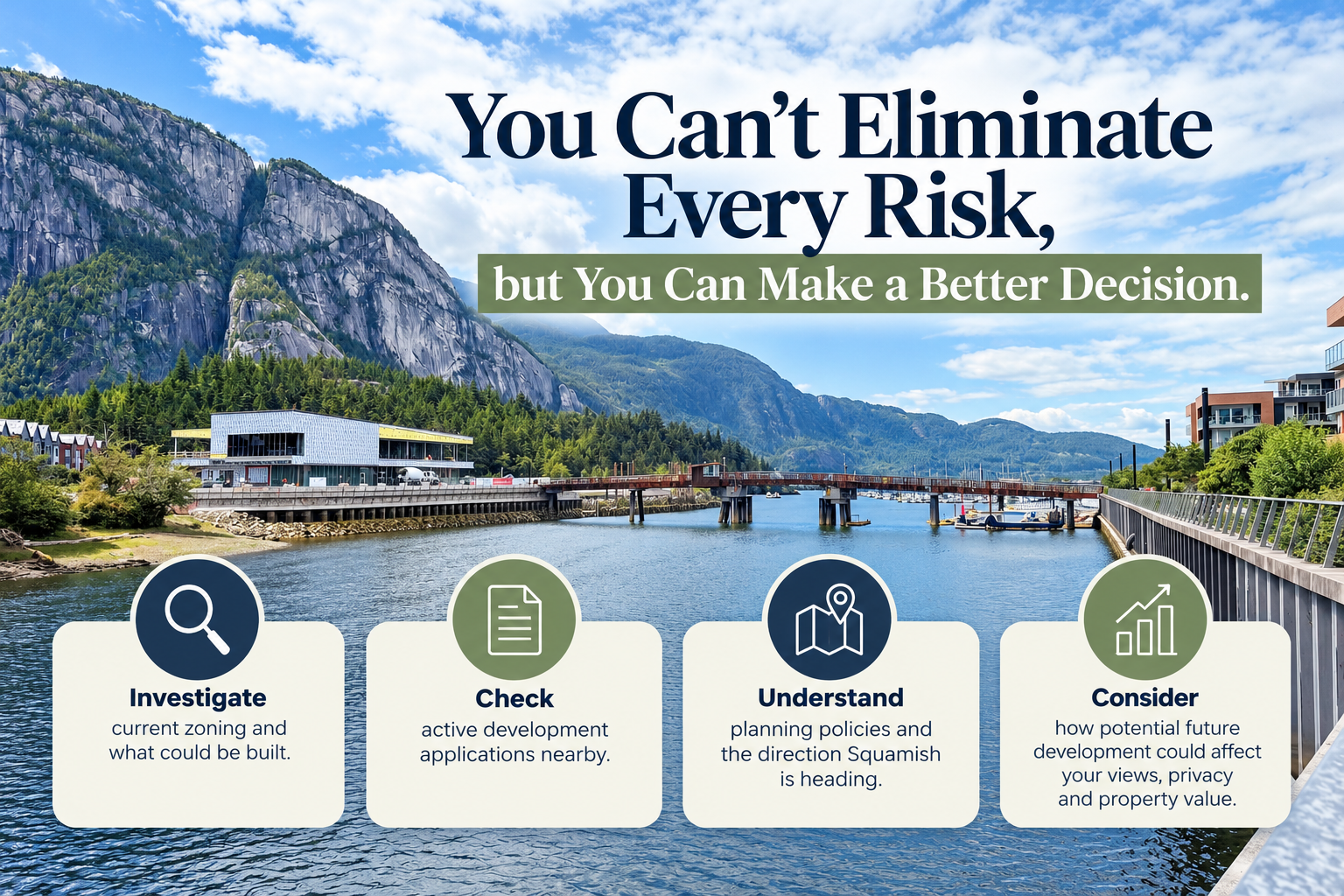
You Can't Eliminate Every Risk, but You Can Make a Better Decision
There's a limit to what anyone can know about future development.
We can investigate current zoning, active applications, planning policies and the development pattern in the surrounding neighbourhood.
We can ask questions of the District and review publicly available information.
But we can't guarantee that a neighbouring property will never be rezoned or redeveloped.
That's simply not realistic in a growing community.
And I don't think the goal should be to eliminate every possible risk.
The goal is to understand the risks well enough to make an informed decision.
If you know that a neighbouring property could potentially be redeveloped, you can consider that when evaluating the price.
If you're buying a condo primarily because of its view, you can investigate how secure that view is likely to be.
And if you value privacy above almost everything else, you can think carefully about whether the surrounding properties might eventually accommodate more intensive development.
That's much better than finding out after you've purchased the property that something you assumed would never happen was actually a possibility all along.
So, How Worried Should Buyers Be About What's Being Built Next Door?
I think buyers should be concerned enough to investigate it properly, but not so concerned that they assume every neighbouring property is going to be redeveloped.
Squamish is changing, and I expect that process to continue.
That's why I believe buyers need to think beyond the current appearance of a property and understand the development possibilities around it.
Start with the District's Development Showcase and current land development applications. Review the existing zoning. Look at the Official Community Plan and any relevant neighbourhood plans. Pay attention to where densification is occurring and consider how future changes could affect the property you're buying.
And don't assume that because a particular building height or density isn't permitted today, it could never be permitted in the future.
The biggest mistake isn't necessarily buying next to a property that might be developed. It's buying without understanding that development was a possibility.
When you're investing in real estate in Squamish, you want to know not just what you're purchasing today, but what the surrounding area could look like in the years ahead.
That's an important part of making a good buying decision.
 The data relating to real estate on this website comes in part from the MLS® Reciprocity program of either the Greater Vancouver REALTORS® (GVR), the Fraser Valley Real Estate Board (FVREB) or the Chilliwack and District Real Estate Board (CADREB). Real estate listings held by participating real estate firms are marked with the MLS® logo and detailed information about the listing includes the name of the listing agent. This representation is based in whole or part on data generated by either the GVR, the FVREB or the CADREB which assumes no responsibility for its accuracy. The materials contained on this page may not be reproduced without the express written consent of either the GVR, the FVREB or the CADREB.
Comments:
Post Your Comment: