

There are difficult properties to sell.
There aren't unsellable properties.
There's just a price at which the market says yes.
After more than 25 years selling real estate, that's one of the things I've become pretty convinced of.
It doesn't matter whether we're talking about a beautiful house with an incredible view, an older townhouse that needs work, a dark property in a difficult location or, to use an extreme example, a neglected house sitting next to the dump.
There's a buyer for it.
The question is:
At what price?
That doesn't mean price is the only thing that matters when selling a property. Far from it.
There are four factors I think about when selling a home, and I put them in a very specific order:
1. Price
2. Position
3. Preparation
4. Presentation
The interesting thing is that these four don't operate independently.
Price is by far the most important factor in determining whether the property actually sells.
But Position, Preparation and Presentation help determine what that price should be.
Understanding that relationship is one of the keys to pricing a Squamish property properly.
Price Is Number One
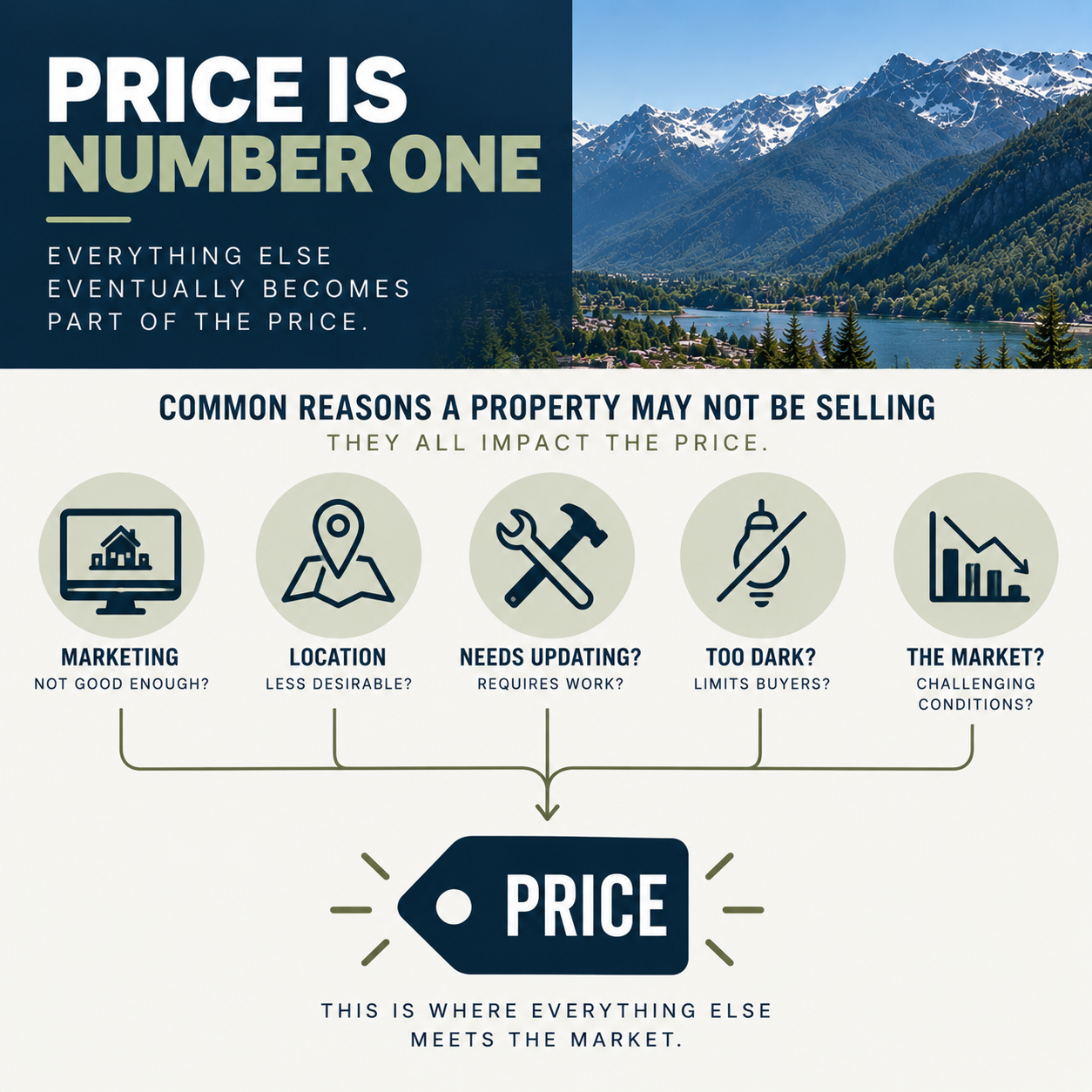
Let's start with price because ultimately this is where the market makes its decision.
If a property isn't selling, sellers naturally look for explanations.
Maybe the marketing isn't good enough.
Maybe buyers don't like the location.
Maybe the house needs updating.
Maybe it's too dark.
Maybe it's the market.
All of those things can be true.
But they all eventually become part of the price.
If the location is less desirable, the price needs to reflect it.
If the property needs $200,000 worth of work, the price needs to reflect that.
If there's something unusual about the house that dramatically reduces the number of potential buyers, the price needs to reflect that too.
That's why I say every property is sellable.
Price is where everything else about the property eventually meets the market.
But that raises a much more interesting question:
How do we determine the right price?
That's where the other three Ps come in.
Position Has the Greatest Effect on Market Value
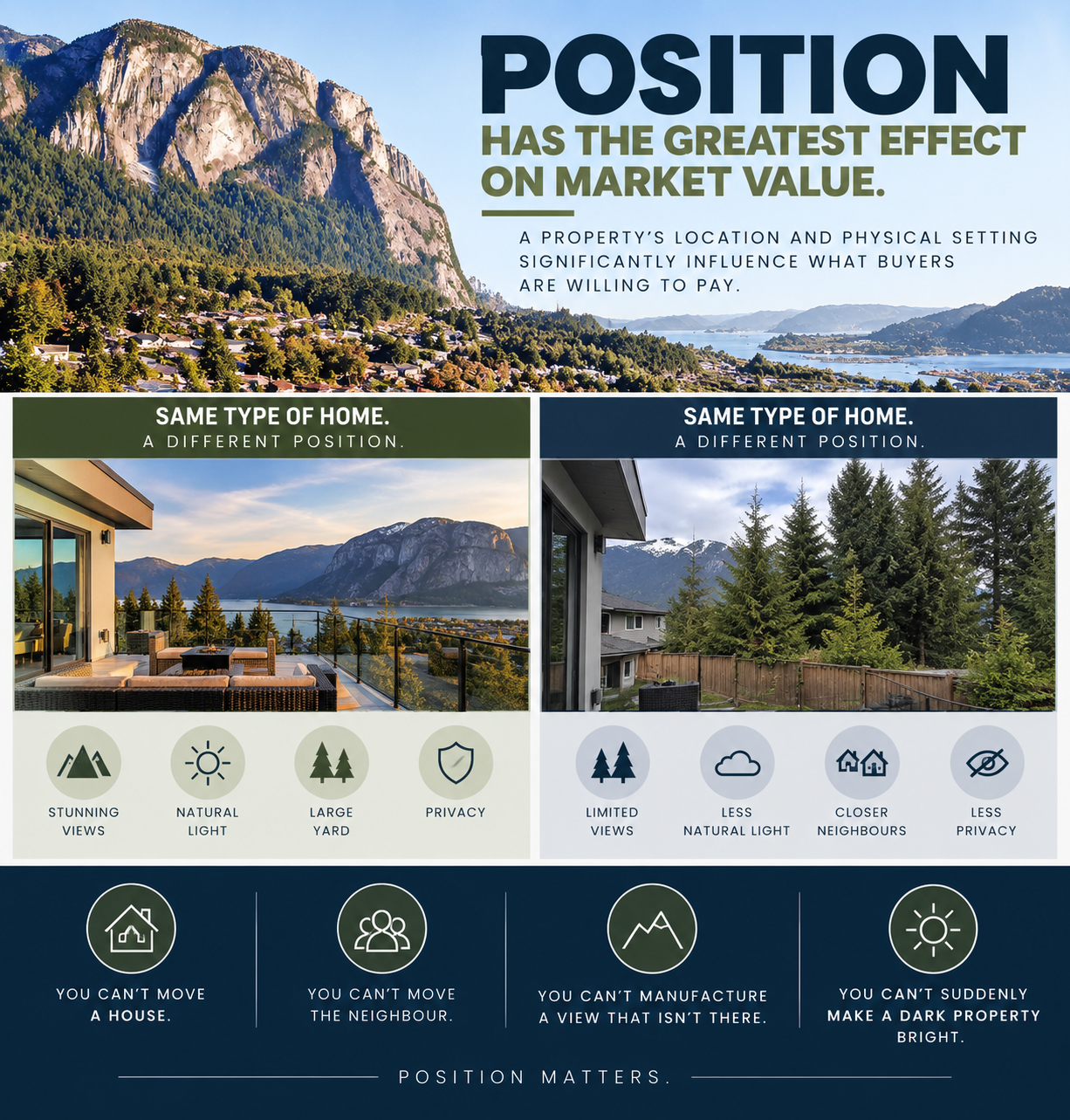
After price, I rank Position as the most important factor.
Position is essentially the property's location and physical setting.
And it's important because it's the thing we generally have the least ability to change.
You can't pick up a house and move it.
You can't move the neighbour.
You can't manufacture a view that isn't there.
You can't suddenly make a dark property bright.
Consider a Squamish house with an unobstructed view of Howe Sound and the Chief, a large backyard, lots of natural light and good privacy.
Now compare that with a similar house where trees and neighbouring properties significantly reduce the light, privacy and views.
Those two houses aren't necessarily worth the same amount simply because they have similar square footage, bedroom counts and finishes.
Their positions are different.
And position contributes significantly to what buyers are ultimately willing to pay.
Position Isn't Simply About the “Best” Neighbourhood
This is where I think the analysis needs to become more sophisticated.
Position doesn't mean declaring Garibaldi Highlands better than Valleycliffe, or Valleycliffe better than Brackendale.
They offer different things.
For someone regularly commuting to Vancouver, Valleycliffe's location at the southern end of Squamish can be a significant advantage.
Garibaldi Highlands has a completely different position. It's elevated, has established residential streets and underground utilities, and depending on the property may offer views, trail access and other characteristics that appeal to a particular buyer.
Brackendale offers something different again.
Even within the same neighbourhood, position changes from property to property.
One house may back onto green space.
Another may get considerably more sunlight.
One may have exceptional privacy.
Another may have a better view.
So we don't simply ask:
“Is this a good neighbourhood?”
We ask:
“What is valuable about the position of this particular property?”
We can't necessarily change the position, but we can understand its effect on value—and make sure buyers understand its advantages.
Preparation Comes Next
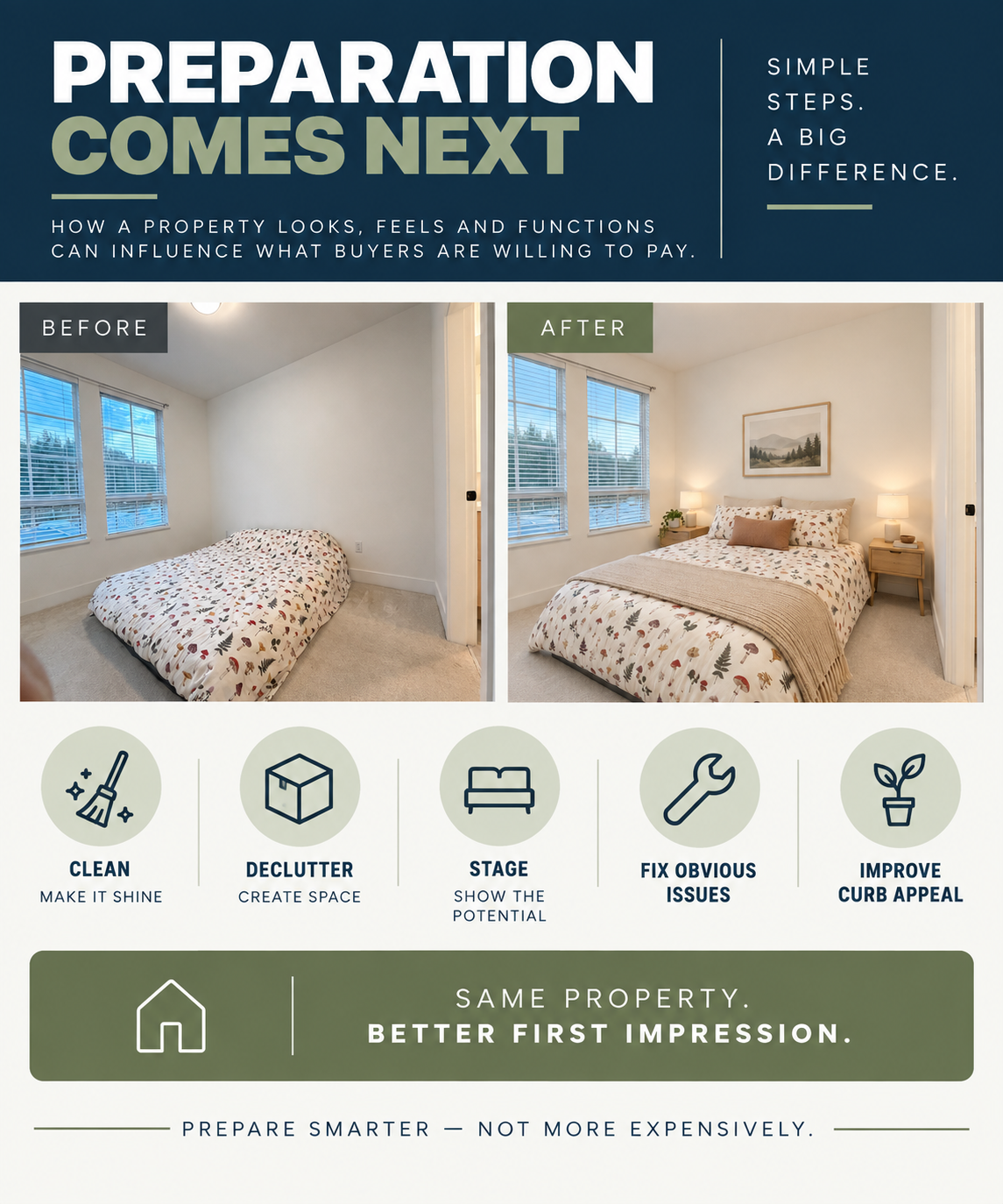
The third factor is Preparation.
This is where the seller starts to have considerably more control.
How does the property look when somebody walks through the door?
Is it clean?
Is it cluttered?
Does it need staging?
Is the landscaping overgrown?
Are there obvious maintenance items?
Does the entrance make a good first impression?
Is there something relatively straightforward we can do that changes how buyers perceive the entire property?
Preparation can influence what buyers are willing to pay.
But preparation also needs to be intelligent.
As I've discussed previously, I don't think this is necessarily the market to undertake a huge renovation immediately before selling and assume you'll get all of that money back.
Sometimes the right preparation is much simpler.
Clean it.
Declutter it.
Take care of the landscaping.
Fix the things buyers will immediately notice.
Stage it where appropriate.
Make the property feel cared for.
And if the house is already substantially renovated, perhaps complete the remaining work so it feels finished.
The objective isn't to spend as much money as possible. It's to prepare the property in the way that produces the best response from buyers.
The Four Ps Aren't Equal
This is where the framework gets interesting.
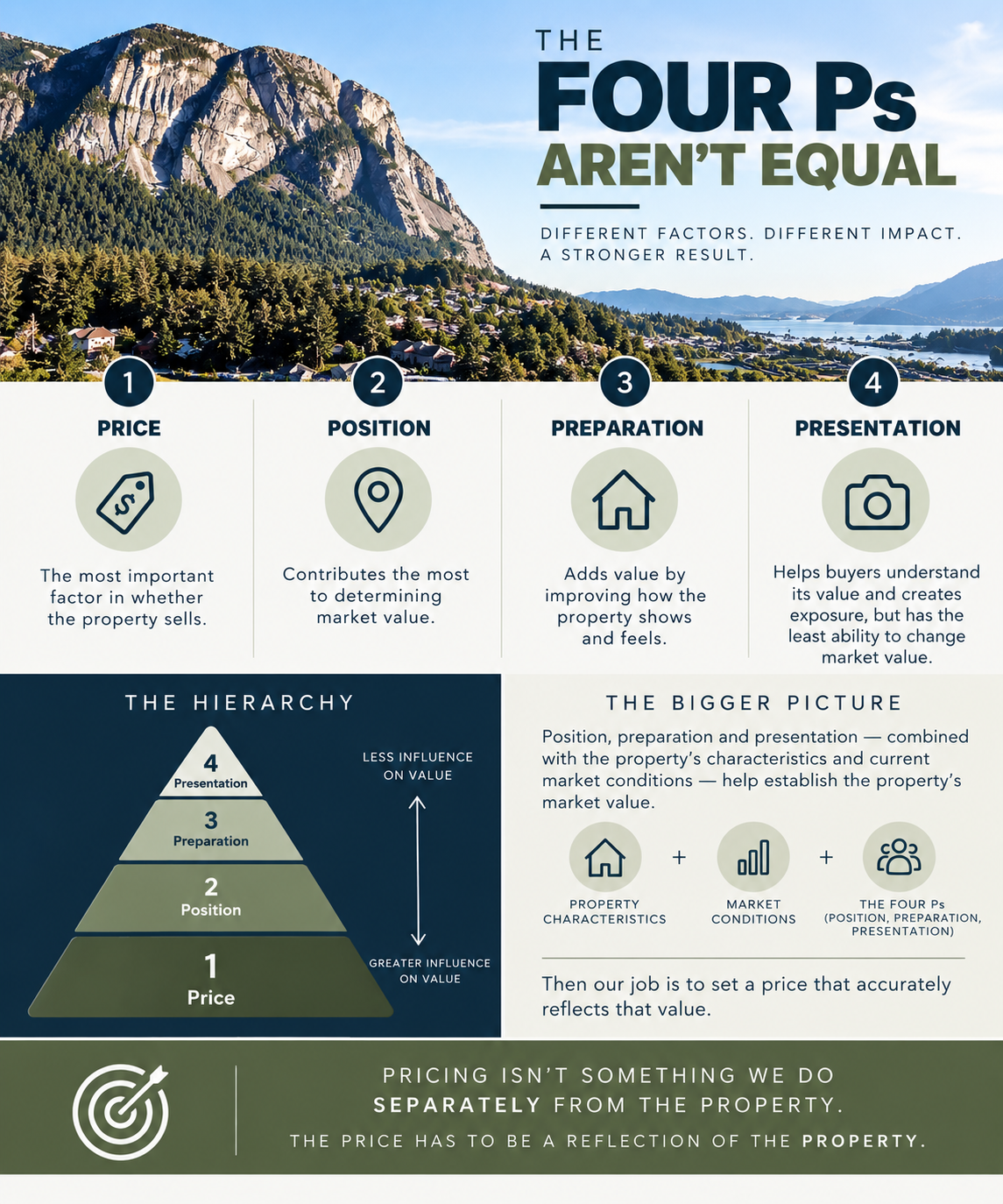
You could look at the hierarchy like this:
Price is the most important factor in whether the property sells.
But when we're determining what that price should be:
Position contributes the most.
Preparation contributes next.
Presentation contributes after that.
Those three factors combine with the characteristics of the property and current market conditions to help establish its market value.
Then our job is to set a price that accurately reflects that value.
That's the part I think sellers sometimes misunderstand.
Pricing isn't something we do separately from the property.
The price has to be a reflection of the property.
The Danger Is Pricing Above—or Below—What Those Factors Justify
Most sellers understandably worry about pricing too low.
Nobody wants to give their house away.
But there's risk on both sides.
If we've objectively looked at the position, properly prepared the home and professionally presented it, but then price it well beyond what buyers believe those things are worth, we're overpriced.
The market will eventually tell us that.
But if a property has an exceptional position, has been beautifully prepared and is presented properly—and we fail to recognize how much buyers value those characteristics—we can also be underpriced.
That's not the objective either.
The goal isn't:
“How cheaply do we have to price this house to make it sell?”
The goal is:
“What is the maximum price the current market will support given everything this property offers?”
That's a completely different question.
We're Seeing How Important This Is in Squamish Right Now
This becomes especially important in a slower, price-sensitive market.
Right now, we're seeing some very specific patterns in Squamish.
One-bedroom properties are having a difficult time selling.
We're also seeing considerable resistance with townhouses priced between roughly $900,000 and $1 million.
Get below $900,000 and we're seeing substantially more attention.
We're also seeing something that would normally seem counterintuitive: in some situations, older Squamish townhomes are selling more readily than newer ones.
We've discussed this before.
Some buyers like the layouts and feeling of older townhome developments. They may prefer being closer to the ground, having fewer stairs, different outdoor spaces or greater separation from neighbouring units.
A newer property isn't automatically worth more to every buyer simply because it's newer.
That's exactly why we have to watch what buyers are actually doing.
If the market isn't absorbing a particular category of property at a particular price, that doesn't mean those properties are unsellable.
It means we need to understand the price at which buyers perceive the value differently.
The Current Market Makes Correct Pricing Even More Important
The broader real estate environment reinforces the importance of this.
Buyers currently have considerable choice, and they're behaving cautiously.
That means they can compare your property against a lot of alternatives.
They don't have to convince themselves that your house is worth the asking price.
You have to demonstrate that it is.
That's where all four Ps come together.
Maybe your position is exceptional.
Maybe your preparation is substantially better than competing listings.
Maybe your presentation makes the advantages very clear.
Those things can justify a higher market value.
But the asking price still needs to make sense relative to what else the buyer can purchase.
This Is Why Pricing a Property Isn't Just Looking at Comparable Sales
Comparable sales are important.
But pricing a property properly requires more than finding three houses that sold nearby and averaging the numbers.
Why did one property sell for more?
Was the position better?
Did it have a view?
Was it brighter?
Did it back onto green space?
Was it renovated?
Was it prepared substantially better?
How was it presented?
What was happening in the market when it sold?
And how do buyers currently perceive those differences?
Those questions help explain why two apparently similar properties can have different values.
The numbers matter.
But understanding what created the numbers matters too.
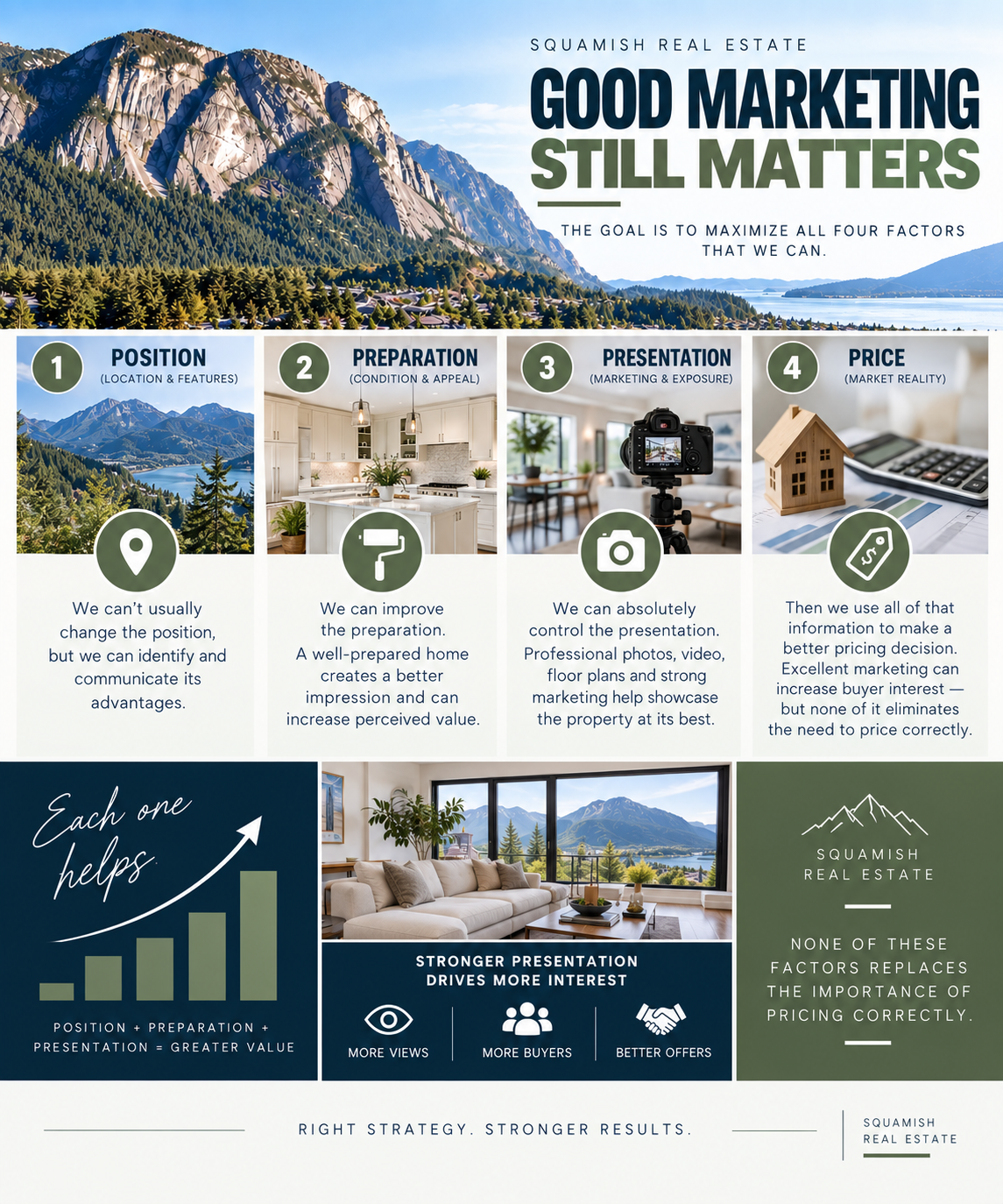
Good Marketing Still Matters
Putting Presentation fourth could sound like I'm saying marketing isn't important.
That's not what I mean at all.
The goal is to maximize all four factors that we can.
We can't usually change the position, but we can identify and communicate its advantages.
We can improve the preparation.
We can absolutely control the presentation.
And then we can use all of that information to make a better pricing decision.
If excellent presentation increases buyer interest, that's valuable.
If better preparation changes how buyers perceive the home, that's valuable.
If explaining the position helps somebody understand why the property works for them, that's valuable.
Each one helps us push toward the highest market value the property can reasonably achieve.
But none of them eliminates the need to price correctly.
So, Is Every Squamish Property Sellable?
Yes.
I believe it is.
Some properties are much easier to sell than others.
Some have fantastic positions.
Some require work.
Some appeal to almost everybody.
Others appeal to a very specific buyer.
And sometimes the current market simply isn't particularly interested in a certain property type.
But none of those things makes a property unsellable.
They affect its value.
That's why my hierarchy is:
Price first.
Position second.
Preparation third.
Presentation fourth.
But remember how they interact.
Position, preparation and presentation help determine what the market believes the property is worth.
Price needs to reflect that market value.
Our job is to maximize the factors we can control, properly account for the ones we can't, and then establish a price that neither leaves money on the table nor asks the market to pay for value that isn't there.
Because ultimately:
There are difficult properties to sell. There aren't unsellable properties. There's just a price at which the market says yes.
 The data relating to real estate on this website comes in part from the MLS® Reciprocity program of either the Greater Vancouver REALTORS® (GVR), the Fraser Valley Real Estate Board (FVREB) or the Chilliwack and District Real Estate Board (CADREB). Real estate listings held by participating real estate firms are marked with the MLS® logo and detailed information about the listing includes the name of the listing agent. This representation is based in whole or part on data generated by either the GVR, the FVREB or the CADREB which assumes no responsibility for its accuracy. The materials contained on this page may not be reproduced without the express written consent of either the GVR, the FVREB or the CADREB.
Comments:
Post Your Comment: