

Part Two: Understanding Secondary Suites, Mortgage Qualification and Municipal Approval
One of the questions buyers ask when they're looking at detached homes in Squamish is whether they can get a mortgage on a property that has an unauthorized secondary suite.
And the answer is yes. You absolutely can.
The fact that a house has an unauthorized suite doesn't automatically mean a bank won't finance it. There are lenders that will consider these properties, and depending on the circumstances, they may even recognize some of the rental income from the suite when qualifying you for a mortgage.
But there's an important distinction between being able to get a mortgage and being able to use all the rental income from that suite to qualify for one.
And that's where things become interesting.
Because when you're buying a detached house in Squamish, the rental income from a basement suite can make a meaningful difference to your monthly finances. It can also influence how much mortgage financing you qualify for.
The amount of income a lender is prepared to recognize may depend on whether the suite is authorized, how the lender evaluates rental income and the particular mortgage product you're applying for.
So I think there are two things buyers really need to understand: how the mortgage qualification works, and what it actually means when somebody tells you a suite is registered or legal in Squamish.
An Unauthorized Suite Doesn't Automatically Prevent You From Getting a Mortgage
Let's start with the financing.
If you're buying a house in Squamish with a basement suite that hasn't been properly approved by the District, you shouldn't automatically assume you can't get a mortgage.
Some lenders are prepared to consider properties with unauthorized suites. Others may have more restrictive requirements, particularly if the buyer needs the rental income to qualify.
The distinction matters because the rental income could be a significant part of your financial plan.
You might be buying a house with the intention of living upstairs and renting the basement for $2,000 per month. That $2,000 is real money coming into your household, and it could make the monthly cost of owning the property considerably more manageable.
But just because you're receiving $2,000 per month doesn't mean the lender will count the full $2,000 when calculating your mortgage qualification.
And that's where the difference between an authorized and unauthorized suite can become important.
How Much Rental Income Will a Lender Recognize?
Let's use a simple example.
Suppose you're looking at a detached house in Squamish with a basement suite that rents for $2,000 per month.
If a lender is prepared to recognize 60% of that rental income for qualification purposes, the amount they're considering would be $1,200 per month.
Now imagine the same house has a properly authorized suite, and a different lending policy allows 80% of the rent to be recognized.
In that situation, the recognized amount would be $1,600 per month.
That's a $400 monthly difference.
Those percentages are illustrations, not universal banking rules. Different lenders and mortgage insurers use different approaches, and some may recognize more or less rental income depending on the circumstances.
But the example demonstrates the point.
Two buyers looking at the same rental income could receive different mortgage qualification results depending on how the lender treats that income.
And the suite's authorization status can be one of the factors affecting that decision.
What Could That $400 Difference Mean?
To put that into perspective, let's use a rough mortgage-payment example.
If we assume that every $100,000 of mortgage financing costs approximately $600 per month in principal and interest, then $1,200 would be equivalent to the monthly payments on roughly $200,000 of mortgage financing.
Using the same assumption, $1,600 would cover the payments on approximately $266,700.
That's a difference of about $66,700 in mortgage-payment equivalents.
Now, I want to be very clear about something here.
That doesn't mean a bank will automatically lend you another $66,700 because it recognizes an additional $400 per month in rental income.
Mortgage qualification is more complicated than that.
Lenders consider your employment income, other debts, property taxes, heating costs, qualifying interest rates and debt-service ratios. They also have different methods of incorporating rental income into those calculations.
The $66,700 is simply an illustration of why the difference between recognizing $1,200 and $1,600 per month can matter.
The actual difference in the mortgage you qualify for could be considerably different.
But if you're trying to purchase a detached home in Squamish and rental income is an important part of your affordability calculation, it's worth investigating.
Different Lenders Have Different Rules
One of the things buyers need to understand is that there isn't one universal rule governing how every bank treats rental income from a secondary suite.
Some mortgage products have specific methods for adding rental income to the borrower's qualifying income. Others use an offset or net-rental-income calculation.
The lender may also require documentation, such as an existing tenancy agreement or an appraisal supporting the expected market rent.
And the rules can differ depending on whether the property is owner-occupied, whether the mortgage is insured and how many dwelling units are involved.
For example, Canada Mortgage and Housing Corporation has a mortgage-insurance qualification approach that can recognize up to 100% of gross rental income for certain eligible owner-occupied two-unit properties.
Sagen, another Canadian mortgage insurer, also has published guidance allowing unauthorized suites to be reviewed on a case-by-case basis.
That reinforces my main point: an unauthorized suite isn't necessarily an automatic financing problem.
But it does mean you need to understand how your particular lender will assess the property.
This is why I would encourage buyers who are relying on suite income to speak with a knowledgeable mortgage broker early in the process.
You want to know how the lender will treat that specific suite before you commit to the purchase, not after you've removed your financing condition.
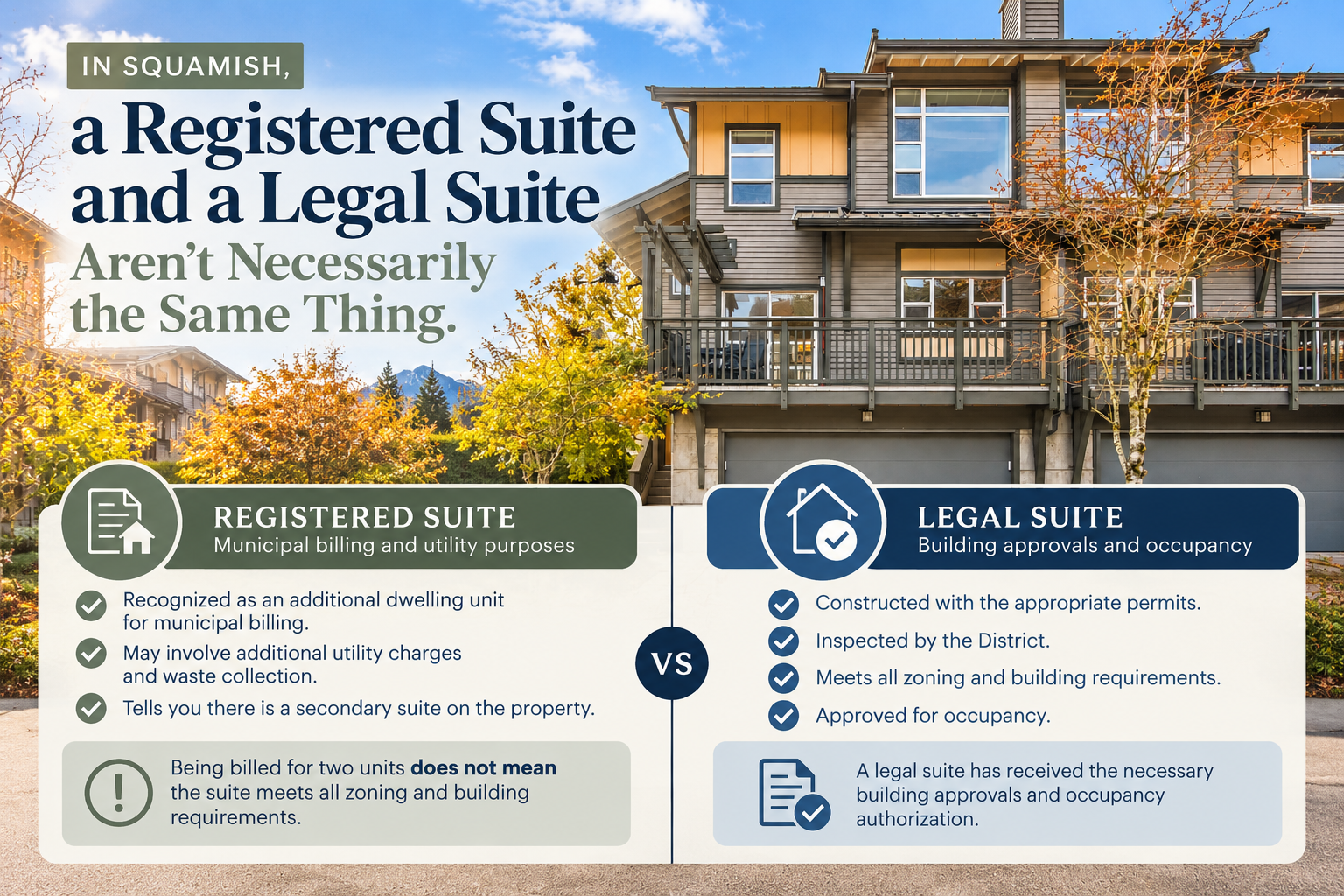
In Squamish, a Registered Suite and a Legal Suite Aren't Necessarily the Same Thing
Now, here's where the Squamish-specific side of this becomes particularly important.
When buyers are looking at houses with secondary suites, they may hear somebody say that the suite is registered with the District.
And they naturally assume that means the suite is legal.
But that's not necessarily the case.
There are two different things we need to look at.
One is whether the District recognizes an additional dwelling unit for municipal billing and utility purposes.
The other is whether the suite has received the necessary building approvals and occupancy authorization.
Those are not interchangeable.
A property might be billed for two dwelling units because it contains a secondary suite. That may involve additional utility charges and waste-collection arrangements.
But paying those charges doesn't necessarily mean the suite was constructed with the appropriate permits, inspected or approved for occupancy.
The District of Squamish specifically cautions that being billed for utilities for two units does not establish that the suite meets all zoning and building requirements.
I think that's an extremely important distinction for buyers to understand.
What Makes a Secondary Suite Legal in Squamish?
The District of Squamish has a process for approving secondary suites.
In general, the property must meet applicable zoning requirements, and the suite must comply with the relevant building requirements.
That involves obtaining the appropriate building permit, completing the required work and inspections, and receiving occupancy approval from the District.
When that process has been completed, the buyer has a much clearer basis for understanding the suite's authorized status.
But if somebody simply tells you that a suite has been there for twenty years, or that the District charges additional utilities for it, that doesn't establish the same thing.
The suite may have been constructed without permits. It may have had permits that were never finalized. Or the owner may simply be unaware of the actual approval history.
That's why I think it's important to verify the records rather than rely on how the suite is described in conversation.
And this is also why I would be cautious about treating the word registered as equivalent to legal.
The terminology matters less than what the District's records actually confirm.
Why Does This Matter to Your Insurance Company?
The lender isn't the only party that may be interested in the suite's status.
Your insurance provider also needs to know that the property contains a secondary suite and how that space is being used.
A house occupied by one household is a different insurance risk from a house containing a separate rental unit.
Depending on the property and insurer, there may be additional questions about fire separation, electrical systems, entrances, safety features and whether the suite has been approved for its intended use.
Some insurers may be prepared to insure a property with an unauthorized suite, subject to their underwriting requirements. Others may require additional information, inspections or corrective work.
And if you need a mortgage, obtaining acceptable property insurance is normally part of completing the financing.
So even where a lender is prepared to consider an unauthorized suite, you still need to establish that you can obtain the insurance required for the property and its intended use.
I wouldn't assume that every unauthorized suite creates an insurance problem, but I certainly wouldn't ignore the question.
What Should You Check Before Buying a House With an Unauthorized Suite?
If you're looking at a house in Squamish that has a basement suite, I think the first step is to establish exactly what you're buying.
Is the suite approved for occupancy? Are there building permits and final inspections on record? Is the property simply being billed as having an additional dwelling unit? Or is the suite entirely unauthorized?
Those distinctions can affect your financing, insurance and plans for the property.
I would also want to know whether the suite complies with the current requirements that apply to its use, and whether any outstanding permit or building issues need to be addressed.
If you intend to rely on the rental income, speak with your mortgage broker about that specific property. Don't simply assume the bank will use the entire rental amount when calculating your qualification.
And contact your insurance provider to confirm that the intended rental arrangement can be insured on acceptable terms.
In our buyer representation work, this is the type of information we want to investigate during the due-diligence process, before the buyer removes their subjects.
It's much better to discover that a lender will recognize less rental income than expected while you still have the opportunity to evaluate the purchase.
Should You Avoid Buying a House With an Unauthorized Suite?
No, not necessarily.
There are houses in Squamish with unauthorized secondary suites that may still represent perfectly reasonable purchases.
The fact that a suite doesn't have the appropriate approvals doesn't automatically mean the work was done poorly or that the property can't be financed.
But it does mean there are additional questions to answer.
You need to understand what the lender will accept, whether the property can be insured, what the District's records show and whether bringing the suite into compliance could involve additional work or expense.
And if the rental income is essential to your ability to afford the house, those questions become particularly important.
A house with an unauthorized suite might be a good opportunity for one buyer and completely unsuitable for another.
For example, somebody who qualifies for the mortgage without any rental income may view the situation very differently from somebody who needs the suite income to qualify.
That's why I wouldn't make a blanket recommendation to avoid these properties.
I would recommend understanding the specific circumstances before deciding what the property is worth to you.
The Bottom Line: Can You Get a Mortgage on an Unauthorized Suite in Squamish?
Yes, you can.
An unauthorized secondary suite does not automatically prevent you from obtaining mortgage financing.
But the suite's status can influence how lenders evaluate the property and how much rental income they're prepared to recognize when qualifying you for the mortgage.
And in Squamish, there's an important distinction between a property that's being billed for an additional dwelling unit and a suite that has actually received the necessary building and occupancy approvals.
My advice is to establish the suite's real status, confirm how your lender will treat its rental income and verify your insurance before committing unconditionally to the purchase.
A secondary suite can be an excellent financial advantage when buying a detached home in Squamish. But you need to understand what you're buying and what that rental income will actually do for your mortgage qualification.
That's how you avoid making a major purchasing decision based on assumptions that may not hold up when the financing is finalized.
Simon Hudson | Team Hudson, Macdonald Realty | Squamish, BC
This article provides general real-estate information. Mortgage qualification, insurance eligibility and building approvals depend on individual circumstances. Buyers should obtain property-specific confirmation from their mortgage professional, insurance provider and the District of Squamish.
 The data relating to real estate on this website comes in part from the MLS® Reciprocity program of either the Greater Vancouver REALTORS® (GVR), the Fraser Valley Real Estate Board (FVREB) or the Chilliwack and District Real Estate Board (CADREB). Real estate listings held by participating real estate firms are marked with the MLS® logo and detailed information about the listing includes the name of the listing agent. This representation is based in whole or part on data generated by either the GVR, the FVREB or the CADREB which assumes no responsibility for its accuracy. The materials contained on this page may not be reproduced without the express written consent of either the GVR, the FVREB or the CADREB.
Comments:
Post Your Comment: