

BC Assessment comes up all the time when I’m talking to Squamish homeowners about what their property is worth.
People will say things like:
“My house is assessed at $1.2 million, so it should sell for $1.25 million.”
Or I’ll hear a rule that properties in a particular area are selling 3% above assessment or 3% below assessment.
I understand why people do it. BC Assessment gives you a readily available number attached to your property, so it’s natural to assume that number should tell you what the house is worth.
But I wouldn’t price a property that way.
I use BC Assessment as one piece of supporting information. I don’t use it to determine what a property should sell for.
There’s an important difference.
First, Understand What BC Assessment Is Actually Measuring
BC Assessment is a provincial Crown corporation responsible for assessing real property throughout British Columbia.
For the 2026 assessment roll, the value on your assessment reflects an estimate of the property’s market value as of July 1, 2025.
That’s immediately important if we’re trying to price a Squamish property today.
The real estate market has had more than a year to change.
BC Assessment itself points out that an assessment and a current real estate valuation can differ simply because they’re answering the valuation question at different points in time.
So even if an assessment accurately represented the property’s market value on its valuation date, that doesn’t automatically tell me what a buyer will pay for it today.
BC Assessment Knows More About Your Property Than You Might Think
There’s another misconception worth clearing up.
BC Assessment doesn’t simply look at your lot size and the age of your house and generate a number.
Its assessment process considers property characteristics and market information, and BC Assessment obtains information from multiple sources, including municipalities, land-title information, transactions, owner information, inspections and imagery.
Building permits can be one source of information. When municipalities issue permits, that information may be reviewed by BC Assessment to determine whether the assessment needs to be updated.
So this isn’t an unsophisticated system.
But there is an important distinction.
BC Assessment is conducting mass appraisal across more than two million properties in British Columbia.
When I’m evaluating your house for sale, I’m trying to answer a much narrower question:
What is a buyer likely to pay for this particular Squamish property in the market we’re in today?
Those aren’t quite the same exercise.
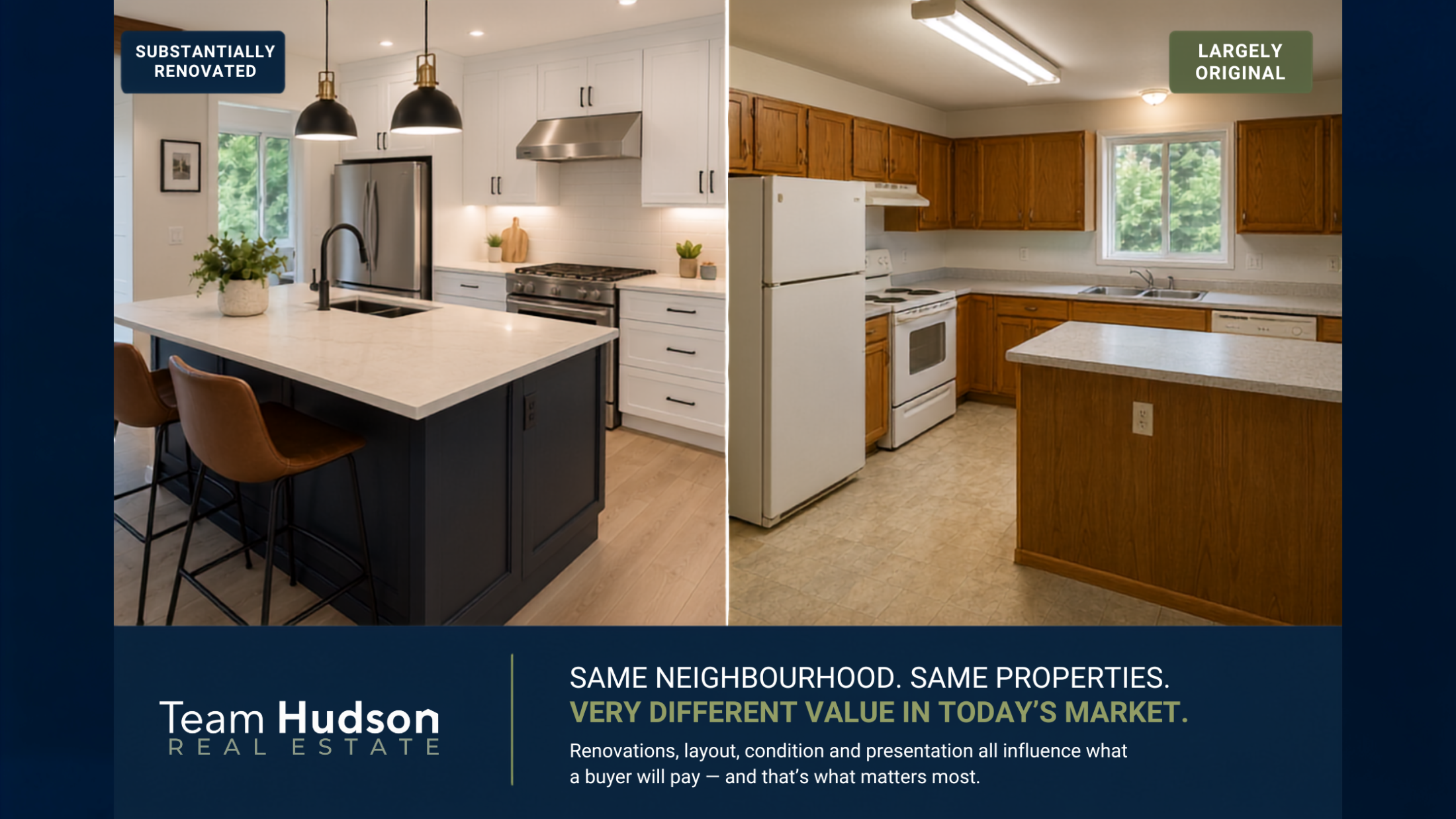
Renovations Are One Reason Assessment and Market Value Can Differ
Imagine two similar Squamish houses.
They’re roughly the same age, on similar-sized lots and perhaps even on the same street.
One has been substantially renovated. The kitchen has been replaced, the layout improved, the bathrooms updated and the overall presentation is excellent.
The other is largely original.
Those properties may share many of the same basic characteristics.
A buyer walking through them may see two very different products.
BC Assessment has ways of gathering information about physical changes and property condition. But when I’m pricing a home for sale, I have the advantage of standing inside the property and evaluating what’s actually there and how buyers in today’s market are likely to react to it.
I’m not going to assume every dollar somebody spends renovating adds a dollar of value.
It doesn’t.
But I’m also not going to ignore meaningful improvements simply because the assessed value doesn’t appear to recognize them to the same degree today’s buyer might.
So Why Do I Use BC Assessment?
Because it can still be useful.
Just not in the way people sometimes think.
When I’m evaluating a property, I use several different pricing methods. I’m looking at comparable transactions, market movement, when previous sales occurred, what kind of market existed at the time, the individual characteristics of the property and other indicators.
BC Assessment can then give me another way to test that work.
For example, I can look at relevant properties that have actually sold and compare their sale prices with their assessed values.
Were they selling above assessment?
Below assessment?
By approximately how much?
Then I want to know why.
Was one extensively renovated?
Did another have a better view?
Was the location different?
Was there something about the lot, layout or condition that buyers valued differently?
That’s where the information becomes useful.
I’m not saying:
“This house is worth 5% above assessment.”
I’m asking:
“Does the relationship between assessed values and actual sale prices support the value range my other analysis is giving me?”
That’s a completely different use of the information.
I Use BC Assessment to Check the Answer, Not Create the Answer
This ties into the way I approach pricing generally.
I don’t like relying on one metric.
When Team Hudson presents pricing to a seller, we typically approach the property’s value through four different analyses.
We’re looking for convergence.
If several independent ways of analyzing the property start pointing toward a similar range, that gives me considerably more confidence that we’re on the right track.
BC Assessment can provide another supporting data point within that process.
If my other analysis suggests one value and the assessment comparison appears completely inconsistent with it, I’m not automatically changing my price.
I’m asking why.
Maybe I’ve missed something.
Maybe there’s something unusual about the property.
Maybe the comparable isn’t as comparable as I thought.
Or perhaps market conditions have moved substantially since the assessment’s valuation date.
A good analytical process should force you to challenge your own conclusion.
Sometimes BC Assessment Can Be Higher Than Actual Market Value
There’s another side to this that homeowners should understand.
Sometimes I see a BC Assessment that I believe is substantially higher than what the property would actually sell for.
An assessment isn’t automatically a minimum value for your home.
You shouldn’t assume:
“My assessment says $1.4 million, therefore I would never sell for less than $1.4 million.”
The market doesn’t know what your assessment says.
Buyers are looking at the property, the alternatives available to them and what comparable properties are actually selling for.
If those indicators tell us the market value is lower than the assessed value, then that’s something we have to acknowledge when pricing the property.
What If You Think Your BC Assessment Is Too High?
This becomes important for another reason: assessed values form part of the property-tax calculation.
If you believe BC Assessment has your property’s value wrong, there is a formal process for challenging the assessment.
But there’s an important distinction here as well.
If your assessment rises 10%, that doesn’t automatically mean your property taxes rise 10%. What matters includes how your property’s assessment changes relative to other properties in the same property class and taxation jurisdiction, along with the tax rates established by the relevant taxing authorities.
So an assessment being higher than you expected doesn’t automatically mean you should appeal it.
But if the assessed value appears materially inconsistent with what the property was actually worth on the applicable valuation date, I think it’s worth investigating.
BC Assessment recommends that owners with concerns first review their assessment and comparable sales and contact BC Assessment. If the issue isn’t resolved, there’s a formal Property Assessment Review Panel process.
The deadline is important. It’s normally January 31. For the 2026 assessment, because January 31 fell on a weekend, the deadline was extended to February 2, 2026, and that deadline has now passed.
There’s enough involved in deciding whether an assessment is actually wrong—and assembling useful evidence—that I don’t want to reduce it to a paragraph here.
I’ll cover how to challenge a BC Assessment, what evidence may help, and when I think it’s worth investigating in a separate article.
That’s particularly worth understanding before your next assessment arrives.
Don’t Use a Magic Percentage
For today’s question, this is probably the biggest takeaway for Squamish homeowners.
There isn’t a magic rule saying your property is worth 3% above BC Assessment, 5% below it, or any other fixed percentage.
If properties similar to yours are consistently selling at a particular relationship to assessment, that’s information worth considering.
But you still need to understand why.
A renovated house isn’t necessarily the same as an original house.
A great view isn’t the same as no view.
Street, lot, layout and condition can matter.
And today’s market isn’t necessarily the market that existed on July 1 of the previous year.
So if somebody tells you your Squamish property is worth a certain amount simply because that’s a particular percentage above or below BC Assessment, I’d want to see considerably more analysis before relying on that number.
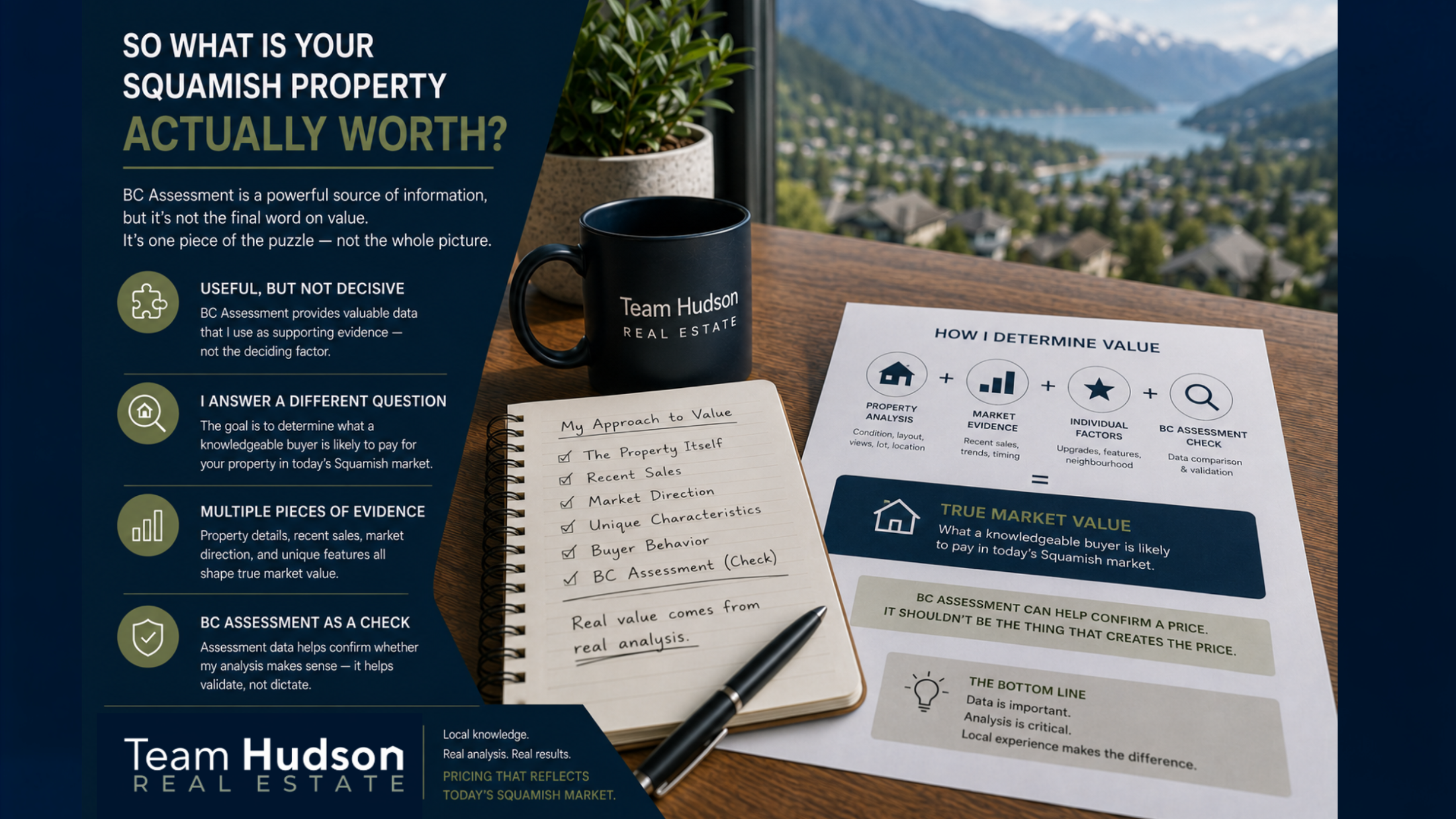
So What Is Your Squamish Property Actually Worth?
BC Assessment isn’t useless.
Far from it.
It’s a substantial source of property and market information, and I use assessment data when I’m analyzing properties.
But I use it as supporting evidence.
I don’t let it dictate the conclusion.
Ultimately, I’m trying to answer a different question:
What is a knowledgeable buyer likely to pay for this particular property in the Squamish market today?
Answering that requires looking at the property itself, relevant transactions, market direction, individual characteristics and several other pieces of evidence.
Then I can use BC Assessment as another check on whether my analysis makes sense.
That’s where I think it’s valuable.
BC Assessment can help confirm a price. It shouldn’t be the thing that creates the price.
 The data relating to real estate on this website comes in part from the MLS® Reciprocity program of either the Greater Vancouver REALTORS® (GVR), the Fraser Valley Real Estate Board (FVREB) or the Chilliwack and District Real Estate Board (CADREB). Real estate listings held by participating real estate firms are marked with the MLS® logo and detailed information about the listing includes the name of the listing agent. This representation is based in whole or part on data generated by either the GVR, the FVREB or the CADREB which assumes no responsibility for its accuracy. The materials contained on this page may not be reproduced without the express written consent of either the GVR, the FVREB or the CADREB.
Comments:
Post Your Comment: