

Funny enough, I don't let people make many mistakes when they're buying a Squamish townhouse, because when I'm walking through properties with clients, I'm constantly asking them to stop looking only at what the townhouse looks like and start thinking about how they're actually going to live in it.
I think that's one of the biggest mistakes buyers can make. They get caught up in the pretty. Does the kitchen look good? Do I like the flooring? Are these the countertops I wanted? Are the cabinets the right colour? Does the whole place have that look I've been imagining?
Those things aren't irrelevant. Of course you want to like your home. But they're also some of the easiest things to become distracted by during a showing, and they can stop you from asking a much more important question:
Does this townhouse actually work for the way I live?
That's what I want buyers thinking about when we walk through the door.
Don't Just Look at the Townhouse. Mentally Live in It.
When you're viewing a property, try to stop thinking like somebody touring a home for 30 minutes and start imagining that you already live there.
Take an ordinary day and mentally go through it.
You wake up in the morning. Where do you go? Maybe the first thing you do is make coffee. Where's the coffee maker? Is there enough counter space for it? Once you've made the coffee, where do you actually sit and drink it?
That may sound ridiculously specific, but those little things are what living in a home actually consists of.
If you're somebody who uses a lot of small appliances, look at the kitchen counters. Where does the toaster go? Where's the coffee machine? What about the blender, air fryer or whatever else you use regularly? Are you going to have enough space, or are you going to spend the next five years moving appliances in and out of cupboards every time you want to cook?
A kitchen can look fantastic in photographs because there's almost nothing sitting on the counters. That doesn't necessarily mean it's going to function well once somebody actually lives there.
Think About How You Cook
This is another simple example.
Maybe there's always one person cooking in your household. In that case, a relatively compact kitchen might work perfectly well.
But what if there are usually two of you cooking?
Now stand in the kitchen together mentally. Can one person be preparing food while the other is at the stove? Can you open the fridge without trapping somebody against the counter? Is there enough prep space? Can you move around each other comfortably?
A kitchen can have beautiful cabinets, expensive countertops and new appliances and still be frustrating for the way you cook.
On the other hand, an older kitchen that doesn't immediately impress you might have a fantastic layout. You can eventually change the cabinets and countertops. Changing the basic functionality of the room can be considerably more difficult.
That's why I want buyers to look beyond the finishes.
Where Does the Dinner Table Go?
If you regularly have people over for dinner, this matters enormously.
Don't look at a staged dining area with a small table and simply say, “Yes, there's a dining room.”
Ask whether your table fits there.
If you regularly have six, eight or ten people over, where are they going to sit? What happens when everybody pulls their chairs out? Can people still walk around the table? Is the dining area actually large enough for the way you entertain, or does it simply look good with a carefully selected staging table?
The same applies if you don't entertain at all. Maybe a large formal dining area is completely wasted on you, and you'd much rather have that square footage somewhere else.
There isn't a correct floor plan for everybody. There's a correct floor plan for how you live.
Actually Sit on the Couch and Think About What Happens Next
When we're walking around a property, I want people to imagine the little things that happen once they're living there.
You're sitting on the couch watching a movie and decide you want popcorn. How far away is the kitchen? Is that important to you?
You need to use the bathroom. Where is it relative to the living room? Are you walking up or down a flight of stairs every time?
Again, these can sound like ridiculously minor considerations when you're buying a property worth hundreds of thousands of dollars. But if you live in that townhouse for seven years, you're going to repeat those little routines thousands of times.
That's why they're worth thinking about.
The expensive countertop might excite you on the day you buy the home. The floor plan affects you every single day you own it.
Squamish Buyers Need to Think About Their Gear
This becomes particularly important in Squamish because of how so many people here spend their time.
If you're a mountain biker, where does the bike go when you get home?
Don't just say, “There's storage.”
Actually follow the route.
You've finished a ride. The bike is wet and muddy. Where do you enter the property? Can you put the bike directly into a garage? Do you need to carry it through part of the townhouse? Is there a shared bike room? Is there enough space for everybody's bikes? Where do your shoes, helmet and other gear go?
Now do the same thing with skis, snowboards, climbing equipment, camping gear, paddleboards or whatever else you use.
A lot of people move to Squamish specifically because they want to do these things more often. If that's part of the reason you're buying here, your home should make that lifestyle easier rather than creating a daily battle over where everything goes.
A beautiful townhouse with nowhere sensible to put your equipment may not be as good a fit as a slightly less impressive property with a garage and a layout that works perfectly for your lifestyle.
Where Does the Workout Equipment Go?
The same idea applies to things that have nothing to do with outdoor sports.
If you work out at home four mornings a week, where are you going to do it?
Maybe you need enough floor space for a mat and a few weights. Maybe you have a treadmill or a bike trainer. Maybe you need an entire room.
Don't buy the townhouse and then figure that out.
Stand in the property and ask where it's going to happen.
If the answer is that you're going to squeeze everything into the corner of a bedroom and move it every time you want to use it, ask yourself whether you're genuinely going to be happy doing that for the next five years.
Sometimes a buyer discovers that the spare bedroom they thought was a bonus isn't actually a spare bedroom at all. It's their office, gym, bike room and storage area combined. Once you start allocating the space according to how you really live, the property can look very different.
Stairs Matter More Than People Think
Townhouses can also have very different relationships with stairs.
A multi-level townhouse may look fantastic during a showing, and walking up and down the stairs a few times doesn't seem like a big deal. But again, mentally live in it.
Where's the kitchen relative to the garage?
Where are the bedrooms?
Where's the laundry?
Where's the bathroom you'll use when you're sitting in the living room?
What happens when you bring groceries home?
What happens if you have young children, an older family member visiting, or a dog that eventually struggles with stairs?
I'm not saying stairs are bad. For many buyers they're completely irrelevant. I'm saying you should understand how the layout is going to affect your daily routine rather than discovering it after you move in.
Don't Let the Finishes Make the Decision
The reason buyers get caught by this is understandable. Finishings are immediate.
You walk into a townhouse with the kitchen you've always wanted and you react emotionally. You can picture yourself living there because it looks like the home you've been imagining.
But the flooring will eventually wear. The paint will get marked. Kitchens date. Styles change.
Functionality stays with you.
That doesn't mean you should deliberately buy an ugly townhouse. It means you should separate the things you're looking at into two categories: what you like aesthetically and what you need functionally.
If a property gives you both, fantastic.
If it doesn't, I'd put a lot of weight on the functionality.
Your Lifestyle Should Determine the Floor Plan
One of the reasons I don't think there's a universally “best” Squamish townhouse is that buyers live very differently.
A couple who rarely cooks, eats out frequently and spends most weekends away may be perfectly happy with a compact kitchen and very little storage.
A family that cooks together every night, has friends over constantly and owns six bikes could find the exact same property incredibly frustrating.
Neither buyer is wrong.
That's why I ask clients questions about their lives when we're walking through properties. I'm not just interested in whether they like the kitchen. I want to know what happens in their kitchen. I'm not just interested in whether there's a garage. I want to know what they're going to put in it. I'm not just interested in whether there's a dining area. I want to know how many people they regularly want to sit around the table.
The property has to work for the people buying it.
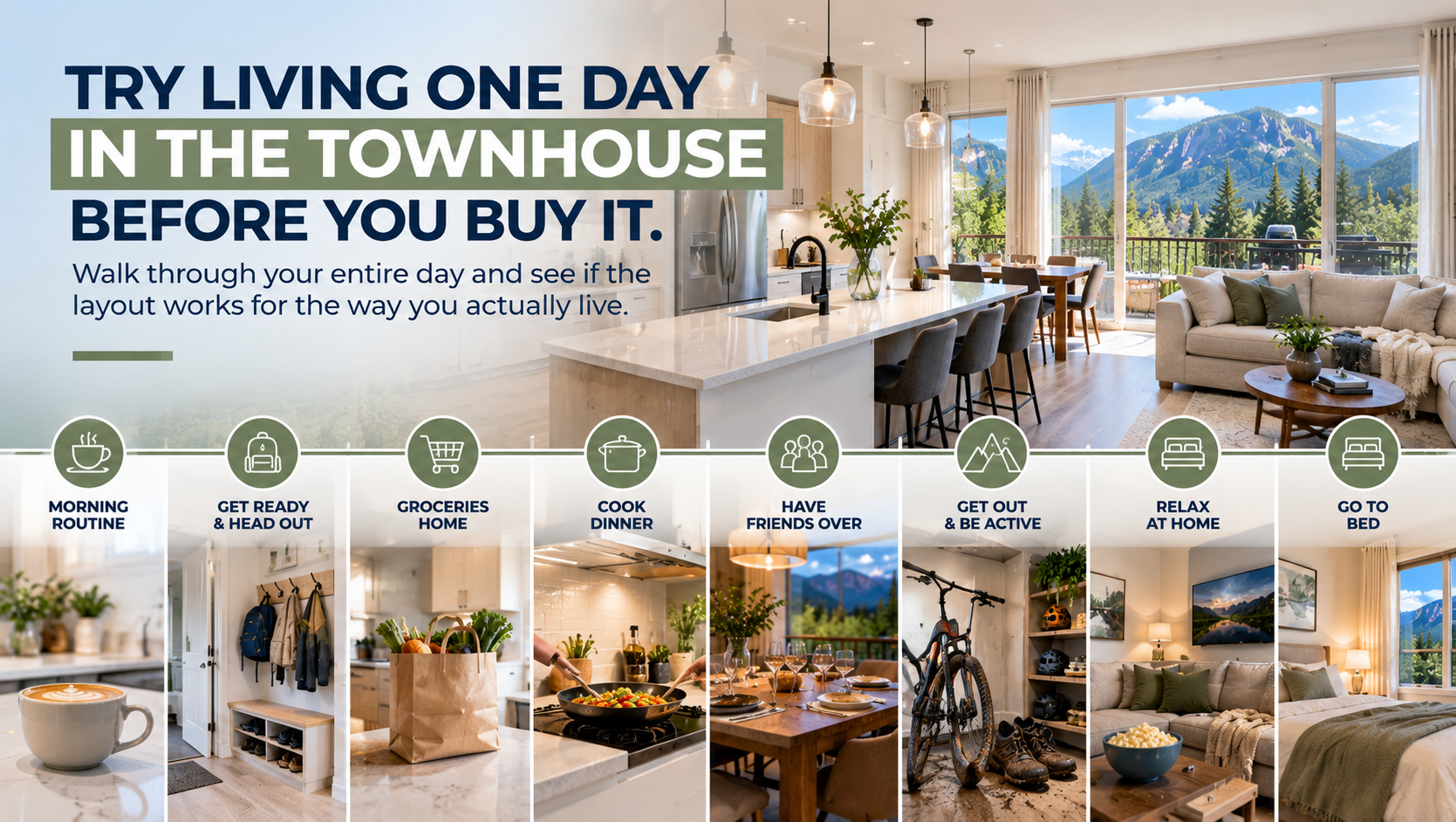
Try Living One Day in the Townhouse Before You Buy It
Obviously, you can't actually move into a property before making an offer. But mentally, you can get surprisingly close.
When you walk through a townhouse, imagine waking up there.
Make your coffee.
Get ready for work.
Take the kids to school.
Bring the groceries home.
Cook dinner.
Have friends over.
Go for a bike ride and come home muddy.
Work out.
Sit on the couch and watch a movie.
Get the popcorn.
Go to bed.
Where did you get annoyed?
Where did the layout make things easy?
What space did you never use?
What space did you wish you had?
Those questions may tell you considerably more about whether you should buy the townhouse than the colour of the kitchen cabinets.
Because ultimately, you're not buying a property to walk through it and admire it.
You're buying it to live in it.
So when you're viewing a Squamish townhouse, don't just look at the property. Mentally live in it.
 The data relating to real estate on this website comes in part from the MLS® Reciprocity program of either the Greater Vancouver REALTORS® (GVR), the Fraser Valley Real Estate Board (FVREB) or the Chilliwack and District Real Estate Board (CADREB). Real estate listings held by participating real estate firms are marked with the MLS® logo and detailed information about the listing includes the name of the listing agent. This representation is based in whole or part on data generated by either the GVR, the FVREB or the CADREB which assumes no responsibility for its accuracy. The materials contained on this page may not be reproduced without the express written consent of either the GVR, the FVREB or the CADREB.
Comments:
Post Your Comment: