

One of the questions buyers ask when they're looking at a Squamish condo or townhouse is:
How much money should this strata have in its contingency reserve fund?
It's a reasonable question.
But I don't think there's a useful answer that says a good strata should have $100,000, $500,000 or $1 million sitting in the bank.
A million dollars could represent an extremely healthy reserve for one strata and nowhere near enough money for another.
That's because the contingency reserve fund doesn't tell you very much when you look at it by itself.
You need to understand the entire financial system of the strata.
That means looking at the operating budget, strata fees, contingency reserve fund, financial history and depreciation report together.
Only then can you start to understand whether the strata appears financially well prepared—and what expenses an owner might face in the future.
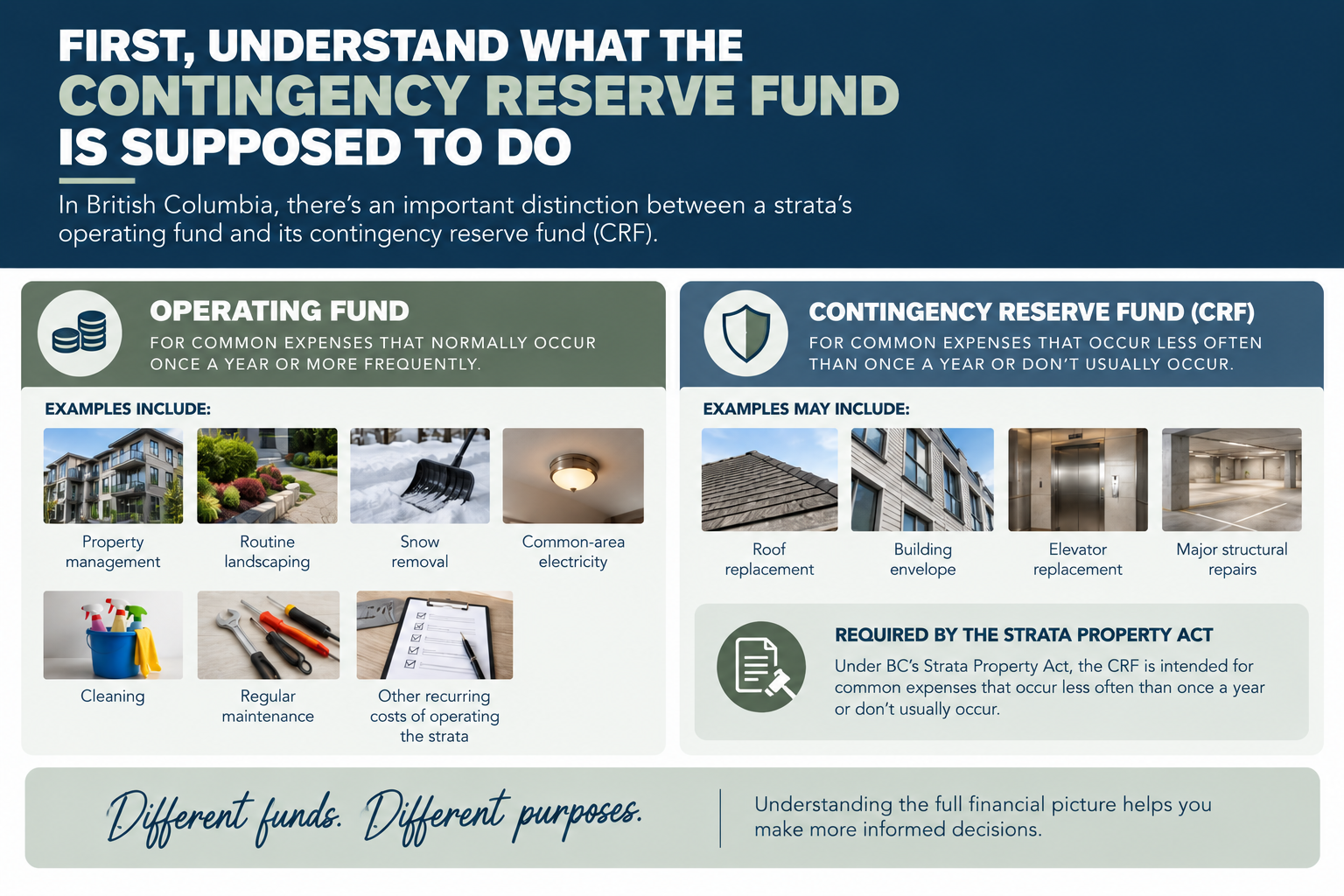
First, Understand What the Contingency Reserve Fund Is Supposed to Do
In British Columbia, there's an important distinction between a strata's operating fund and its contingency reserve fund, usually called the CRF.
The operating fund is intended for common expenses that normally occur once a year or more frequently.
Think about things such as:
property management;
routine landscaping;
snow removal;
common-area electricity;
cleaning;
regular maintenance;
and other recurring costs of operating the strata.
The CRF has a different purpose. Under BC's Strata Property Act, it's intended for common expenses that occur less often than once a year or don't usually occur.
That distinction is important.
But when I'm helping a buyer analyze an existing strata, I don't stop at what the accounts are supposed to do.
I want to understand what has actually happened.

Start With the Operating Budget
Before getting excited—or worried—about the size of the CRF, I want to understand how much it actually costs to run the strata.
What services are included?
How much is being spent on insurance?
Property management?
Landscaping?
Snow removal?
Utilities?
Routine repairs and maintenance?
Then I want to compare those expenses with the money owners are contributing.
In other words:
Is the annual budget realistic?
A strata could have wonderfully low strata fees, but that's not necessarily good news if those fees aren't sufficient to pay the actual cost of operating the property properly.
We've discussed this before when talking about why unusually low or unusually high strata fees both deserve investigation.
Low fees aren't automatically good.
High fees aren't automatically bad.
The question is what you're receiving for the money and whether the numbers make sense.
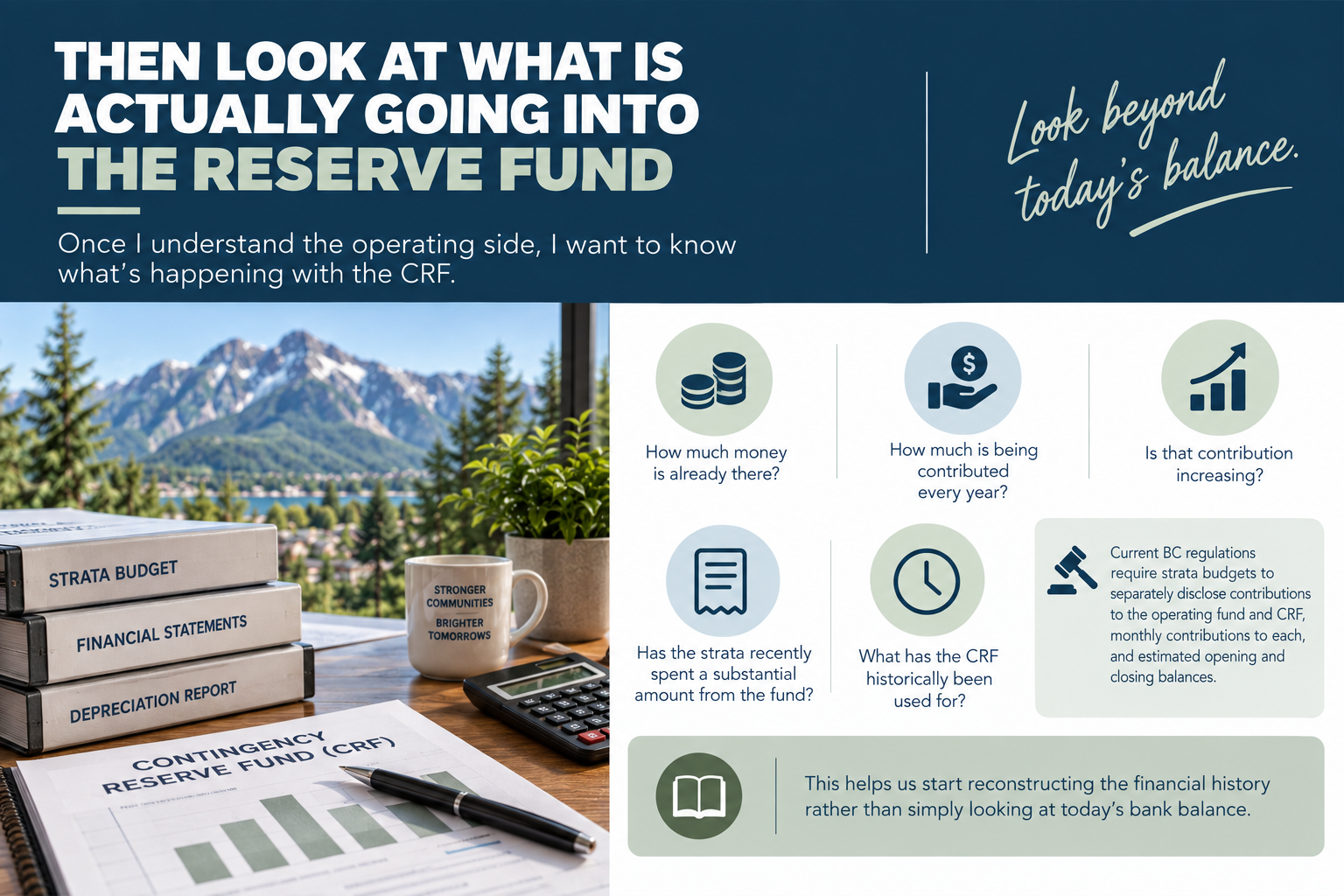
Then Look at What Is Actually Going Into the Reserve Fund
Once I understand the operating side, I want to know what's happening with the CRF.
How much money is already there?
How much is being contributed every year?
Is that contribution increasing?
Has the strata recently spent a substantial amount from the fund?
What has the CRF historically been used for?
Current BC regulations actually require strata budgets to separately disclose things such as contributions to the operating fund and CRF, monthly contributions to each, and estimated opening and closing balances.
That helps us start reconstructing the financial history rather than simply looking at today's bank balance.

Sometimes the Financial History Reveals a Bigger Problem
This is something I've encountered when reviewing strata corporations over the years.
I've occasionally seen poorly managed stratas get themselves into a position where they've had to rely on contingency reserve money when dealing with what are essentially operating pressures.
That's something I want to investigate.
It doesn't necessarily mean that every unusual transfer or expenditure is improper.
BC's legislation contains specific circumstances where CRF money can be used or temporarily lent to the operating fund. For example, the regulations allow a temporary CRF loan to cover a timing shortage in the operating fund, provided the required conditions are met and the loan is repaid by the end of the fiscal year. Emergency expenditures necessary for safety or preventing significant loss or damage can also have different rules.
But there's a big difference between a legitimate temporary cash-flow issue and an operating budget that repeatedly isn't sufficient to pay the strata's normal expenses.
If I see the latter, I want to know why.

Look Backwards, Not Just at Today's Balance
This is why one year's financial statement doesn't necessarily tell me enough.
I want to look at how the strata has operated historically.
Have the budgets generally been accurate?
Have expenses repeatedly exceeded the operating budget?
Have strata fees been kept artificially low?
Has the strata had recurring operating deficits?
Has reserve money been moved around?
Have owners had to approve special levies?
How have previous large repairs been funded?
BC law requires the operating and contingency reserve funds to be accounted for separately, and an operating deficit generally has to be eliminated during the following fiscal year.
The history helps us understand whether we're looking at a one-time situation or a pattern.
The balance in the contingency reserve fund is a snapshot. The financial history tells you what that number actually means.
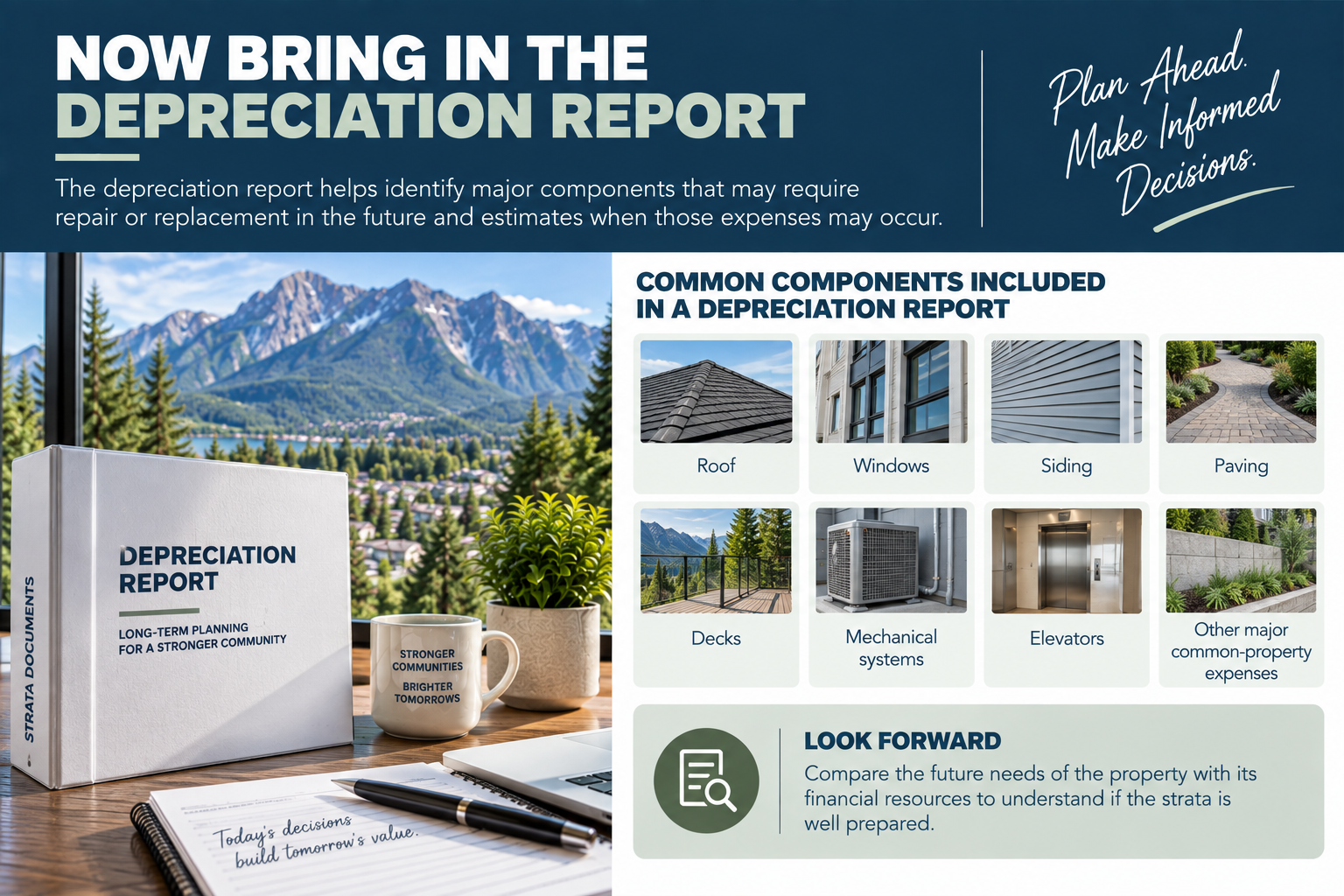
Now Bring in the Depreciation Report
Once we understand how the strata operates today, we need to look forward.
That's where the depreciation report becomes extremely useful.
We discussed depreciation reports in more detail in our article about reviewing strata documents, and I'll be doing a dedicated article on them as well.
For this analysis, the important thing is that the depreciation report helps identify major components that may require repair or replacement in the future and estimates when those expenses may occur.
Maybe there's a roof coming.
Windows.
Siding.
Paving.
Decks.
Mechanical systems.
Or another significant common-property expense.
Now we can start comparing the future needs of the property with its financial resources.
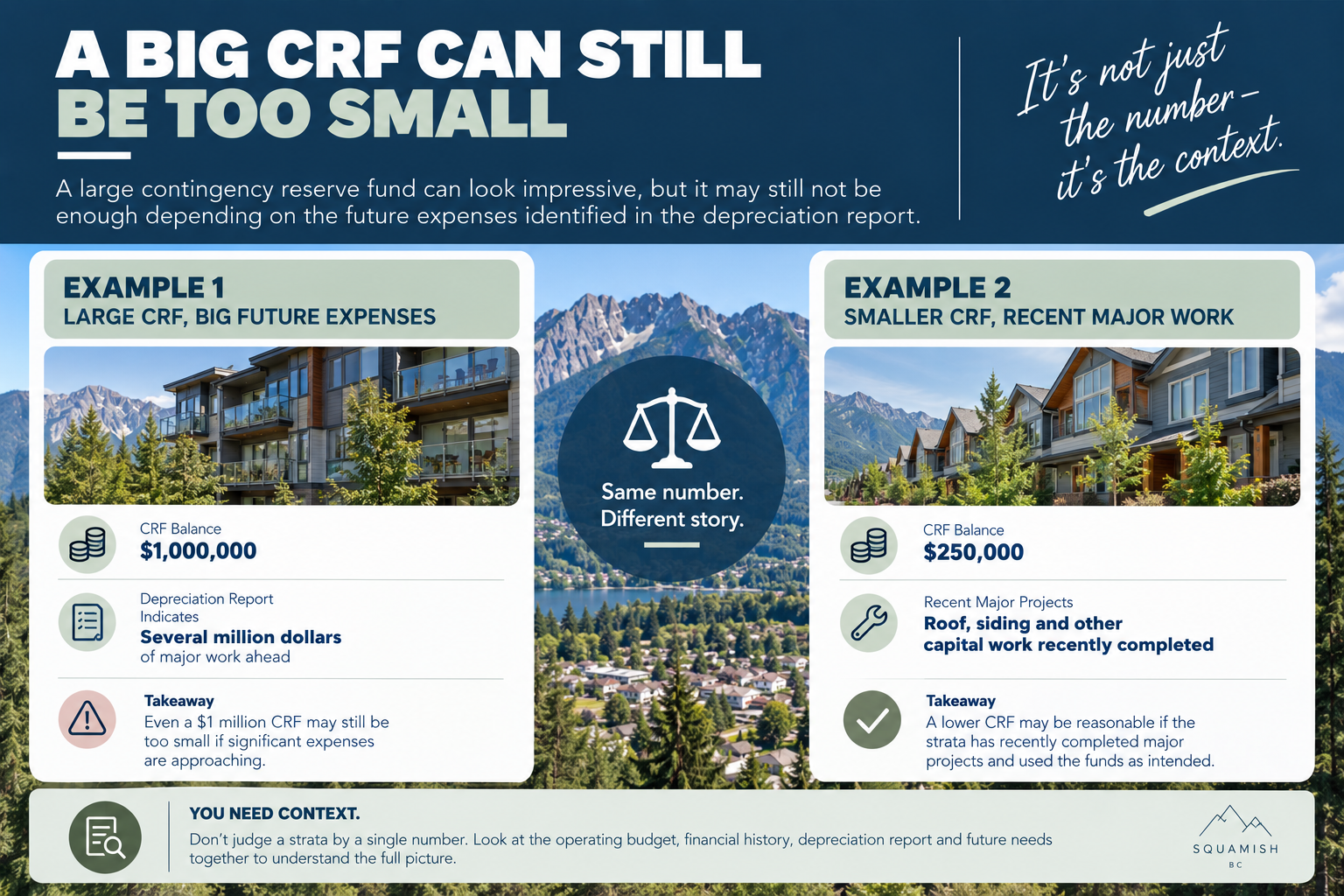
A Big CRF Can Still Be Too Small
Imagine a strata has $1 million in its contingency reserve fund.
That sounds fantastic.
But what if its depreciation report indicates that several million dollars of major work may be approaching?
Suddenly that $1 million looks very different.
Now reverse the situation.
Maybe another strata has a much smaller CRF.
At first glance, that might worry a buyer.
But perhaps that strata just completed its roof, siding and another major capital project.
Its reserve balance may be lower precisely because owners recently used the money for what it was intended to fund.
That's why I don't like judging a strata from a single number.
You need context.

Think About the Funding Gap
One simple way I explain this to buyers is to think about the potential funding gap.
Let's use deliberately simple numbers.
Suppose we determine that the strata can reasonably accumulate another $30,000 toward future work over the next three years.
But we also identify a $50,000 expense expected around that time.
That potentially leaves a $20,000 gap.
Now suppose, simply for illustration, that the cost were divided equally among 20 units.
That's $1,000 per unit.
Real strata expenses aren't necessarily divided equally—the actual allocation can depend on unit entitlement and other applicable rules—but the example illustrates the analysis.
We're trying to identify:
What might need to be spent?
What resources are likely to be available?
And what's the potential difference between the two?
That difference is where future funding decisions may arise.
Maybe contributions increase.
Maybe owners approve a special levy.
Maybe timing changes.
Maybe the actual project costs more or less than projected.
The objective isn't to predict the future to the dollar.
It's to make sure the buyer understands the financial exposure they're potentially taking on.
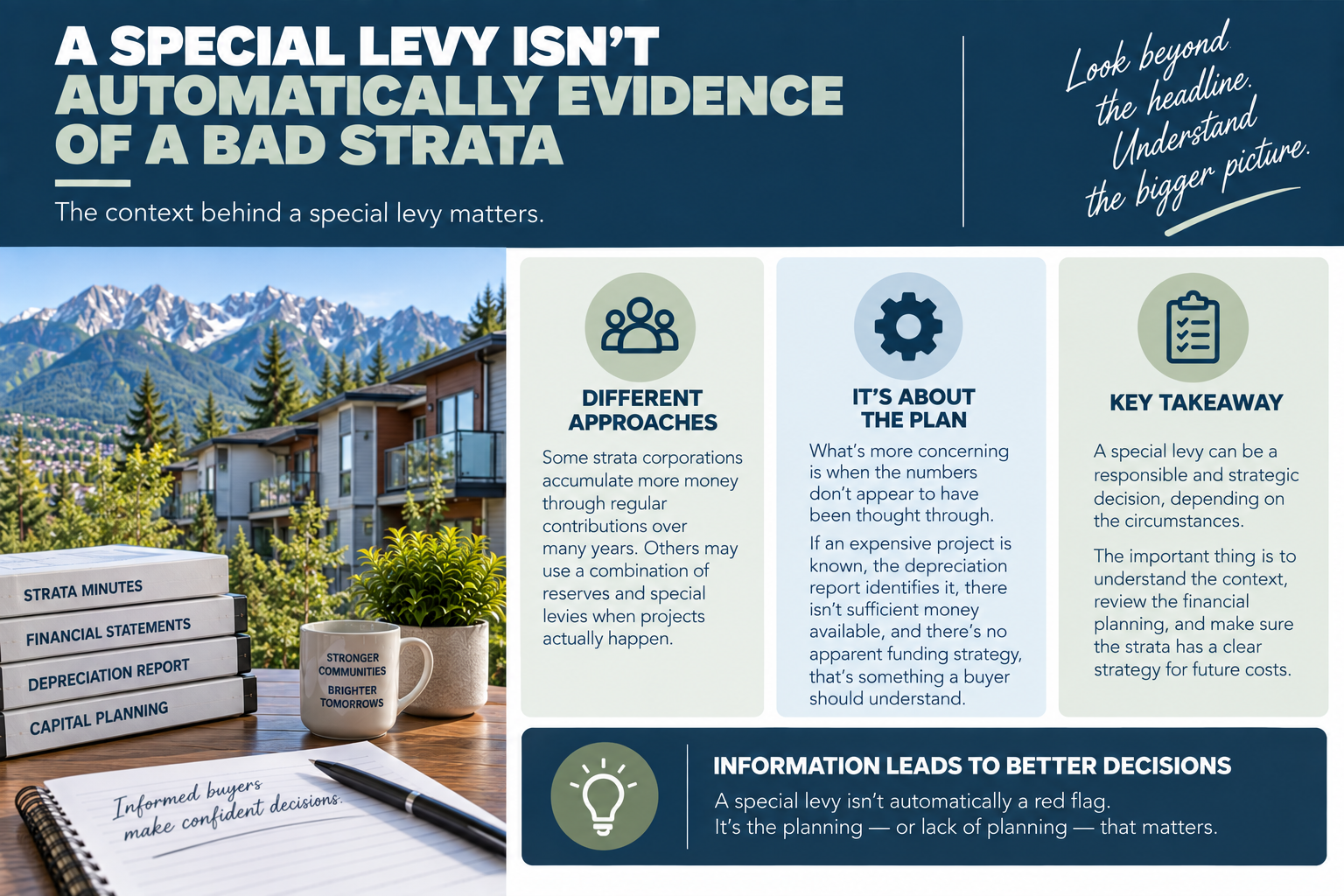
A Special Levy Isn't Automatically Evidence of a Bad Strata
This is another area where buyers can jump to conclusions.
The possibility of a special levy doesn't automatically mean the strata is poorly managed.
Different strata corporations make different decisions about how to fund major work.
Some accumulate more money through regular contributions over many years.
Others may use a combination of reserves and special levies when projects actually happen.
What's more concerning to me is when the numbers don't appear to have been thought through.
If everybody knows an expensive project is approaching, the depreciation report identifies it, there isn't sufficient money available, and there's no apparent funding strategy, that's something a buyer should understand.
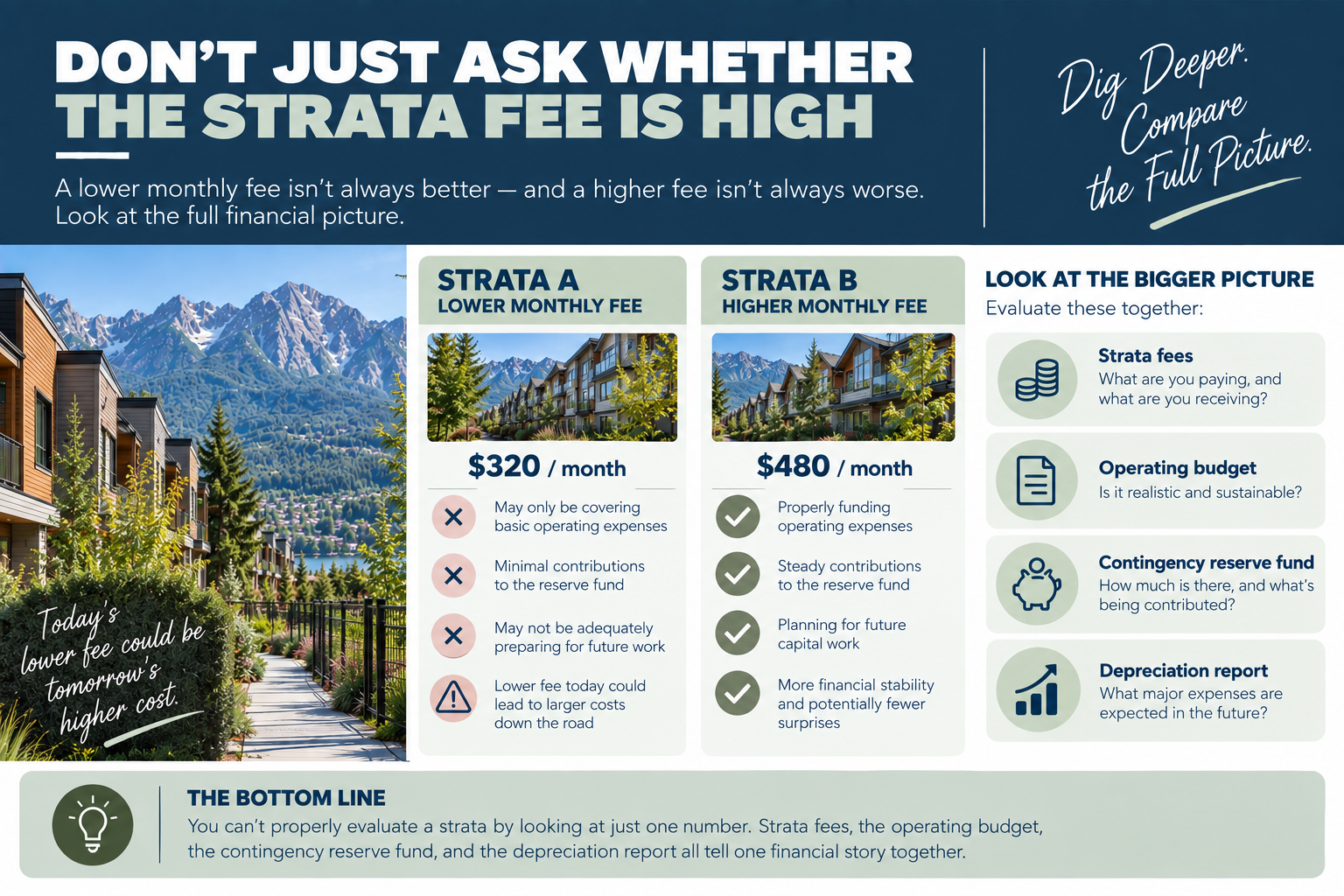
Don't Just Ask Whether the Strata Fee Is High
The same principle applies to strata fees.
Suppose one three-bedroom townhouse has a substantially lower monthly strata fee than another.
It's tempting to assume the lower fee makes it the better-run or less-expensive property.
Maybe.
But what if the higher-fee strata is properly funding its operating expenses and steadily contributing toward future capital work?
And what if the lower-fee strata is barely covering its current expenses and isn't adequately preparing for future work?
The cheaper monthly payment could eventually become the more expensive ownership experience.
That's why I don't think you can properly evaluate:
strata fees,
the operating budget,
the contingency reserve fund,
or the depreciation report
in isolation.
They tell one financial story together.
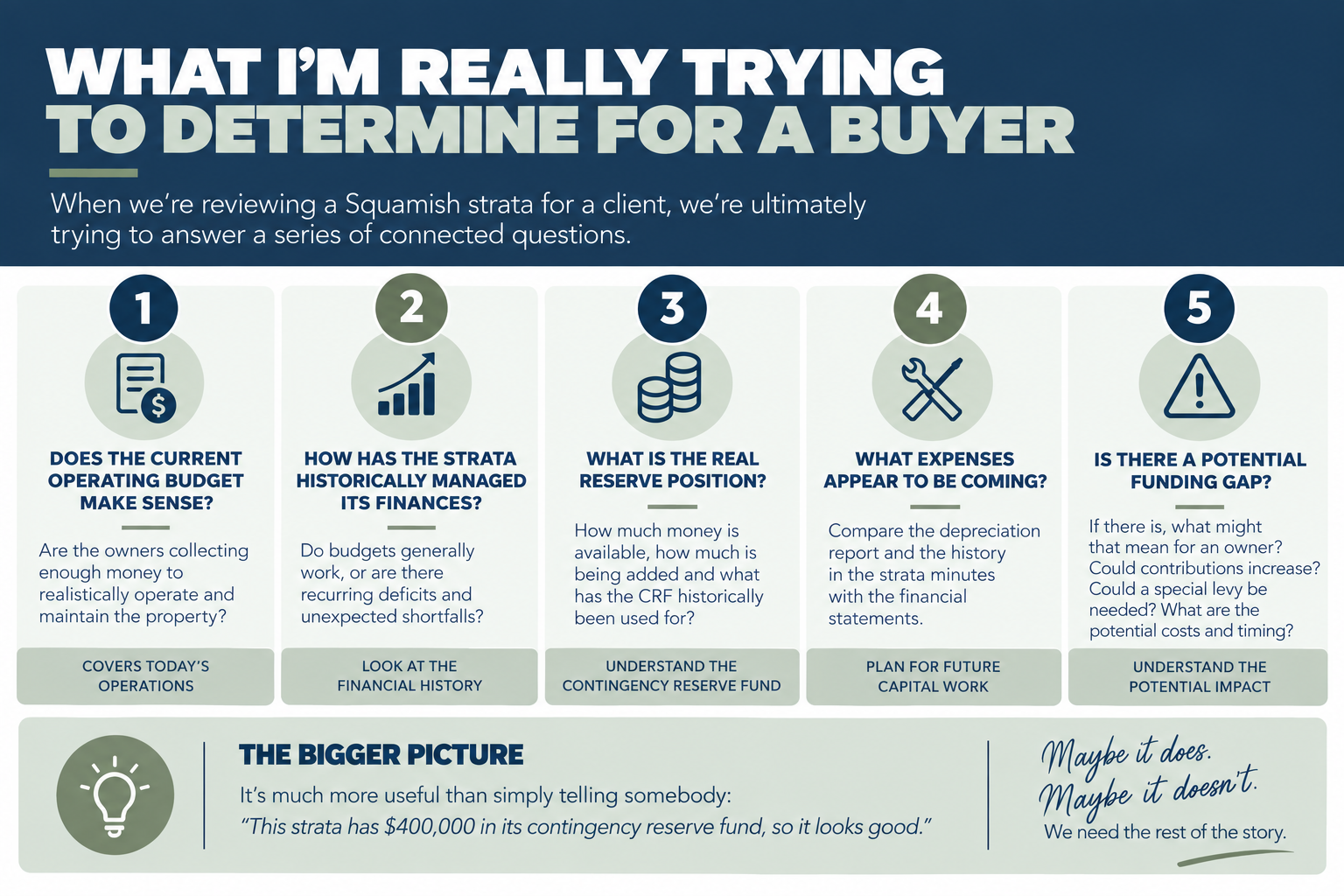
What I'm Really Trying to Determine for a Buyer
When we're reviewing a Squamish strata for a client, we're ultimately trying to answer a series of connected questions.
First: Does the current operating budget make sense?
Are the owners collecting enough money to realistically operate and maintain the property?
Second: How has the strata historically managed its finances?
Do budgets generally work, or are there recurring deficits and unexpected shortfalls?
Third: What is the real reserve position?
How much money is available, how much is being added and what has the CRF historically been used for?
Fourth: What expenses appear to be coming?
That's where we compare the depreciation report and the history in the strata minutes with the financial statements.
Fifth: Is there a potential funding gap?
And if there is, what might that mean for an owner?
That's much more useful than simply telling somebody:
“This strata has $400,000 in its contingency reserve fund, so it looks good.”
Maybe it does.
Maybe it doesn't.
We need the rest of the story.

The Goal Isn't to Find a Strata With the Biggest Bank Account
Ultimately, when I'm helping somebody evaluate a Squamish condo or townhouse, I'm not trying to find the strata with the biggest contingency reserve fund.
I'm trying to understand whether the financial system used by the strata makes sense.
Does the annual budget realistically reflect the cost of running the property?
Are normal operating expenses being properly funded?
Is money being set aside for future work?
Does the financial history show sensible budgeting?
Do the depreciation report and current reserve position line up reasonably well?
And if there's a gap, does the strata appear to have a plan for dealing with it?
That's the analysis.
A contingency reserve fund balance is just one number.
The important question isn't:
“How much money does this strata have?”
It's:
“Given how this strata operates, what it owns, what it costs to maintain and what expenses are coming, does its overall financial situation make sense?”
That's the question I'd want answered before buying into it.
 The data relating to real estate on this website comes in part from the MLS® Reciprocity program of either the Greater Vancouver REALTORS® (GVR), the Fraser Valley Real Estate Board (FVREB) or the Chilliwack and District Real Estate Board (CADREB). Real estate listings held by participating real estate firms are marked with the MLS® logo and detailed information about the listing includes the name of the listing agent. This representation is based in whole or part on data generated by either the GVR, the FVREB or the CADREB which assumes no responsibility for its accuracy. The materials contained on this page may not be reproduced without the express written consent of either the GVR, the FVREB or the CADREB.
Comments:
Post Your Comment: