
A secondary suite adds value to a house in Squamish.
For me, that's not really the question.
The more interesting question is:
How much value does it add, and why can one suite be worth considerably more to a buyer than another?
There's a temptation to put a simple number on it. A one-bedroom suite is worth $150,000. A two-bedroom suite is worth $200,000. Or you take the monthly rent, apply a formula and arrive at an adjustment to the value of the house.
In reality, I don't think it works that neatly.
Rental income matters enormously. But the real value of a suite is often determined by something broader:
What does having that suite allow the buyer to do that they couldn't do without it?
That's where it gets interesting.
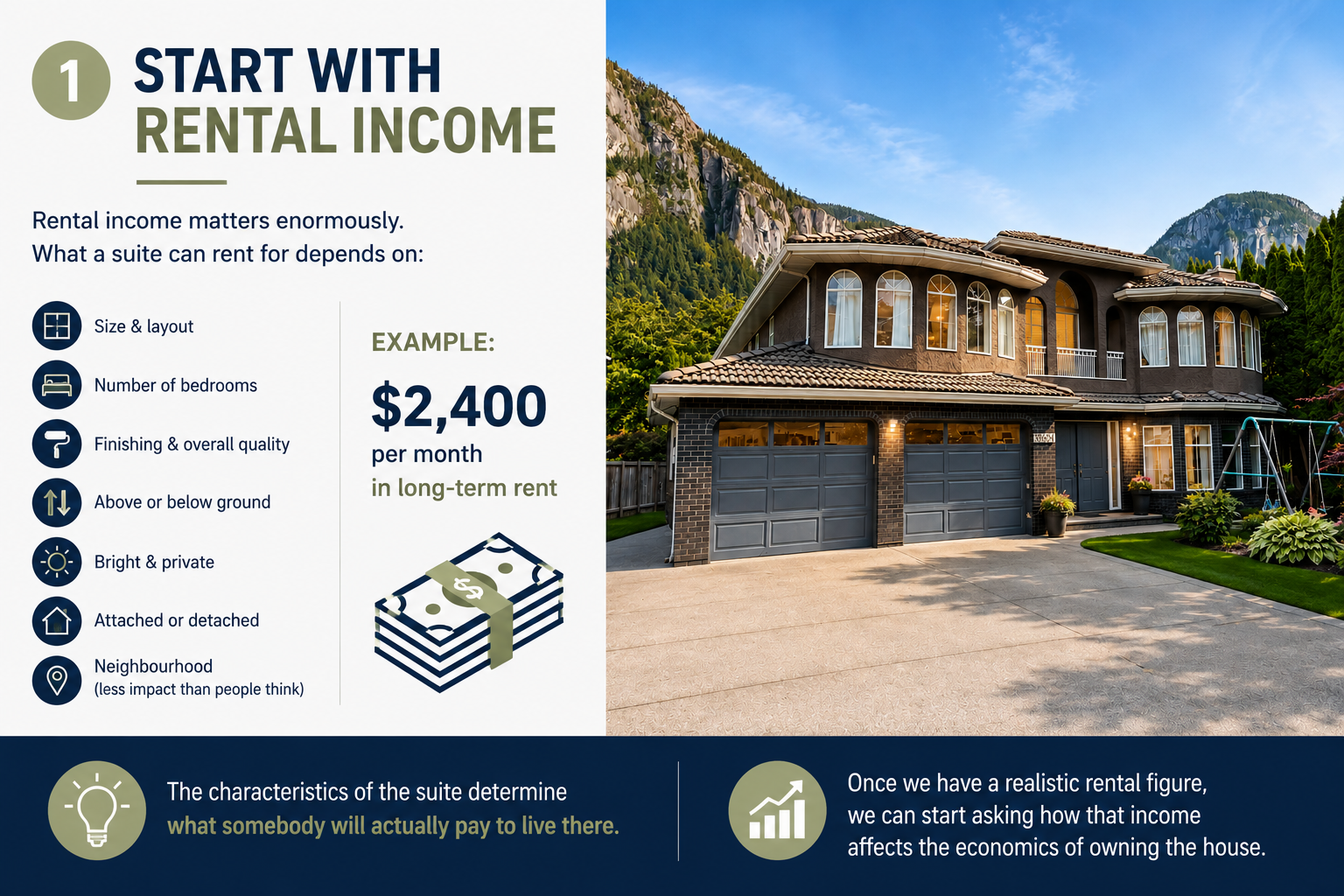
Start With What the Suite Can Rent For
The obvious starting point is rental income.
In my experience in Squamish, the neighbourhood itself often has less influence on secondary-suite rent than people might expect.
The characteristics of the suite can matter considerably.
How large is it?
How many bedrooms?
What are the finishings like?
Is it above ground or below ground?
Is it bright?
Is it attached to the house or a detached accessory dwelling?
What's the overall quality of the space?
Those characteristics help determine what somebody will actually pay to live there.
Once we have a realistic rental figure, we can start asking how that income affects the economics of owning the house.
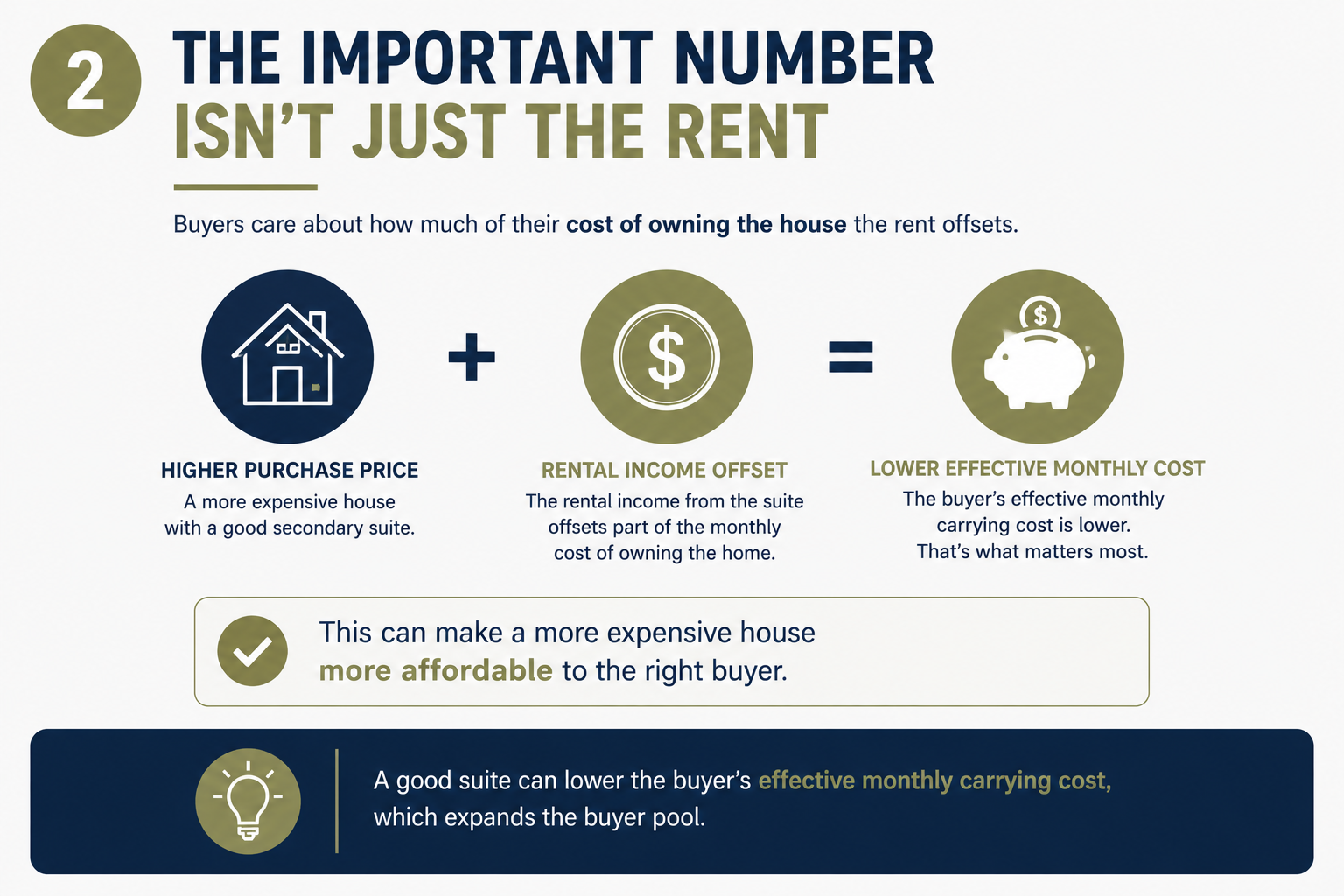
The Important Number Isn't Just the Rent
Let's imagine a suite can generate $2,400 per month in long-term rent.
That's useful information.
But if I'm helping somebody understand what that suite contributes to the value of the property, I want to go further.
How much of the cost of owning the house does that $2,400 offset?
That's the connection buyers care about.
A buyer may look at two houses and prefer the more expensive one because the more expensive property has a good secondary suite.
At first glance that seems strange.
Why would the more expensive house be more affordable?
Because after rental income, the buyer's effective monthly carrying cost may be lower.
That's why a secondary suite can have such a significant effect on the buyer pool for a detached home.
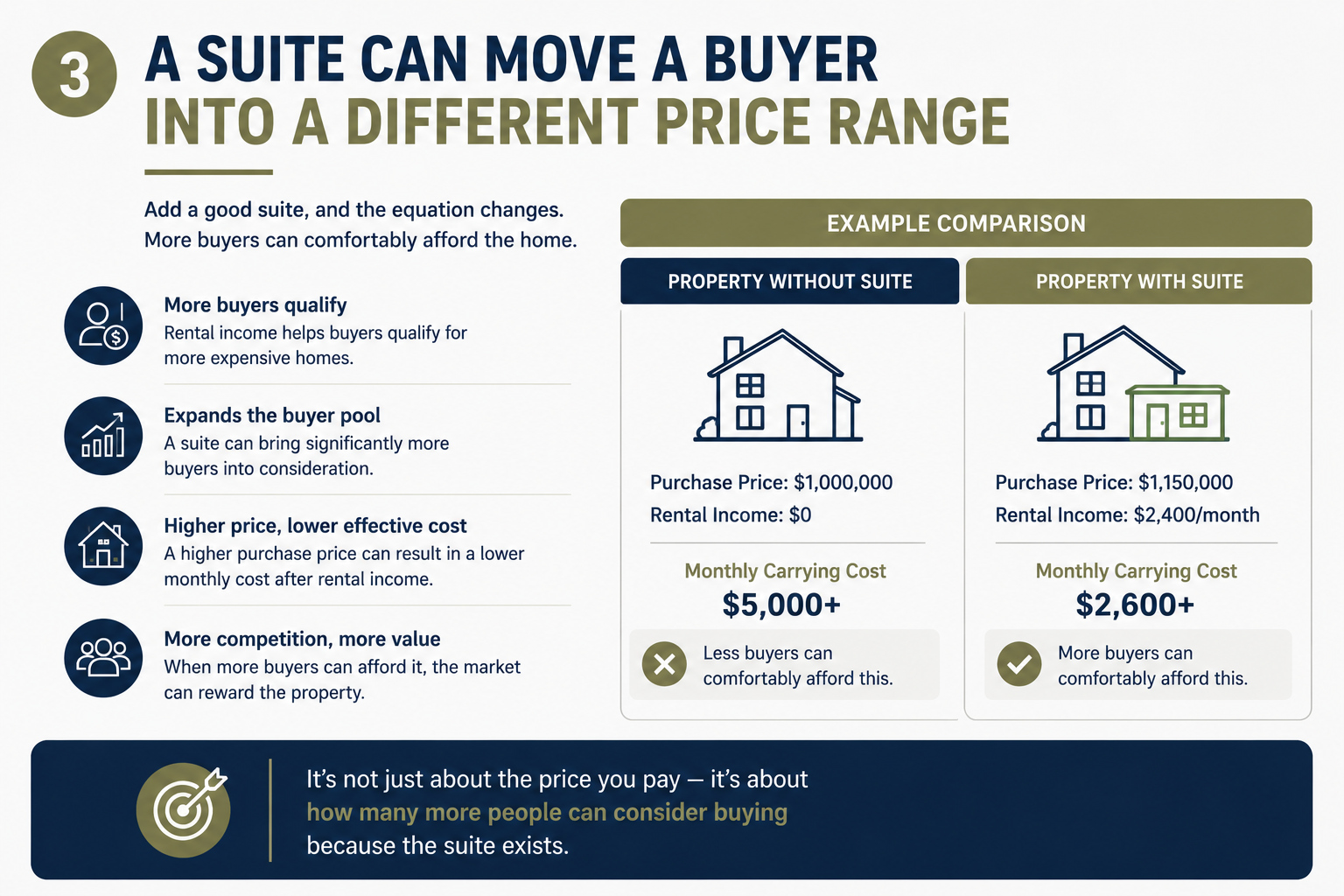
A Suite Can Move a Buyer Into a Different Price Range
We're seeing this in Squamish.
There are price points where buyers without additional income simply reach the limit of what they're comfortable carrying.
Add a good suite, and the equation changes.
A house without a suite may technically have a lower purchase price but attract fewer qualified or comfortable buyers.
Another house might be $100,000 or $150,000 more expensive but include a desirable suite with meaningful rental potential.
Suddenly the second property can make more sense to the buyer.
That's one reason I don't think you can value a suite simply by looking at what it cost to build.
Its value is partly about how many more people can realistically consider buying the house because the suite exists.
And in a market where affordability is challenging, that can be extremely important.
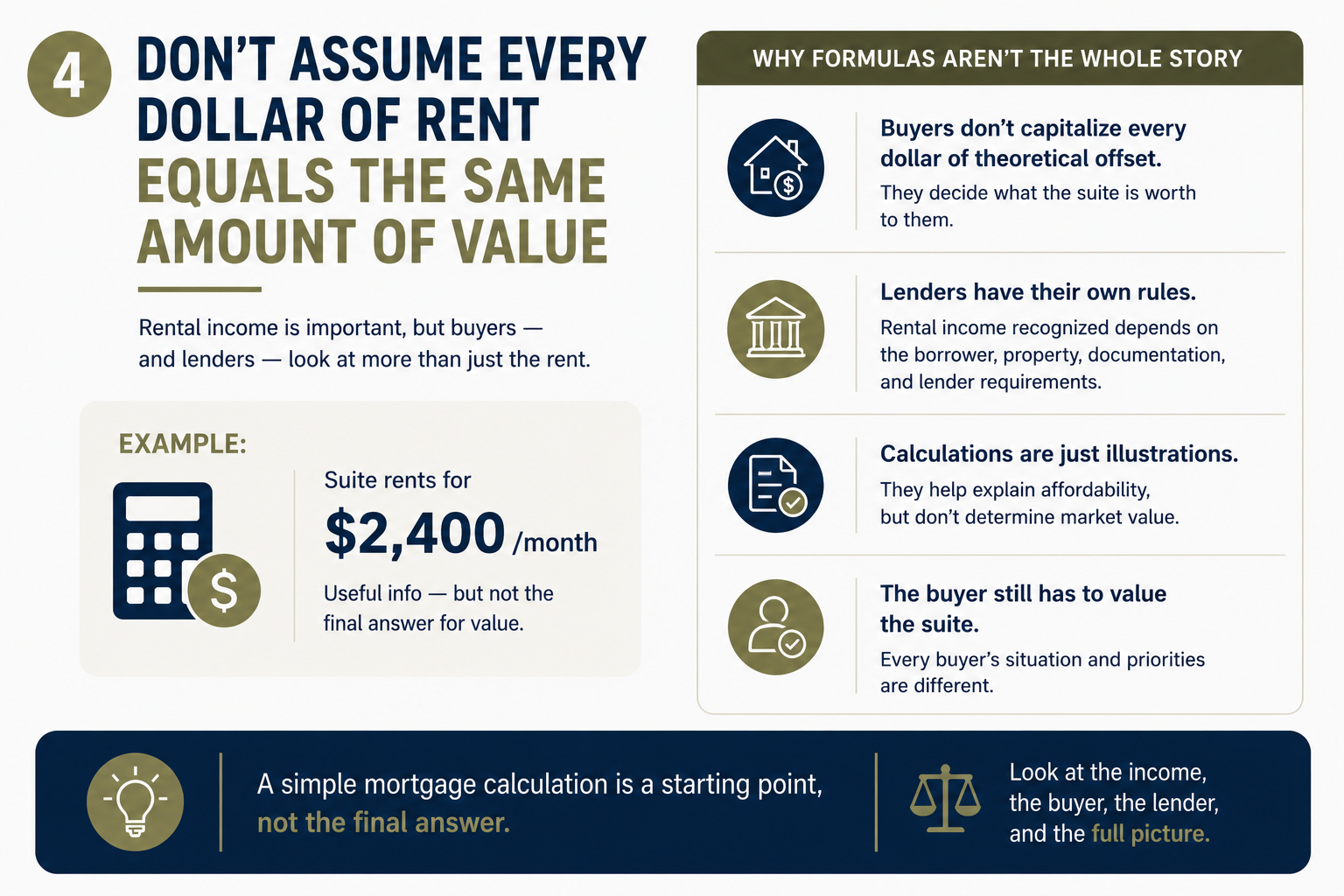
Don't Assume Every Dollar of Rent Equals the Same Amount of Property Value
This is where I become cautious about formulas.
You can calculate what a particular monthly rent would theoretically contribute toward mortgage payments under a given interest rate and amortization.
That's useful as an illustration.
But it doesn't mean buyers will simply capitalize every dollar of theoretical mortgage offset into the price they're willing to pay for the property.
And lenders have their own methods for considering rental income when qualifying borrowers.
The amount of suite income a particular lender recognizes can depend on the borrower, the property, the documentation and the lender's underwriting requirements.
So when I'm evaluating the suite as part of the real estate, I'm interested in the income.
But I don't treat a simple mortgage calculation as the final answer.
The buyer still has to value the suite.
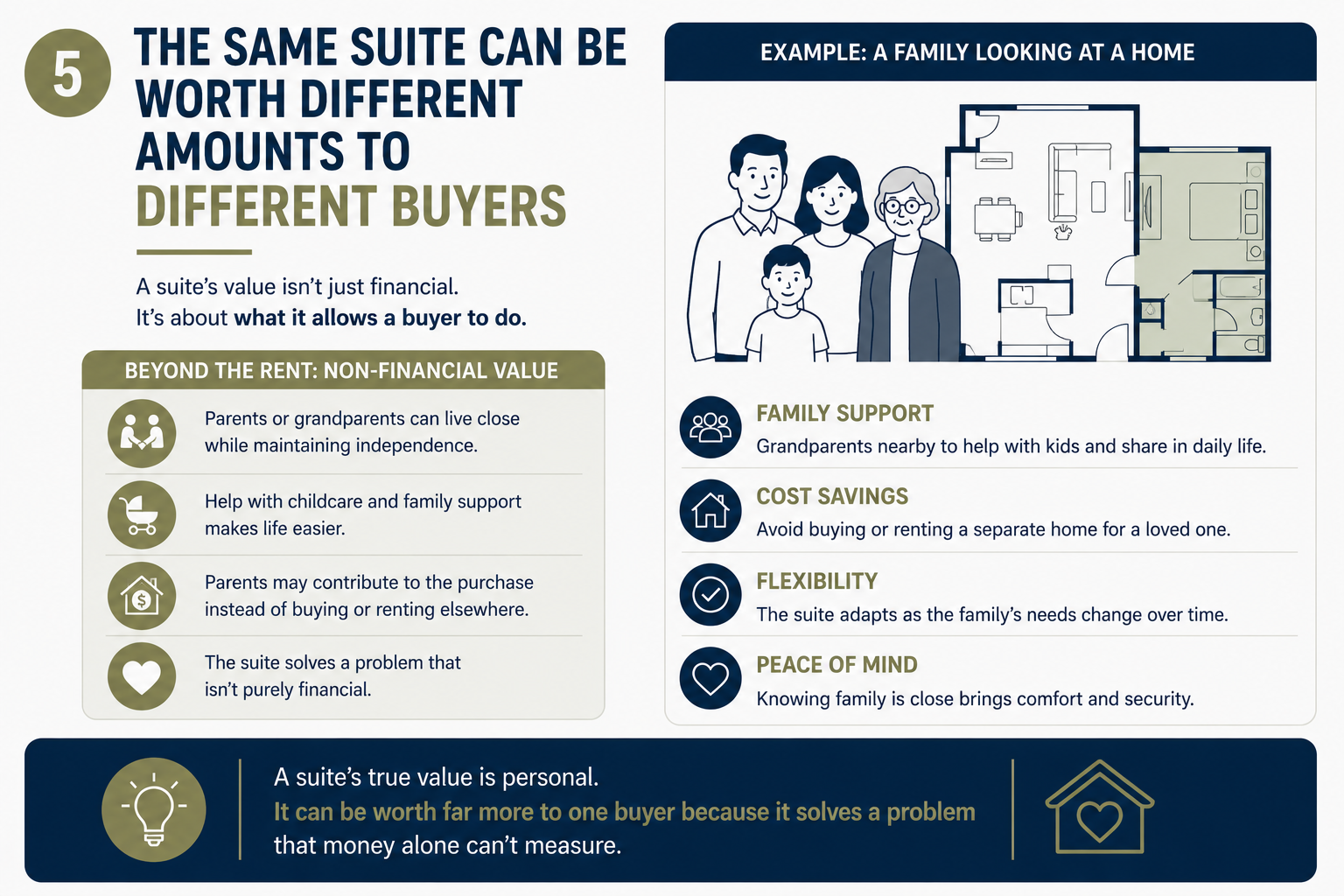
The Same Suite Can Be Worth Different Amounts to Different Buyers
This is probably the most interesting part.
Imagine a family looking at a house with a really nice secondary suite.
They're not planning to rent it to a stranger.
Mom and Dad are going to live there.
Now the calculation changes completely.
Maybe the parents are contributing money toward the purchase.
Maybe they're happy to contribute substantially because the alternative is buying or renting another home.
Maybe having grandparents living downstairs means they can help with childcare.
Maybe it allows an aging parent to live close to the family while still having some independence.
At that point, asking whether the suite rents for $2,200 or $2,400 doesn't capture its full value to that family.
They may willingly pay considerably more for the right property because the suite solves a problem that isn't purely financial.
That's why I don't believe there's one universal adjustment you can make for a secondary suite.
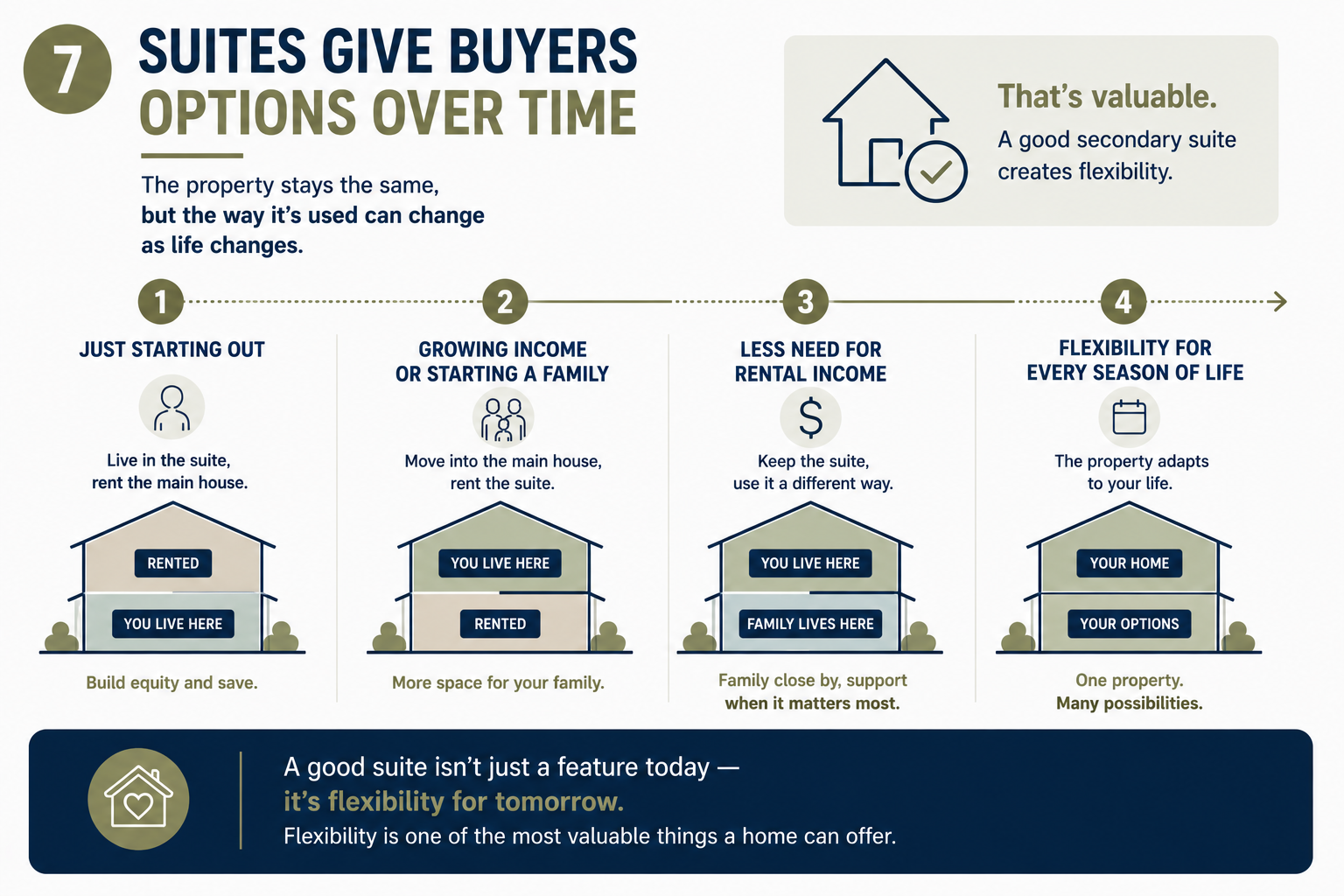
Suites Give Buyers Options Over Time
There's another scenario I see that demonstrates the value particularly well.
A younger buyer purchases a house with a suite but isn't ready to carry the entire house themselves.
They could potentially live in the suite and rent the main portion of the house.
A few years later, their income increases or they start a family.
Now they move into the main house and rent the suite.
Later, perhaps they don't need the rental income as much.
Instead, a parent moves into the suite to be closer to the family and help with the children.
The property hasn't changed.
But the way the owners use it has changed several times.
That's valuable.
A good secondary suite creates flexibility.
And flexibility becomes particularly important when somebody expects to own a house for a long time.
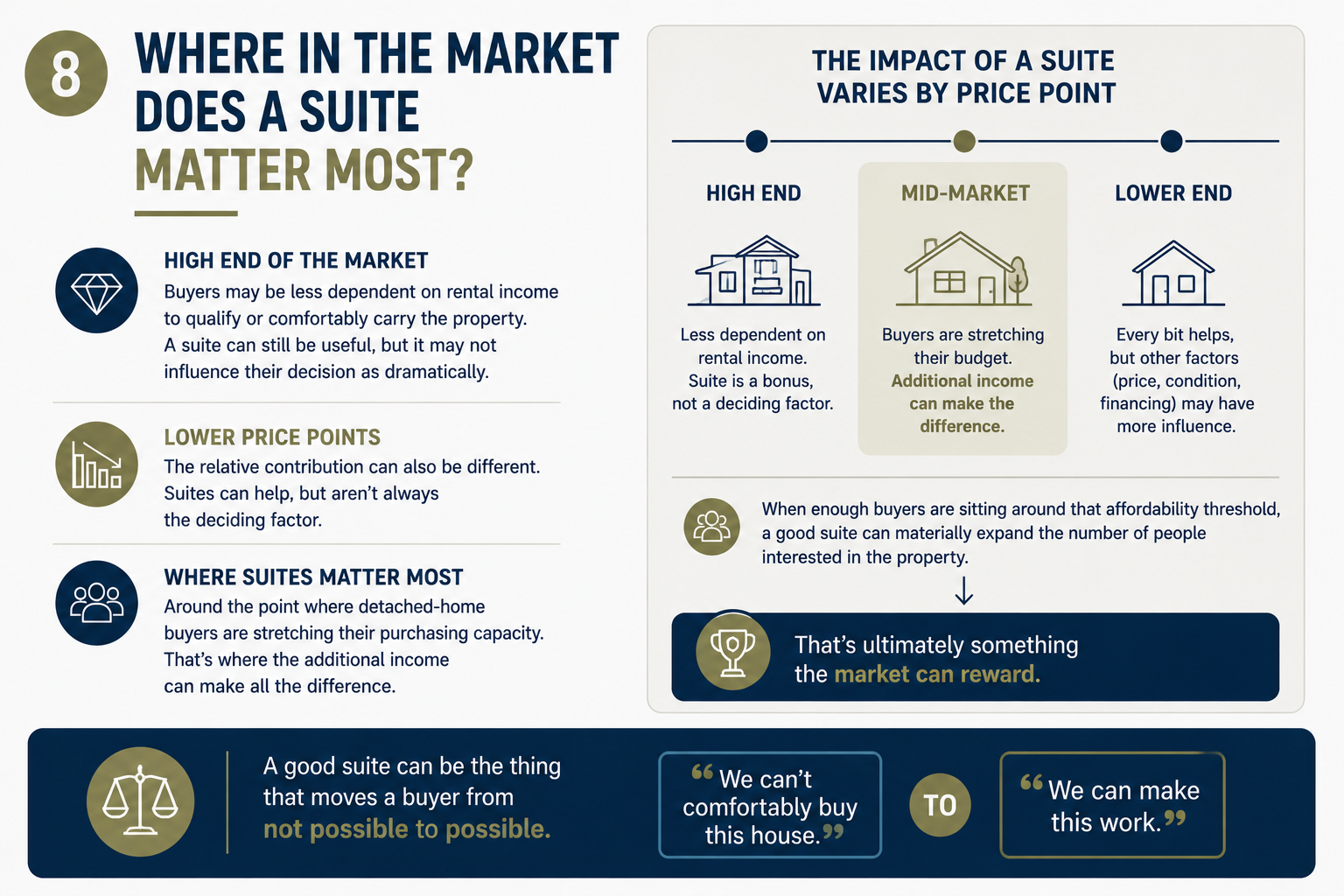
Where in the Market Does a Suite Matter Most?
The value isn't necessarily equal at every price point.
At the very high end of the market, buyers may be less dependent on rental income to qualify or comfortably carry the property. A suite can still be useful, but it may not influence their purchasing decision as dramatically.
At lower price points, the relative contribution can also be different.
Where I find suites particularly influential is around the point where detached-home buyers are stretching their purchasing capacity.
That's where the additional income can make the difference between:
“We can't comfortably buy this house.”
and
“We can make this work.”
When enough buyers are sitting around that affordability threshold, a good suite can materially expand the number of people interested in the property.
That's ultimately something the market can reward.
Not Every Suite Is Equal
If I'm comparing two houses with suites, I'm not simply checking a box that says “secondary suite” and assigning both the same adjustment.
I want to know what the space is actually like.
A bright, well-finished suite that feels like a proper home is different from an awkward basement conversion.
Bedroom count matters.
Size matters.
Finish matters.
Privacy matters.
Whether it's above or below grade can matter.
The quality of the living space matters.
And if we're thinking about multigenerational living, the characteristics that make the suite suitable for a parent or grandparent can become particularly important.
So yes, both houses may technically have suites.
That doesn't mean buyers will value those suites equally.
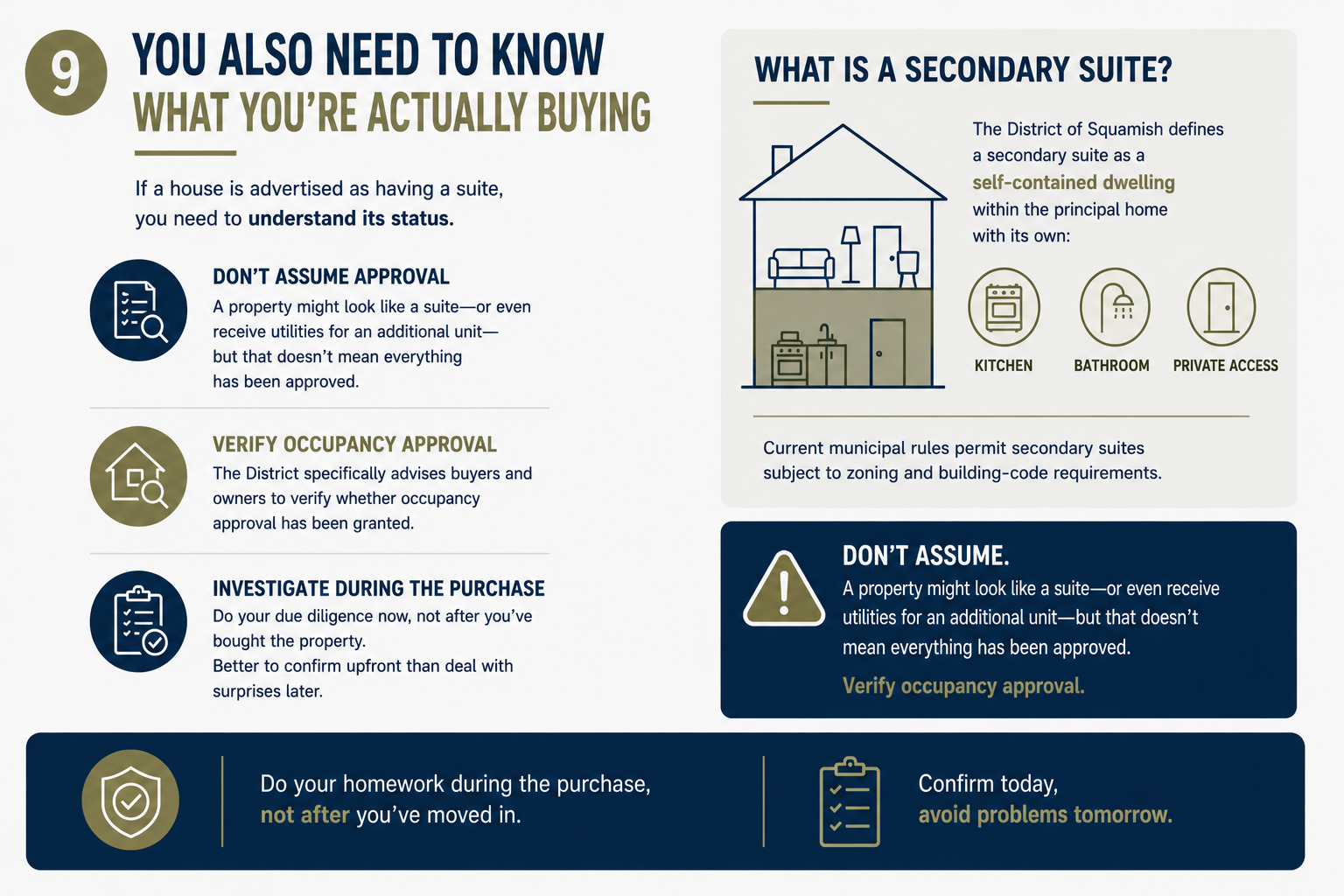
You Also Need to Know What You're Actually Buying
There's one practical issue buyers shouldn't overlook.
If a house is advertised as having a suite, you need to understand its status.
The District of Squamish defines a secondary suite as a self-contained dwelling within the principal home with its own kitchen, bathroom and private access. Current municipal rules permit secondary suites subject to zoning and building-code requirements.
But don't assume that because a property has been physically configured as a suite—or even receives utilities for an additional unit—that everything has necessarily been approved.
The District specifically advises buyers and owners to verify whether occupancy approval has been granted.
That's something to investigate during the purchase rather than discovering afterward.
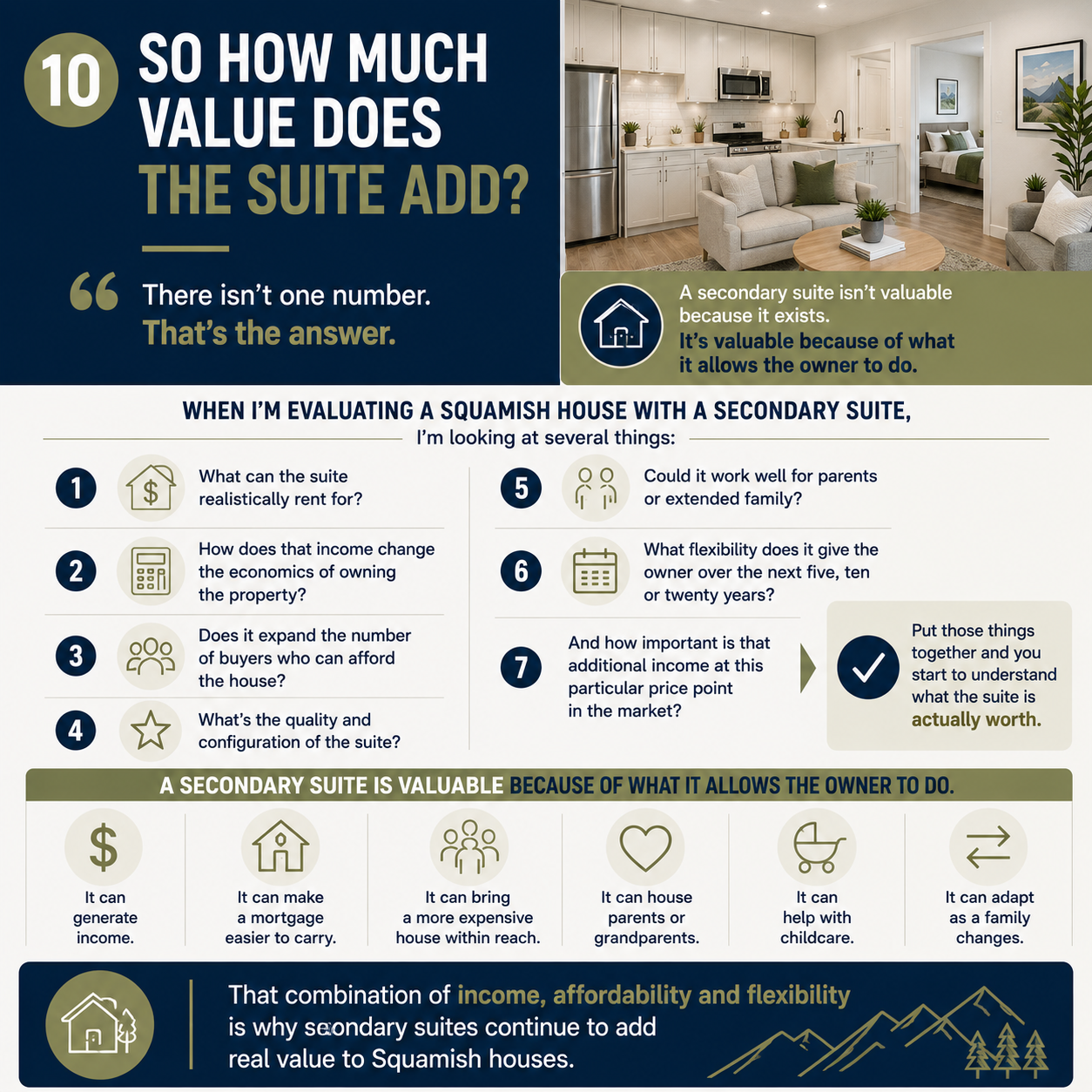
So How Much Value Does the Suite Add?
There isn't one number.
That's the answer.
When I'm evaluating a Squamish house with a secondary suite, I'm looking at several things:
What can the suite realistically rent for?
How does that income change the economics of owning the property?
Does it expand the number of buyers who can afford the house?
What's the quality and configuration of the suite?
Could it work well for parents or extended family?
What flexibility does it give the owner over the next five, ten or twenty years?
And how important is that additional income at this particular price point in the market?
Put those things together and you start to understand what the suite is actually worth.
Because a secondary suite isn't valuable simply because there's another kitchen downstairs.
It's valuable because of what it allows the owner to do.
It can generate income.
It can make a mortgage easier to carry.
It can bring a more expensive house within reach.
It can house parents or grandparents.
It can help with childcare.
It can adapt as a family changes.
And that combination of income, affordability and flexibility is why secondary suites continue to add real value to Squamish houses.
 The data relating to real estate on this website comes in part from the MLS® Reciprocity program of either the Greater Vancouver REALTORS® (GVR), the Fraser Valley Real Estate Board (FVREB) or the Chilliwack and District Real Estate Board (CADREB). Real estate listings held by participating real estate firms are marked with the MLS® logo and detailed information about the listing includes the name of the listing agent. This representation is based in whole or part on data generated by either the GVR, the FVREB or the CADREB which assumes no responsibility for its accuracy. The materials contained on this page may not be reproduced without the express written consent of either the GVR, the FVREB or the CADREB.
Comments:
Post Your Comment: