

When you're buying a home in Squamish, you sometimes have to make compromises. And one of the questions I occasionally get asked is whether it's better to buy a larger house on a busier street or a smaller house on a quieter street.
It's an interesting question because most people would probably say they'd prefer to live on a quiet street. But what happens when the house on the busy street is considerably larger, has a better layout or offers features you couldn't otherwise afford?
Do you sacrifice the size of the house to get the quieter location?
My answer is that it really depends on what you want from the property, how long you intend to live there and what you're prepared to compromise on.
There are also some important resale considerations, particularly when you start thinking about how Squamish might change over the years.
And sometimes the layout of the house itself can make more of a difference than people realize.
Are You Buying a Forever Home or Thinking About Resale?
The first thing I'd want to understand is what you're planning to do with the property.
If you're buying what you consider your forever home, somewhere you expect to live for many years, then your personal preferences should carry a lot of weight.
If you love the larger house, need the extra bedrooms and don't particularly mind the traffic, then buying on a busier street might be a perfectly reasonable decision.
You're going to be the one living there, so what matters most is whether the property works for you.
On the other hand, if you're buying a house that you expect to sell in five or ten years, then I think you need to look a little more carefully at how the location might affect its future resale value.
That's not to say you should ignore resale considerations when buying a forever home. Circumstances change, and people sometimes end up selling properties they expected to own indefinitely.
But there's a difference between buying a house primarily for your own long-term enjoyment and buying one where future marketability is a major part of the decision.
Does a Busy Street Affect Property Value?
Generally speaking, a house on a busy street will appeal to a smaller group of buyers than an otherwise comparable house on a quiet residential street.
There are obvious reasons for that.
Some buyers don't like traffic noise. Others are concerned about privacy, vehicle access or having children playing near the road. Some simply prefer the feeling of living on a quiet street.
And when fewer buyers are interested in a property, that can affect its market value.
But here's something important to understand.
The disadvantage of being on a busy street may already be reflected in the asking price.
Imagine two similar houses in Squamish. One is on a quiet street, and the other is on a road with considerably more traffic.
If the house on the busy street is priced appropriately, it may already be selling at a discount compared with the quieter location.
That doesn't necessarily make it a bad investment.
In fact, if you're comfortable with the traffic and the property offers more house for your money, you might be getting very good value.
The important question is whether the price adequately reflects the disadvantages of the location.
If it does, then you haven't necessarily made a poor purchase simply because the house is on a busy street.
And I wouldn't automatically assume that the quieter property will appreciate more in dollar terms or percentages. Both properties will be affected by the broader market, their individual characteristics and how their locations change.
The price you pay at the beginning matters.
What Happens When You Eventually Sell?
This is where I think the quieter street can have a real advantage.
Let's imagine you own a house on a busy street and decide to sell during a strong real estate market.
If there are plenty of buyers looking for homes in Squamish, you may have several people interested in your property despite the traffic.
Some buyers will be willing to overlook the location because they like the house, need the space or recognize that they're getting more property for their money.
But what happens if you need to sell during a slower market?
Now buyers have more choice.
If somebody can purchase a similar house on a quieter street for a price they can afford, they're probably going to give that property serious consideration.
And families with young children may eliminate the busy-street property from their search altogether.
That's why I generally think houses on quieter streets can be easier to sell, particularly when market conditions aren't favourable.
They tend to appeal to a broader range of buyers.
It doesn't mean a busy-street property won't sell. It means you may have to be more competitive with your pricing or wait longer for the right buyer.
That becomes particularly important if you know you might need to sell within a relatively short period.
A Quiet Street Today Might Not Be a Quiet Street Forever
There's another consideration that I think buyers sometimes overlook, especially in a growing community like Squamish.
Just because a street is quiet today doesn't mean it will always be quiet.
As communities grow, traffic patterns can change.
New residential developments can bring additional vehicles into a neighbourhood. Road connections can change how people travel through an area, and a street that was once used almost exclusively by local residents might eventually become a more convenient route for other drivers.
So when you're comparing a house on a busy street with one on a quieter street, I think it's worth asking a second question.
Is the quiet street likely to remain quiet?
If you're buying on a small cul-de-sac with limited opportunities for additional road connections, that may be quite different from buying on a street that could eventually serve new development.
You can't predict every change that will happen in a community, but you can investigate what's being planned.
In Squamish, that means looking at the District's Official Community Plan, transportation planning documents and nearby development proposals.
These won't necessarily tell you exactly how many cars will travel past a particular house in ten years, but they can help identify potential changes that are worth investigating.
And if you're paying a premium for a quiet location, I think it's particularly important to understand whether that advantage is likely to remain.
What About a Street That's Already Busy?
Interestingly, there can be an advantage to buying a house where the traffic conditions are already well established.
At least you have a reasonable understanding of what you're purchasing.
You can visit the property at different times of day, listen to the traffic and decide whether it's something you can live with.
You can see how vehicles move through the neighbourhood, whether people tend to drive quickly and how easy it is to get in and out of the driveway.
And if the property is priced appropriately, those existing conditions should already be part of the market's assessment of its value.
Compare that with a quiet street where future development could substantially increase traffic.
The quieter location may still be the better purchase, but I wouldn't make that assumption without looking into what could change.
Of course, traffic can increase on an already busy street too. There's no guarantee that current conditions will remain unchanged.
The point is that you should consider both the present situation and the potential future situation before making a decision.
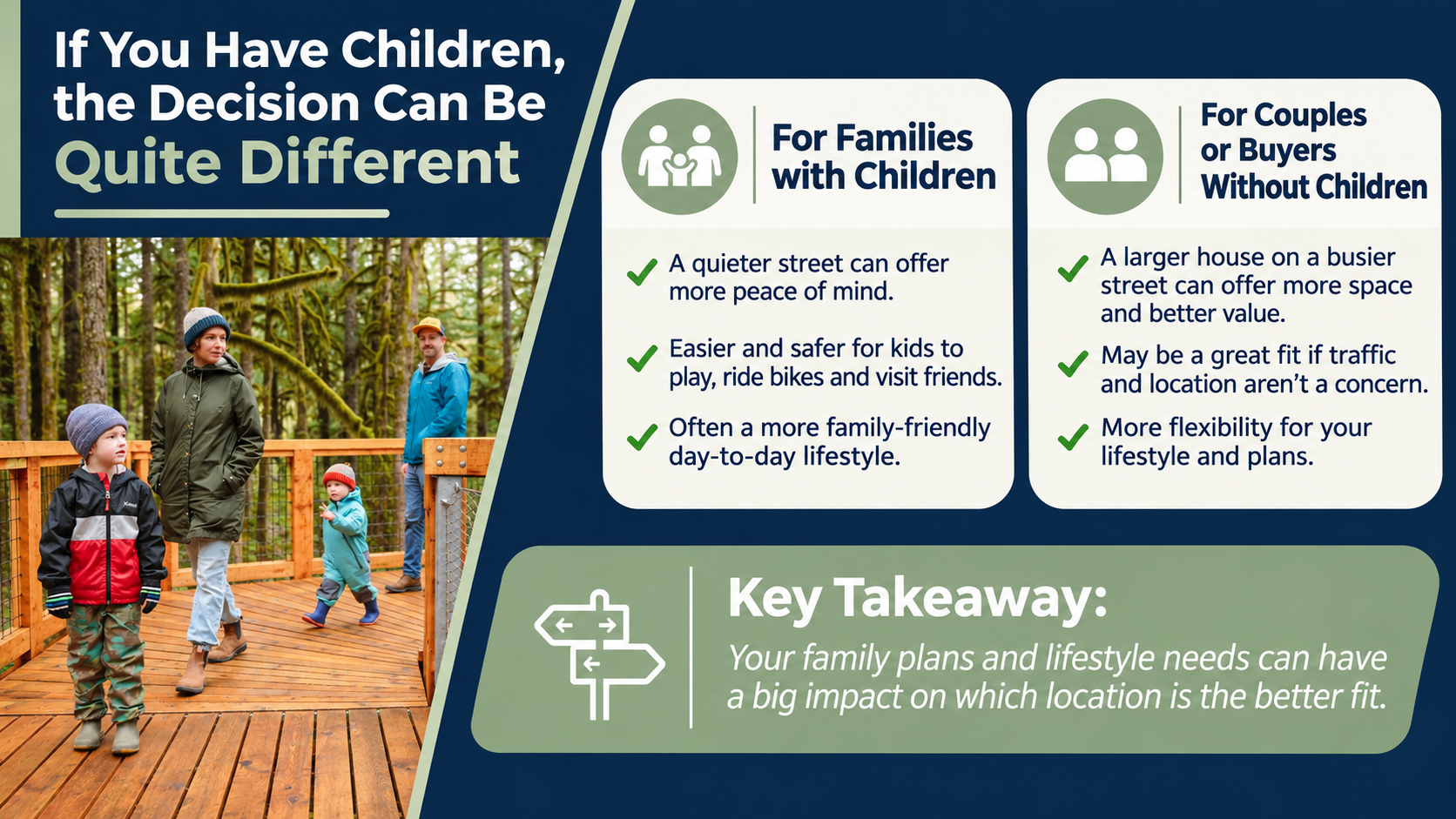
If You Have Children, the Decision Can Be Quite Different
For many buyers, I think this whole question comes down to whether they have children or plan to have children.
And that's understandable.
A quieter street can make a big difference to how a family uses its home.
Children may want to ride their bikes, play outside or visit friends in the neighbourhood. Parents may feel more comfortable in an area with less traffic, particularly when children are young.
That doesn't mean a quiet street is automatically safe or that children can't live happily on a busy street. Road design, vehicle speeds, sidewalks, crossings and supervision all matter.
But traffic exposure is a legitimate consideration.
And if you're planning to raise a family in the property, I can certainly understand why you might choose a smaller house on a quieter street rather than a larger house on a busy road.
In fact, I'd say that in many of these conversations, whether the buyer has children or intends to have children becomes one of the most important factors in the decision.
A couple without children might look at a larger house on a busy street and see an opportunity to get more space for their money.
A family with young children might look at exactly the same property and decide that the location simply doesn't work for them.
Neither buyer is necessarily wrong.
They're making different decisions because their needs are different.
Don't Overlook Which Side of the House Gets the Sun
Now let's get into some of the smaller details, because this is where I think looking at individual properties becomes particularly important.
Imagine you're considering a house on a busier street, and the front of the property faces south.
In Squamish, sunlight can be a very desirable feature, particularly given the mountains and the way they affect sunlight in different parts of the community.
A south-facing front yard might be the sunniest and most enjoyable outdoor space on the property.
But what if that front yard is right beside a busy road?
You might have a lovely sunny area where you'd like to sit outside, but you don't particularly enjoy spending time there because of the traffic.
Now imagine a different property where the backyard receives the best sunlight and is separated from the road by the house itself.
That could be a completely different living experience, even if the two properties are on similarly busy streets.
This is why I don't think you can simply categorize houses as being on busy or quiet streets and make a decision based on that alone.
You have to look at how the property actually works.
Where will you spend your time?
Which outdoor areas are most usable?
How much sunlight do those areas receive?
And how does the traffic affect the parts of the property you're going to enjoy most?
Those details can make a significant difference.
The Layout of the House Can Change Everything
The layout of the house itself is another factor that I think deserves more attention.
Let's say you're looking at a house on a busy street where the primary bedroom and main living room are both at the front of the property.
Those are rooms where you're likely to spend a considerable amount of time.
If they're facing the road, you may be more aware of traffic noise and activity.
Now compare that with a house on the same street where the primary bedroom and main living spaces are at the back.
The house itself may provide some separation from the road.
You might find that the bedrooms are quieter, the living area feels more private and the backyard is a much more comfortable place to spend time.
Suddenly, the fact that the property is on a busy street may be less of a concern.
The road hasn't changed.
But the way the house is designed has changed how much the road affects your everyday life.
Window quality, landscaping, fencing and the distance between the house and the road can also influence the experience.
That's why I think it's so important to walk through a property and consider how you're actually going to live in it, rather than judging it solely by its address.
Should You Sacrifice House Size for a Quieter Location?
So let's return to the original question.
Should you buy the bigger house on the busy street or the smaller house on the quiet street?
I don't think there's one answer that applies to everybody.
If you're planning to have children, value privacy and want a property that will appeal to a broad range of buyers when you eventually sell, I'd generally lean toward the quieter street, provided the smaller house still meets your needs.
But if you need the additional space, plan to stay in the property for a long time and aren't particularly bothered by traffic, the larger house might be the better choice.
Especially if the busy-street location has already been accounted for in the price.
And then there are the individual details.
Does the quiet street have the potential to become busier as Squamish grows?
Does the larger house have its bedrooms and living areas away from the road?
Which property gets better sunlight?
Where are the outdoor living spaces?
And how much are you actually paying for the difference in location?
Those are all things I'd want to consider before recommending one property over the other.
My Advice to Buyers in Squamish
I think the biggest mistake would be to assume that a quiet street is always worth sacrificing everything else for, or that a larger house automatically represents better value.
Neither is necessarily true.
A house is somewhere you're going to live, and the way it functions for you and your family matters enormously.
At the same time, you need to recognize that your circumstances may change and that eventually you might want or need to sell.
When that happens, the property's appeal to other buyers becomes important.
A quiet street will generally be attractive to more people, particularly families, and that can be an advantage in a slower market.
But a well-priced house on a busy street can still be an excellent purchase for the right buyer.
Ultimately, I'd rather see somebody buy a home that genuinely works for their lifestyle, at a price that properly reflects its location, than sacrifice something important simply because one street is quieter than another.
And in a growing community like Squamish, I'd also encourage buyers to think beyond what the street looks like today.
Consider how the neighbourhood might change, how you'll use the house and how other buyers may view the property when it comes time to sell.
Those are the things that help turn a difficult choice between two properties into a much more informed decision.
Simon Hudson
Team Hudson | Macdonald Realty
Squamish, British Columbia
 The data relating to real estate on this website comes in part from the MLS® Reciprocity program of either the Greater Vancouver REALTORS® (GVR), the Fraser Valley Real Estate Board (FVREB) or the Chilliwack and District Real Estate Board (CADREB). Real estate listings held by participating real estate firms are marked with the MLS® logo and detailed information about the listing includes the name of the listing agent. This representation is based in whole or part on data generated by either the GVR, the FVREB or the CADREB which assumes no responsibility for its accuracy. The materials contained on this page may not be reproduced without the express written consent of either the GVR, the FVREB or the CADREB.
Comments:
Post Your Comment: