

If you’re buying a townhouse in Squamish, it’s easy to assume that newer is better.
Newer finishes. Newer appliances. More modern construction. Less immediate renovation work.
But after showing a lot of townhouses in Squamish, I don’t think it’s nearly that simple.
In fact, there are some characteristics of Squamish’s older townhouse complexes that we’re probably never going to reproduce in new construction. And as more of those older homes get renovated, I think that distinction is going to become increasingly important to buyers.
The real question isn’t whether an older or newer townhouse is “better.”
It’s what are you actually getting for your money, and which parts of that property can you change later?
The Big Advantage of Older Squamish Townhouses: Space
Take some of Squamish’s established townhouse complexes: Shannon Estates, Highland Glen, Emerald Place, Cottonwoods and Eagle View, among others.
One of the things buyers frequently notice when they walk into these older properties is the space.
That doesn’t necessarily mean every older townhouse is enormous. It’s also about how that space is distributed.
Bedrooms can feel like actual bedrooms. Secondary bedrooms may be considerably more usable than what you find in some newer floorplans. There can be more separation between neighbouring homes, more parking and, importantly, actual yards or outdoor areas that feel connected to the home.
That’s something I hear from buyers when we’re viewing properties.
They walk into one of the larger older townhouses and immediately recognize how much more space they’re getting.
Then comes the trade-off.
They look at the older kitchen, bathrooms, flooring or finishes and compare those with a brand-new or nearly new townhouse. Suddenly the decision isn’t quite so easy.
A Three-Bedroom Townhouse Isn’t Always a Three-Bedroom Townhouse in Practice
This is one area where buyers need to look beyond the listing details.
You can have two properties that are both marketed as three-bedroom townhouses, but that doesn’t mean those bedrooms function the same way.
In some newer floorplans, the third bedroom can be substantially smaller than the primary bedroom, and sometimes considerably smaller than the second bedroom as well. Some rooms marketed as bedrooms don’t have closets.
The important question for a buyer isn’t simply:
“How many bedrooms does it have?”
It’s:
“Can my family actually use these rooms the way we need to?”
Can you fit the bed, dresser and desk your child needs? Does the room still function when the door is open? Is there practical storage? Could two children realistically use the secondary bedrooms as they get older?
Those questions matter much more than the number printed on the feature sheet.
Why Some Newer Squamish Townhouses Feel More Like Apartments
Another major difference is the relationship between the living space and the ground.
Squamish has significant floodplain considerations, and flood construction requirements have influenced how development is designed in parts of the community.
The District of Squamish has used flood construction levels to establish minimum elevations for habitable areas. Depending on the site and applicable requirements, that can result in lower levels being used for parking or other non-habitable purposes with the living space above.
For buyers, the practical result can be a townhouse with a large garage level followed by stairs up to the main living area and then another level of bedrooms.
There’s nothing inherently wrong with that design. For some people, it’s ideal.
But it feels very different from an older townhouse where you can walk in closer to ground level, move easily between the house and yard, and feel more directly connected to the outdoor space.
Buyers notice that difference.
Some simply don’t want to climb multiple flights of stairs every time they come home. Others don’t like how tightly some newer developments are configured.
That feeling is difficult to quantify on a listing sheet, but it can become very important once you’ve actually viewed both types of property.
Where Newer Townhouses Have a Real Advantage
I don’t want this to sound like an argument that older construction is better across the board. It isn’t.
Modern construction has some genuine advantages.
One of the biggest can be sound separation between neighbouring units. Modern building codes address acoustic performance between dwelling units, and newer construction techniques and assemblies can provide much better sound separation than what was typical decades ago.
That can make an enormous difference in attached housing.
There are also newer building systems, energy-efficiency requirements and construction practices that didn’t exist when many of Squamish’s older complexes were built.
But I would still be careful about assuming that “new” automatically means “high quality.”
I’ve seen newer properties with very attractive finishes that look high-end but aren’t necessarily as impressive once you start looking beyond the cosmetics.
So buyers should separate three different things:
How new is it?
How good does it look?
How well is it actually built?
Those aren’t always the same thing.
The Shannon Estates vs. The Breeze Example
A recent comparison illustrates why this gets interesting.
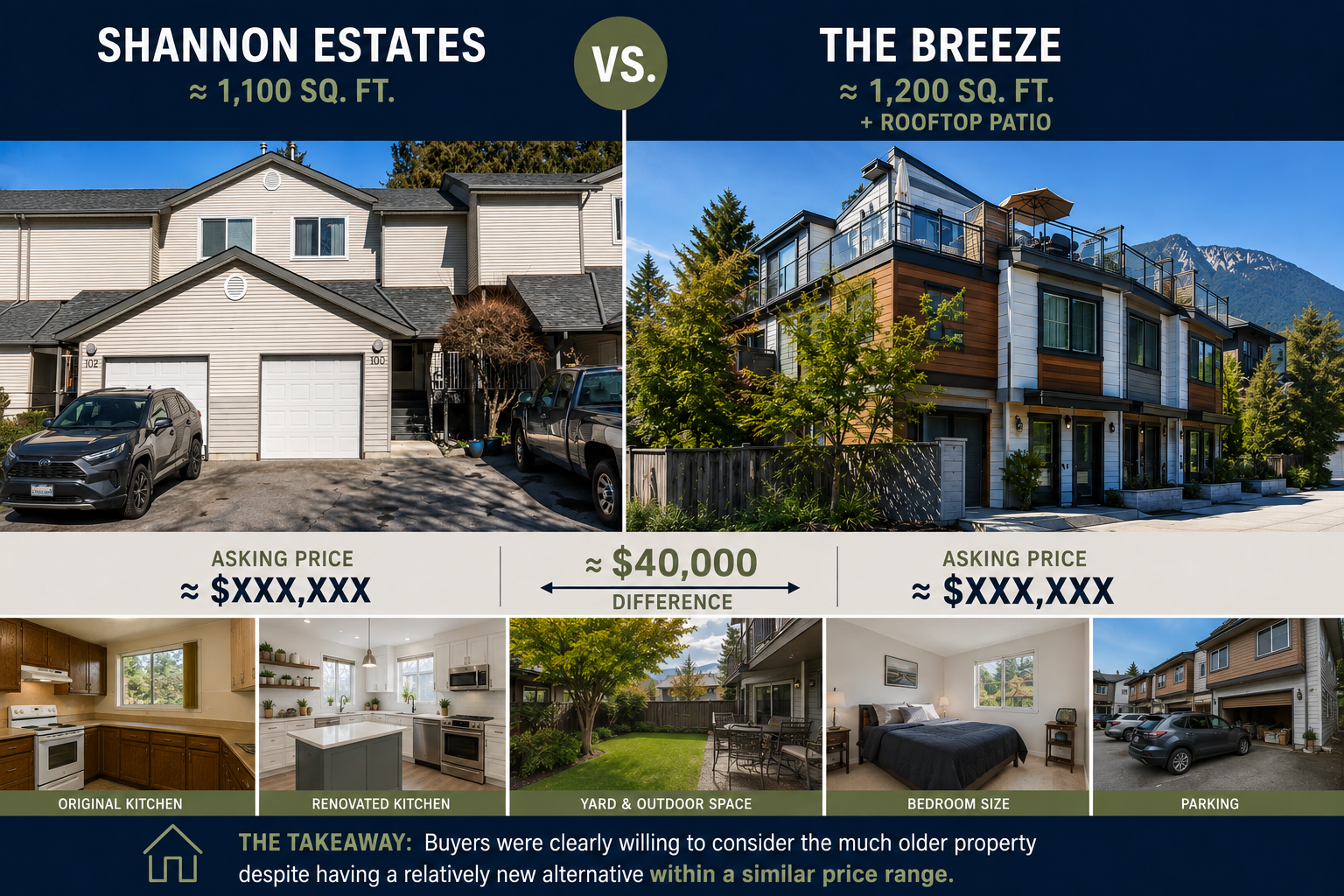
There was a townhouse listed in Shannon Estates at approximately 1,100 square feet. At the same time, there was a unit available at The Breeze at approximately 1,200 square feet.
The Breeze is substantially newer and offers features including a rooftop patio. Despite that, the difference in asking price between the two properties was only around $40,000, and the Shannon Estates property went under offer first.
I wouldn’t use one example to claim that Shannon Estates is therefore “worth more” than The Breeze. That’s not how real estate valuation works, and individual condition, location within the complex, pricing and seller motivation all matter.
What I find interesting is that buyers were clearly willing to consider the much older property despite having a relatively new alternative within a similar price range.
That’s something I see repeatedly when showing townhouses.
There is value in features that don’t necessarily show up when you simply compare age, bedroom count and square footage.
You Can Renovate Finishes. You Can’t Renovate the Site Plan.
This is probably the most important point I would make to somebody deciding between an older and newer Squamish townhouse.
Imagine an older townhouse that is perfectly livable but hasn’t been completely renovated.
The kitchen may be dated. The flooring may need changing. Maybe the bathrooms eventually need to be redone.
Those things cost money, and buyers absolutely need to budget for them.
But they’re changeable.
Over time, you can potentially renovate that property so the interior feels considerably more modern.
What can’t you renovate?
You can’t create more space between your building and the neighbouring building.
You can’t move your living room closer to the ground.
You can’t easily turn a tiny secondary bedroom into a large one if the floorplan doesn’t allow it.
You can’t create a large yard where one doesn’t exist.
You can’t redesign the entire complex to provide more parking or a different relationship between the homes.
That’s why I think some older Squamish townhouses—particularly ones that are livable today but still offer renovation potential—can present a very interesting value proposition.
You’re buying the things you can’t change and improving the things you can.
But Don’t Ignore the Strata
There is an important qualification here.
Buying an older townhouse isn’t simply about finding the biggest unit with the biggest yard.
The older the complex, the more important it becomes to understand the condition of the buildings and the strata corporation.
Before buying, you need to look carefully at the strata documents, depreciation information where applicable, contingency reserve fund, meeting minutes, insurance, planned projects and the history of major components.
A beautiful renovated kitchen doesn’t compensate for major building issues you didn’t understand before purchasing.
That’s where the comparison between older and newer becomes more sophisticated than simply looking at price per square foot.
So, Is an Older or Newer Squamish Townhouse Better Value?
There isn’t one answer for everybody.
If your priorities are modern construction, contemporary finishes, potentially better acoustic separation and less immediate renovation work, a newer townhouse may make considerably more sense.
If your priorities are larger rooms, usable outdoor space, fewer stairs, parking, separation from neighbouring units and a more ground-oriented way of living, some of Squamish’s older townhouse complexes deserve a very close look.
Personally, I think those characteristics could become increasingly important over time because they’re difficult to recreate in new development.
The mistake is assuming age determines value.
It doesn’t.
When I’m comparing townhouses with clients, I’m much more interested in identifying what we’re paying for that can never be changed and what we’re discounting simply because it can be renovated later.
That distinction can completely change which property looks like the better buy.
 The data relating to real estate on this website comes in part from the MLS® Reciprocity program of either the Greater Vancouver REALTORS® (GVR), the Fraser Valley Real Estate Board (FVREB) or the Chilliwack and District Real Estate Board (CADREB). Real estate listings held by participating real estate firms are marked with the MLS® logo and detailed information about the listing includes the name of the listing agent. This representation is based in whole or part on data generated by either the GVR, the FVREB or the CADREB which assumes no responsibility for its accuracy. The materials contained on this page may not be reproduced without the express written consent of either the GVR, the FVREB or the CADREB.
Comments:
Post Your Comment: