

Pricing for Tomorrow's Market, Not Yesterday's
Why sellers need a different strategy when the market begins to soften
Every real estate market has its own personality.
Sometimes buyers compete aggressively. Homes sell in days, multiple offers are common, and pricing slightly below market value can produce exceptional results.
Other times, the market quietly changes.
Not overnight.
Not dramatically.
But enough that the strategies which worked six months ago simply don't work anymore.
From what I'm seeing on the ground in Squamish today, I believe we've entered one of those periods.
In over 25 years of selling real estate, I've only seen this type of market transition three times.
And while history never repeats itself perfectly, it often rhymes.
The Most Difficult Markets Aren't Falling Markets...
They're the Markets That Stop Moving
One of the biggest misconceptions about a softening market is that prices immediately start falling.
That's rarely what happens.
Instead, something much more subtle takes place.
Buyers become cautious.
Sellers continue pricing their homes based on yesterday's market.
The result?
Very few properties actually sell.
When sales volume drops, something interesting happens.
It becomes incredibly difficult for everyone, buyers, sellers and even REALTORS®, to determine what market value actually is.
The market hasn't stopped because homes suddenly aren't worth anything.
It's stopped because buyers and sellers haven't yet agreed on today's value.
Why This Matters
When very few homes are selling, buyers gain patience.
Instead of feeling pressure to make quick decisions, they begin waiting.
They know another property will likely come along.
They know motivated sellers may negotiate.
They know they have options.
That's a very different environment from the one we've experienced over much of the past several years.
What History Has Taught Me
Every market cycle is different, but I've now experienced this type of transition three separate times during my career.
In each case, the pattern looked remarkably similar.
The market slowed.
Prices softened.
Activity stabilized.
Sometimes prices softened again before eventually finding their footing.
In those previous cycles, prices ultimately declined by roughly seven percent before the market established a new equilibrium.
Does that mean we'll see exactly the same thing this time?
Absolutely not.
Every cycle has different economic conditions.
But it does remind us that markets rarely move in a straight line.
They pause.
They adjust.
Then they eventually find balance again.
The Biggest Mistake Sellers Make
Most sellers think they're pricing for today's market.
In reality, they're often pricing for yesterday's.
That's an important distinction.
In a rising market, pricing at market value is usually enough.
By the time buyers negotiate, market values may already have moved higher.
In a softening market, the opposite can happen.
If the market is gradually declining while your home sits unsold, your asking price effectively becomes more expensive every week.
You're not standing still.
You're slowly becoming overpriced.
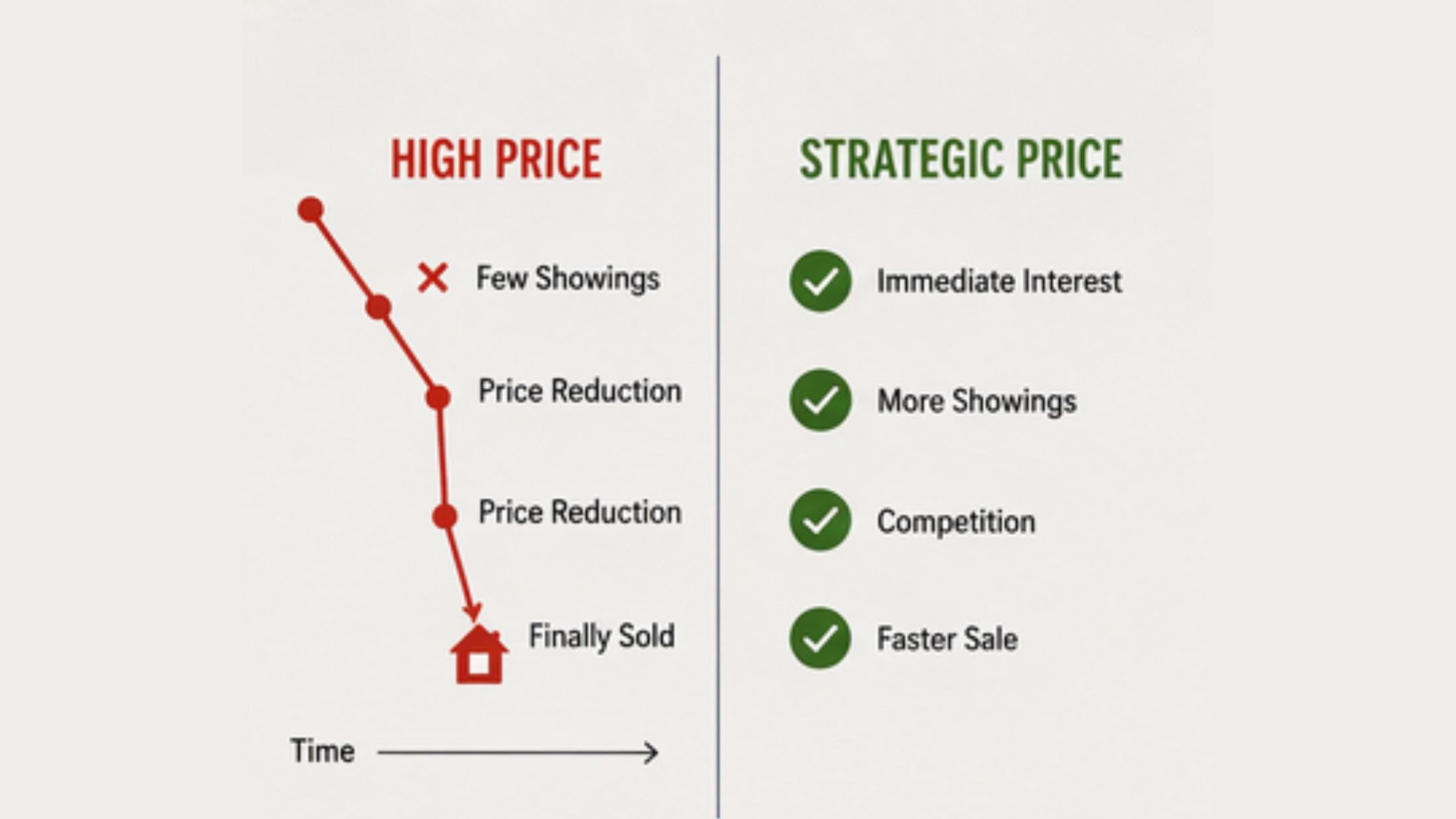
Eventually many sellers reduce their price.
Then reduce it again.
In real estate we often call this chasing the market.
And it's one of the most expensive mistakes a seller can make.
Price Ahead of the Market, Not Behind It
This is why my advice to sellers changes during markets like today's.
If your goal is to sell within the next six months, your pricing strategy matters more than ever.
Rather than testing the market with an optimistic price, it often makes more sense to price sharply from day one.
That doesn't mean giving your home away.
It means recognizing where the market is heading rather than where it has been.
Ironically, pricing slightly below where competing listings sit can actually produce a stronger result.
When buyers recognize value, they show up.
More showings create more interest.
More interest creates competition.
And competition is still the best way to discover true market value.
I've seen many sellers receive a better outcome by pricing strategically than by reducing their price several times over a period of months.
The Economic Picture Adds Some Uncertainty
Real estate doesn't exist in isolation.
Interest rates, inflation, employment, consumer confidence and global economic conditions all influence buyer behaviour.
Today, central banks continue to balance inflation against economic growth. While the Bank of Canada recently held its policy rate steady, it also acknowledged that uncertainty remains high. In the United States, the Federal Reserve also held rates steady, although some policymakers argued that inflation risks could require tighter policy in the future.
No one knows exactly how these factors will affect housing over the next six to twelve months.
But uncertainty alone is often enough to make buyers more selective.
Looking Ahead to the Fall Market
Seasonality matters too.
As we move from late summer into fall, the Squamish market typically becomes less active than the spring market.
There are still successful sales.
There are still motivated buyers.
But the pace often slows.
If that seasonal slowdown overlaps with softer pricing, it can create the impression that nothing is happening.
In reality, transactions are still taking place.
They're just happening at prices that reflect today's market rather than yesterday's expectations.
We may not have a much clearer picture until the spring inventory begins arriving in February, when more sales provide stronger evidence of where the market is heading.
The Opportunity Hidden Inside a Soft Market
Soft markets aren't bad.
They're simply different.
For buyers, they often provide more choice, more negotiating power and less pressure.
For sellers, they reward preparation, realistic expectations and smart pricing.
The sellers who understand the market they're in are usually the ones who achieve the best results.
My Take
The goal isn't to predict the future perfectly.
No one can.
The goal is to recognize the market that's in front of us and adjust accordingly.
If the market strengthens, fantastic.
If it softens a little further, we'll adapt.
That's what good real estate advice should do.
It shouldn't be based on hope.
It should be based on experience, evidence and a willingness to change strategies as the market changes.
Today, I believe that means pricing for tomorrow's market, not yesterday's.
Because in a softening market, the first price is often the most important one you'll ever choose.
 The data relating to real estate on this website comes in part from the MLS® Reciprocity program of either the Greater Vancouver REALTORS® (GVR), the Fraser Valley Real Estate Board (FVREB) or the Chilliwack and District Real Estate Board (CADREB). Real estate listings held by participating real estate firms are marked with the MLS® logo and detailed information about the listing includes the name of the listing agent. This representation is based in whole or part on data generated by either the GVR, the FVREB or the CADREB which assumes no responsibility for its accuracy. The materials contained on this page may not be reproduced without the express written consent of either the GVR, the FVREB or the CADREB.
Comments:
Post Your Comment: