

Flooding is a legitimate concern in Squamish, but not every property faces the same risks. Here's what I think buyers need to understand before making a decision.
One of the questions I get asked about buying real estate in Squamish is whether it's a good idea to purchase a property in a floodplain.
And I think there's a lot of misunderstanding about what that actually means.
The first thing many people don't realize is that a substantial part of Squamish is affected by flood hazards.
We're living in a valley surrounded by mountains, with several major rivers flowing through the area and Howe Sound at the southern end of town.
That's part of what makes Squamish such a beautiful place to live, but it also means flooding is something we have to take seriously.
I've lived in Squamish for approximately 25 years, and I've seen periods when river levels have been extremely high, groundwater has risen, and certain areas have experienced flooding.
But I've also seen how people sometimes misunderstand the different ways flooding can occur.
My view is that buying a house in a Squamish floodplain isn't necessarily a bad decision. What matters is understanding the specific risks associated with that property and deciding whether you're comfortable accepting them.
And to do that, you first need to understand that not all flooding is the same.
Two Different Types of Flooding Buyers Need to Understand
When people think about flooding in Squamish, they often imagine a river overflowing its banks, a dike breaking, and a massive amount of water rushing through the community.
That's certainly one of the potential hazards.
But there's another issue that I think people often overlook.
And that's groundwater.
These are two different ways that water can affect a property, and they can have very different consequences.
1. River Flooding and Dike Failures
Squamish has an extensive system of dikes designed to help protect developed areas from river flooding.
During periods of heavy rainfall, snowmelt or other high-flow conditions, water levels in the rivers can rise significantly.
The concern is that water could overtop a dike, or that a dike could fail, allowing water to enter areas that are normally protected.
Now, I think it's important to understand that a dike breach doesn't automatically mean every property in Squamish is going to experience the same level of flooding.
The consequences depend on where the breach occurs, how much water escapes, how quickly it moves and the elevation and layout of the surrounding land.
Some areas could experience relatively shallow flooding, while others could experience much deeper or faster-moving water.
And that's why the District of Squamish has invested considerable effort in flood modelling, dike improvements and flood hazard planning.
You can't simply look at a map, see that a property is in a floodplain, and assume that every house in that area faces exactly the same risk.
You need to understand the specific location.
2. Rising Groundwater
The second type of flooding is something I've seen firsthand over the years.
And in some parts of Squamish, it can be a very practical concern for homeowners.
When river levels are high and the ground becomes saturated, groundwater levels can also rise.
Groundwater is the water beneath the surface of the land.
In certain conditions, that water can rise close to the surface, fill drainage ditches, saturate lawns and sometimes enter buildings.
You might see water accumulating along the front of a property or in low-lying areas, even though no river has overtopped its dike.
And that's something buyers need to understand.
A property doesn't necessarily have to be directly flooded by a river to experience water-related problems.
In areas such as Brackendale, Dentville, Downtown Squamish and parts of the Garibaldi Estates, groundwater and drainage conditions are worth investigating carefully.
That doesn't mean every property in those neighbourhoods has a groundwater problem.
It means the conditions can vary, sometimes significantly, from one property to another.
Why Older Squamish Homes Can Be More Vulnerable
One thing I pay particular attention to when looking at older houses in Squamish is how the home was originally built.
Some of the older homes were constructed relatively close to the natural ground level.
Others have basements or lower living areas that sit below the surrounding grade.
When groundwater rises, those lower areas can be more vulnerable to water entering the building.
And that's where things like perimeter drainage, foundation waterproofing and sump pumps become particularly important.
A sump pump is designed to remove water that collects in a sump pit, helping keep it away from the building.
But if the pump stops working, loses power or simply can't keep up with the amount of water coming in, you can have a problem.
I've seen how important these systems can be in Squamish.
And I think buyers sometimes focus so much on whether a house is in a designated floodplain that they overlook the practical question of how water is managed around the building itself.
You can have two houses in the same neighbourhood, relatively close together, with very different drainage conditions.
One might have a raised foundation, good grading and an effective drainage system.
The other might have a low basement, aging perimeter drains and a history of water entering the building.
Those are not the same situations.
So when you're buying an older house, I think it's particularly important to understand how the building deals with water.
What I've Seen During 25 Years in Squamish
Over the approximately 25 years I've lived here, I can recall periods when we had very high water levels and genuine concerns about flooding.
I remember one particularly difficult period when groundwater levels were high, drainage systems were under pressure and some areas of Brackendale experienced substantial flooding.
There were streets and properties where water became a serious problem.
What stayed with me from that experience was that flooding isn't always as simple as a river overflowing its banks.
Local drainage conditions, infrastructure and the way land has been developed can all influence where water accumulates.
And that's an important lesson for anyone buying property here.
I don't think it's sensible to assume that because a house has never flooded, it never will.
But I also don't think it's sensible to assume that every property within a flood hazard area is equally vulnerable.
You have to look at the actual property, its surroundings and the information available about its flood risk.
What About the Dikes in Squamish?
The District of Squamish has been studying and managing flood hazards for many years.
In 2017, the District adopted its Integrated Flood Hazard Management Plan.
That plan identified improvements to the existing dike network, upgrades to coastal flood protection and higher protection standards for important sections of the Squamish and Mamquam river dikes.
It also addressed land-use planning and development requirements intended to reduce future flood risks.
That's important because flood protection isn't just about having a dike beside a river.
It's also about how development is designed, how water is managed and how the community prepares for extreme events.
However, I wouldn't suggest that the existence of a dike eliminates the risk.
Dikes reduce certain flood hazards, but they don't make the land behind them completely immune to flooding.
And groundwater, drainage and other hazards can still affect properties.
For buyers, the sensible approach is to understand what protection exists and what risks remain.
Which Squamish Neighbourhoods Have Flood Risk?
This is where I think buyers need to be particularly careful about generalizations.
Squamish has a variety of neighbourhoods with very different elevations, topography and natural hazards.
Low-lying areas near the river systems and Howe Sound can be exposed to river flooding, coastal flooding or groundwater issues.
Higher-elevation areas such as Garibaldi Highlands, University Highlands, parts of Valleycliffe, Crumpit Woods, Hospital Hill and other hillside developments generally have different exposure to river floodplain hazards.
But I wouldn't describe any neighbourhood as completely immune to natural hazards.
Higher-elevation properties can have their own issues, including slope stability, surface runoff and other site-specific concerns.
And even within one neighbourhood, individual properties can have different elevations, drainage systems and flood histories.
So rather than saying that one entire neighbourhood is safe and another isn't, I'd encourage buyers to look at the specific property.
The District has flood hazard mapping and planning information available, and that's an excellent starting point.
For a property where the hazard is a significant concern, it may also be appropriate to consult a qualified engineer or other relevant specialist.
The Cheekeye Fan: A Different Hazard That Buyers Should Know About
There's another natural hazard in Squamish that I think is particularly important to understand.
And that's the Cheekeye Fan, near Brackendale.
This isn't simply a question of groundwater rising or a river overflowing a dike.
The Cheekeye Fan is an area where debris flows have occurred historically.
A debris flow can involve a large amount of water, mud, rocks, trees and other material moving rapidly down a steep channel.
These events can be extremely destructive.
The District of Squamish has studied the Cheekeye Fan extensively because of the potential consequences for existing and proposed development.
There has also been substantial work on a major debris-flow mitigation barrier intended to reduce the hazard.
The District's October 2026 project update identifies the Cheekeye barrier as one of its major infrastructure projects.
I think this is something buyers should understand if they're considering property in an area affected by the Cheekeye Fan hazard.
It's a different type of risk from the flooding people normally picture when they think about Squamish.
And it's important to review the actual hazard mapping and available technical information rather than relying on general assumptions about which areas might be affected.
For me, the key point is that Squamish has several different natural hazards, and they need to be understood individually.
Does Being in a Floodplain Affect Property Values?
Naturally, buyers also want to know whether being in a floodplain will affect the value of a home.
And the answer is that it can.
If buyers are concerned about flood risk, insurance availability, drainage problems or future building restrictions, those concerns may influence what they're prepared to pay.
But I don't think you can put a single discount on every property that's located within a floodplain.
A well-maintained home with a raised foundation, good drainage and no known history of water intrusion may be viewed very differently from a house with a low basement and recurring water problems.
Location, property condition, flood history, available insurance and the cost of managing the risk all matter.
And of course, the overall real estate market matters too.
If there are several similar properties available, buyers may prefer the one with fewer apparent concerns.
If a particular home offers something that's difficult to find elsewhere, buyers may be more willing to investigate and accept certain risks.
Ultimately, it's about understanding what you're buying and whether the asking price reflects the property's characteristics.
What Should You Check Before Buying a House in a Squamish Floodplain?
If I were helping somebody purchase a home in an area affected by flood hazards, there are several things I'd want them to understand before they made a final decision.
First, identify the actual hazard.
Is the property exposed to river flooding, coastal flooding, groundwater problems, debris flows or some combination of those?
Those are different situations, and they shouldn't be treated as though they're interchangeable.
Second, look at the property's elevation and construction.
Is the home raised above the surrounding ground? Does it have a basement? Are there lower living areas that might be vulnerable to water?
For properties with potential flood exposure, buyers should also investigate any applicable flood construction levels, registered covenants and building restrictions.
Third, investigate drainage and water intrusion.
Are there sump pumps? Has the perimeter drainage been maintained? Has water ever entered the basement or crawl space?
I would want to review the seller's disclosures and any available records, while recognizing that the absence of a reported problem isn't proof that one has never occurred.
Fourth, confirm insurance before removing subjects.
Don't assume that every type of flooding is covered by a standard home insurance policy.
Overland flooding, sewer backup and groundwater-related damage can be treated differently by insurers, and coverage can vary by policy and location.
Buyers should speak directly with an insurance professional and confirm what coverage is available, what it costs and what exclusions or deductibles apply.
Fifth, understand the emergency and evacuation considerations.
If you're purchasing in a hazard area, it's worth knowing how warnings are issued, whether evacuation routes could be affected and what preparations would be appropriate for the household.
Finally, decide whether you're comfortable with the risk.
That's really what it comes down to.
Every property has risks of one kind or another.
The important thing is to understand them before you commit to the purchase.
So, Should You Buy a House in a Squamish Floodplain?
My answer is that I wouldn't automatically rule out a property simply because it's in a floodplain.
A significant part of Squamish is affected by one or more flood hazards, and people have been living in these neighbourhoods for many years.
But that doesn't mean we should ignore the risks.
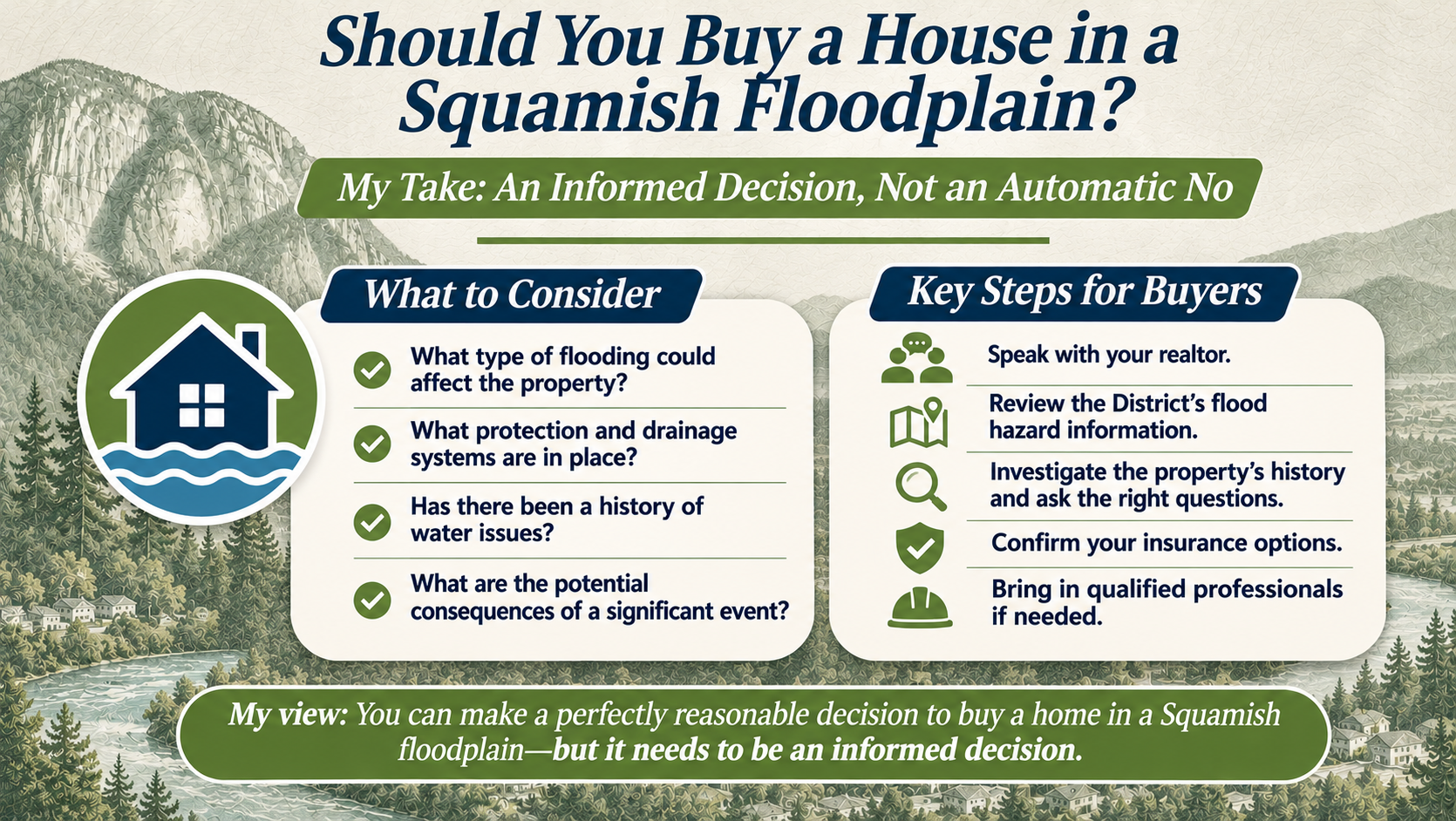
You need to understand what type of flooding could affect the property, what protection and drainage systems are in place, whether there have been previous problems and what the consequences could be if a significant event occurs.
You also need to be comfortable with the possibility that a serious flood could happen, even if it hasn't happened during the time you've owned the home.
And if you don't understand the risk, that's the time to get more information.
Speak with your realtor. Review the District's flood hazard information. Ask questions about the property's history. Bring in qualified professionals where necessary, and make sure you've investigated your insurance options.
I think you can make a perfectly reasonable decision to purchase a home in a Squamish floodplain. But it needs to be an informed decision.
Understand the risks, take the appropriate precautions and make sure you're prepared to deal with the consequences if something does happen.
That's the way I'd approach buying property in Squamish.
Simon Hudson
Team Hudson | Macdonald Realty
Squamish, British Columbia
This article provides general real estate information and local observations, not a property-specific flood hazard assessment. Flood risk, insurance coverage and development requirements should be confirmed with the appropriate qualified professionals and authorities.
 The data relating to real estate on this website comes in part from the MLS® Reciprocity program of either the Greater Vancouver REALTORS® (GVR), the Fraser Valley Real Estate Board (FVREB) or the Chilliwack and District Real Estate Board (CADREB). Real estate listings held by participating real estate firms are marked with the MLS® logo and detailed information about the listing includes the name of the listing agent. This representation is based in whole or part on data generated by either the GVR, the FVREB or the CADREB which assumes no responsibility for its accuracy. The materials contained on this page may not be reproduced without the express written consent of either the GVR, the FVREB or the CADREB.
Comments:
Post Your Comment: