

One of the questions buyers ask when looking at older homes in Squamish is whether they're better off buying something that's already been renovated or purchasing a property that needs work and renovating it themselves.
It's a good question, and the answer is very dependent on the market you're buying in.
Right now, I would generally lean toward buying a property that's already been renovated, provided the renovation is good quality and suits what you're looking for.
That's not because renovating is necessarily a bad idea. It's because of the relationship between property values and construction costs in the current Squamish market.
When property prices aren't increasing significantly, but the cost of doing renovations continues to rise, it becomes increasingly difficult to recover the money you spend on improvements through an increase in the property's market value.
But that's only one part of the equation. There are some very good reasons to buy a property that needs work, particularly if you're planning to live there for a long time or want something very specific.
So rather than simply deciding that renovated homes are better than fixer-uppers, I think we need to look at what you're trying to accomplish.
Why Buying an Already-Renovated Home May Be Better Value Right Now
In a rising real estate market, buyers can sometimes justify taking on significant renovations because property values are increasing while they're doing the work. By the time the renovation is finished, the market may have moved enough to help absorb some of the cost.
But that's not the market we're experiencing in Squamish at the moment.
Prices have been relatively stable or under some downward pressure, while the cost of construction and renovations remains high. Materials, labour and the various expenses associated with renovation projects can add up very quickly.
The result is that somebody might spend a substantial amount renovating their property without seeing an equivalent increase in what the property would sell for.
For example, imagine you're looking at two similar houses in the same Squamish neighbourhood. One has already been renovated, and the other needs a new kitchen, bathrooms, flooring and a considerable amount of additional work.
The unrenovated property is obviously going to be cheaper. But the important question is whether the difference in purchase price is enough to cover the renovations.
If the renovated house costs $150,000 more, but it would cost you $200,000 to bring the other house up to a similar standard, buying the renovated property may be the better financial decision.
And that's before considering the time, inconvenience and potential surprises associated with doing the work yourself.
Those figures are just an illustration, but the principle is important.
The market doesn't necessarily increase the value of a property by the amount somebody spends renovating it.
That's why I think buyers need to be particularly careful about assuming that purchasing a fixer-upper is automatically a way to build equity.
The Problem With Buying Somebody Else's Renovation
Of course, there's another side to this.
When you buy an already-renovated home, you're buying somebody else's decisions.
They chose the kitchen layout, the cabinets, the countertops, the flooring, the bathrooms and all the other finishes. They decided where to spend money and where to save it.
And those choices might not be the choices you would have made.
Maybe the kitchen looks beautiful, but you don't particularly like how it's laid out. Maybe the bathrooms have been renovated with finishes that aren't to your taste. Perhaps they've spent a lot of money on features that aren't especially important to you while overlooking things you would have prioritized.
There's also the question of quality.
Just because a renovation looks good doesn't necessarily mean it was done well. You still need to understand the workmanship, materials and whether appropriate permits and inspections were obtained for work that required them.
So although an already-renovated property might represent better financial value, that doesn't automatically make it the better home for you.
If you're going to live in the property for a long time, having a home that works properly for your lifestyle can be more important than simply getting the best apparent deal.
And that's where buying something to renovate can become very attractive.
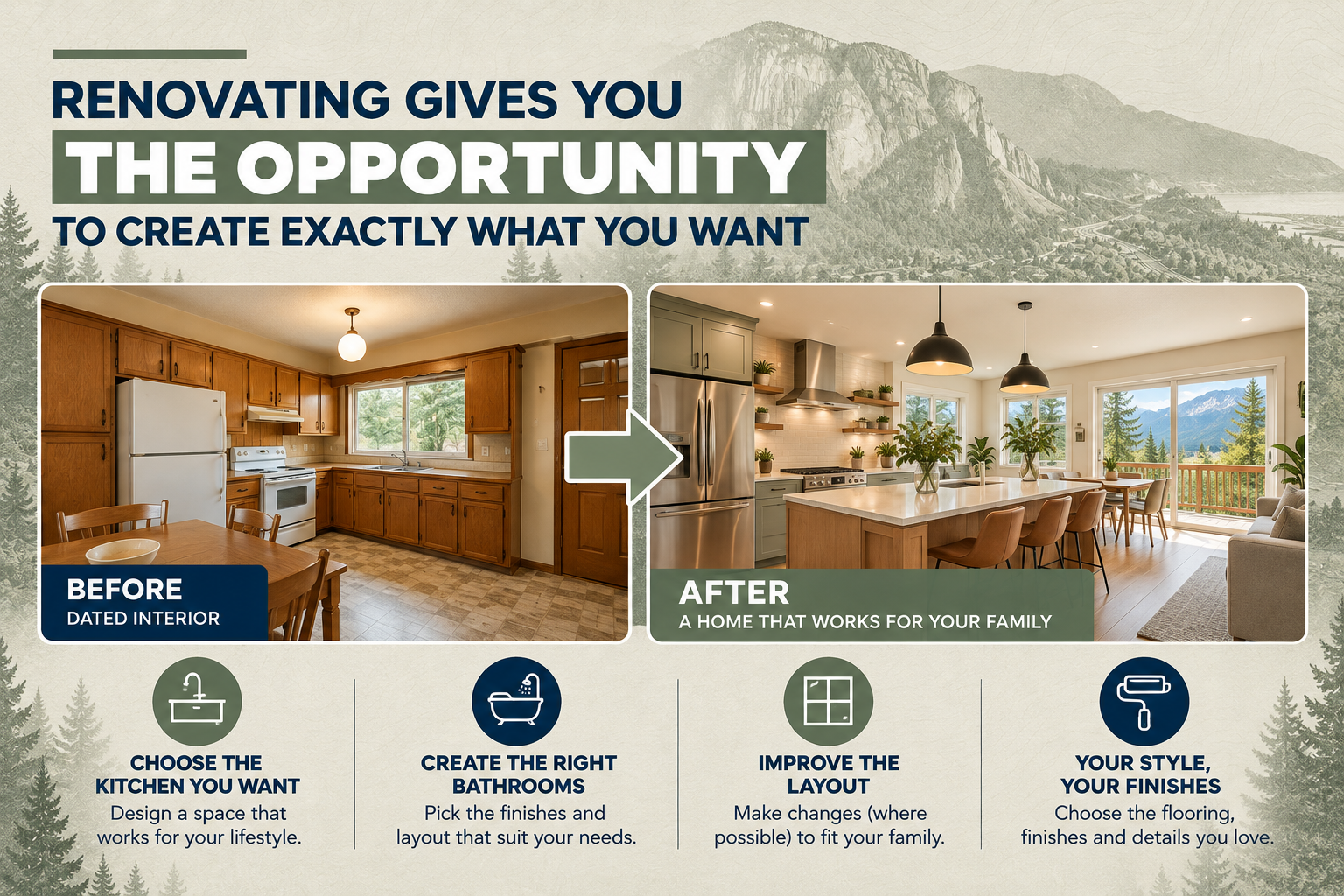
Renovating Gives You the Opportunity to Create Exactly What You Want
One of the biggest advantages of buying an unrenovated property is that you get to make the decisions.
You can choose the kitchen you want, the bathroom layouts, the flooring and the finishes. Depending on the property and what's structurally and legally possible, you may also be able to change the layout to make it work better for your family.
That's a significant benefit, particularly if you plan on staying in the home for many years.
Let's say you find an older house in Brackendale or Valleycliffe that has a great lot, good sunlight and a location you really like, but the interior is dated.
If the basic structure and layout work for you, that could be an excellent opportunity.
You might decide that you don't particularly care whether the renovation costs a little more than the immediate increase in market value because you're creating a home you intend to enjoy for the next 15 or 20 years.
And I think that's a perfectly reasonable way to look at it.
Not every dollar spent on your home needs to be justified by how much it increases the resale price.
Sometimes you're spending money because you want a better kitchen, a more comfortable bathroom or a layout that works properly for your family.
Those improvements have value to you even if the market doesn't recognize every dollar you spend.
The important thing is understanding the distinction between money you're spending to improve your quality of life and money you're expecting to recover when you sell.
How Long Do You Plan on Owning the Property?
I think this is one of the most important questions to ask before taking on a major renovation.
Are you buying a home that you expect to live in for the next 20 years? Or are you planning to renovate it and sell it in two or three years?
Those are completely different situations.
If you're buying what you consider your forever home, then the economics of the renovation become less critical in some respects. You still need to make sure you can afford the work, but you have many years to enjoy the improvements.
If you spend money creating exactly the kitchen you've always wanted and use it every day for the next 15 years, there's a benefit to that expenditure beyond the property's eventual resale value.
But if your intention is to renovate the property and sell it relatively quickly, then the numbers become much more important.
You need to know what you're paying for the property, what the renovation is realistically going to cost, what the finished property is likely to sell for and whether there's enough room between those numbers to justify the project.
You also need to allow for the unexpected expenses that tend to come with renovation work.
In a market where prices aren't rising significantly, there's less room for error.
A renovation that looks profitable on paper can become much less attractive if construction costs exceed the budget or the finished property doesn't achieve the resale price you expected.
There's a Big Difference Between a Livable Fixer-Upper and a Major Renovation Project
Another factor I think buyers should consider is the condition of the property when they purchase it.
There's a substantial difference between buying a home that's dated but perfectly livable and buying something that requires a major renovation before you can comfortably move in.
If the property is in reasonable condition, you may have the opportunity to renovate it gradually.
Perhaps you move in and live with the existing kitchen for a year or two. Then you renovate the kitchen when you've saved enough money or have a clearer idea of exactly what you want.
A couple of years later, you tackle the bathrooms. Maybe the flooring comes after that.
This approach can work particularly well for people who are comfortable doing some of the work themselves or who don't mind living with an older interior while they make improvements over time.
It also gives you an opportunity to learn how the house actually functions before making expensive decisions.
Sometimes you think you know exactly what you want to change when you first buy a property, but after living there for six months, you discover that your priorities are different.
The downside is that you may be living with ongoing projects for years, and that's not something everybody enjoys.
But financially and practically, a livable home that can be improved gradually is very different from a property that needs everything done immediately.
What If the House Needs a Complete Renovation?
This is where I think buyers need to be much more analytical.
If a property is in such poor condition that it needs a major renovation before it's really usable, I want to understand the entire cost of the project before deciding whether it's a good purchase.
That means starting with the price of the unrenovated property and developing a realistic budget for all the work required.
Not just the new kitchen and bathrooms, but potentially electrical, plumbing, insulation, windows, heating systems, structural repairs and anything else that needs attention.
Depending on the scope of the work, you may also need professional design services, permits, engineering and contingency funds for unexpected problems.
And if you can't live in the property during the renovation, you need to account for the cost of living somewhere else.
Once we have a reasonable estimate of the total cost, we can compare that with what the property is likely to be worth when the work is completed.
That's the comparison I want to make.
If you're going to spend $1 million purchasing a property and another $300,000 renovating it, we need to consider whether the finished property is likely to be worth $1.3 million, substantially more or substantially less.
And if it would only be worth $1.2 million when finished, then you need to understand that you're potentially spending more than the market currently recognizes.
That doesn't necessarily mean you shouldn't buy it. You might still decide it's the right property because of the location, the lot or the opportunity to create exactly what you want.
But at least you're making that decision with a clear understanding of the economics.
Don't Underestimate the Inconvenience of Renovating
This is another part of the equation that I think people sometimes overlook.
Renovations are inconvenient.
If you're replacing the kitchen, you may be without a functioning kitchen for a period of time. If you're renovating bathrooms, you need to think about whether you'll have another bathroom available while the work is being done.
There may be dust, noise, tradespeople coming and going, materials being delivered and areas of the house that you simply can't use.
And renovations don't always run exactly to schedule.
A project that you expected to take six weeks might take longer because of unexpected repairs, material availability or scheduling issues.
If you have young children, work from home or have a particularly busy lifestyle, that inconvenience can be significant.
Some people are perfectly comfortable with it. They enjoy the process, they're happy to live through the disruption, and they like seeing the property gradually become what they envisioned.
Other people would much rather pay more for a finished home, move in and get on with their lives.
Neither approach is wrong.
But the time and inconvenience of doing the work should be part of the decision, not something you discover after you've already committed to the purchase.
Doing the Work Yourself Changes the Numbers
There's another major variable in this conversation, and that's whether you're planning to do the renovations yourself or hire contractors to complete everything.
If you have the skills, experience and time to do some of the work yourself, your renovation costs can be very different from those of somebody who needs to hire professionals for every part of the project.
That can create opportunities.
A property that doesn't make financial sense for somebody paying full contractor rates might be much more attractive to a buyer who can competently complete a substantial portion of the work themselves.
Of course, your time still has value, and certain work requires appropriately qualified professionals and permits. Doing it yourself doesn't eliminate those considerations.
But it certainly changes the calculation.
That's another reason why I don't think you can give everybody the same answer about whether to buy renovated or unrenovated.
Two buyers could purchase exactly the same property and have completely different renovation costs based on their skills, available time and the people they have access to.
What Would I Recommend to a Buyer in Squamish Right Now?
In the current market, if you're looking at two comparable properties and one has already been renovated to a good standard, I think there's a reasonable chance the renovated property will represent better financial value than purchasing the unrenovated one and paying to have all the work completed.
That's particularly true if the unrenovated property requires substantial work and you're planning to hire contractors to do it.
But I wouldn't automatically rule out a fixer-upper.
If the property has a great location, a good lot and the potential to become exactly what you're looking for, it could be a very good purchase.
If it's livable and you can renovate gradually, that gives you flexibility. If you can do some of the work yourself, the economics may become more attractive. And if you're planning to live there for a long time, the personal value of creating your ideal home can be substantial.
On the other hand, if you're planning to renovate and sell relatively quickly, I would be much more cautious. In a relatively flat market, you can't simply assume that the money you spend on renovations will come back to you when you sell.
You need to understand the numbers before committing to the project.
The Bottom Line: Compare the Finished Result, Not Just the Purchase Prices
So, should you buy a renovated home in Squamish or purchase something that needs work?
My general preference in today's market would be to look carefully at already-renovated properties first, because the cost of completing a major renovation can exceed the additional value the market places on the finished home.
But the decision depends on much more than that.
You need to consider how well the existing renovation suits your taste, the quality of the work, whether you can do some renovations yourself, how much disruption you're prepared to live with and how long you intend to own the property.
Most importantly, you need to compare the total cost of purchasing and renovating a property with what an equivalent finished home would actually cost.
A fixer-upper isn't necessarily a bargain just because it's cheaper, and an already-renovated home isn't necessarily overpriced just because somebody else has done the work.
The goal is to understand what you're paying for, what you're getting and whether the property makes sense for the way you intend to use it.
That's how I'd approach the decision when buying a home in Squamish.
 The data relating to real estate on this website comes in part from the MLS® Reciprocity program of either the Greater Vancouver REALTORS® (GVR), the Fraser Valley Real Estate Board (FVREB) or the Chilliwack and District Real Estate Board (CADREB). Real estate listings held by participating real estate firms are marked with the MLS® logo and detailed information about the listing includes the name of the listing agent. This representation is based in whole or part on data generated by either the GVR, the FVREB or the CADREB which assumes no responsibility for its accuracy. The materials contained on this page may not be reproduced without the express written consent of either the GVR, the FVREB or the CADREB.
Comments:
Post Your Comment: