

When you’re buying a condo or townhouse in Squamish, the strata documents can be some of the most important information you receive.
The problem is that buyers often get hundreds of pages at once.
Meeting minutes.
AGM minutes.
Special general meeting records.
Financial statements.
Budgets.
Bylaws.
Rules.
A depreciation report.
Insurance information.
And if you don’t spend much time around stratas, it can be difficult to know what you’re actually looking for.
For me, the documents are trying to answer two big questions:
What am I buying financially and legally?
And:
What might it actually be like to live in this strata?
That second question gets overlooked surprisingly often.
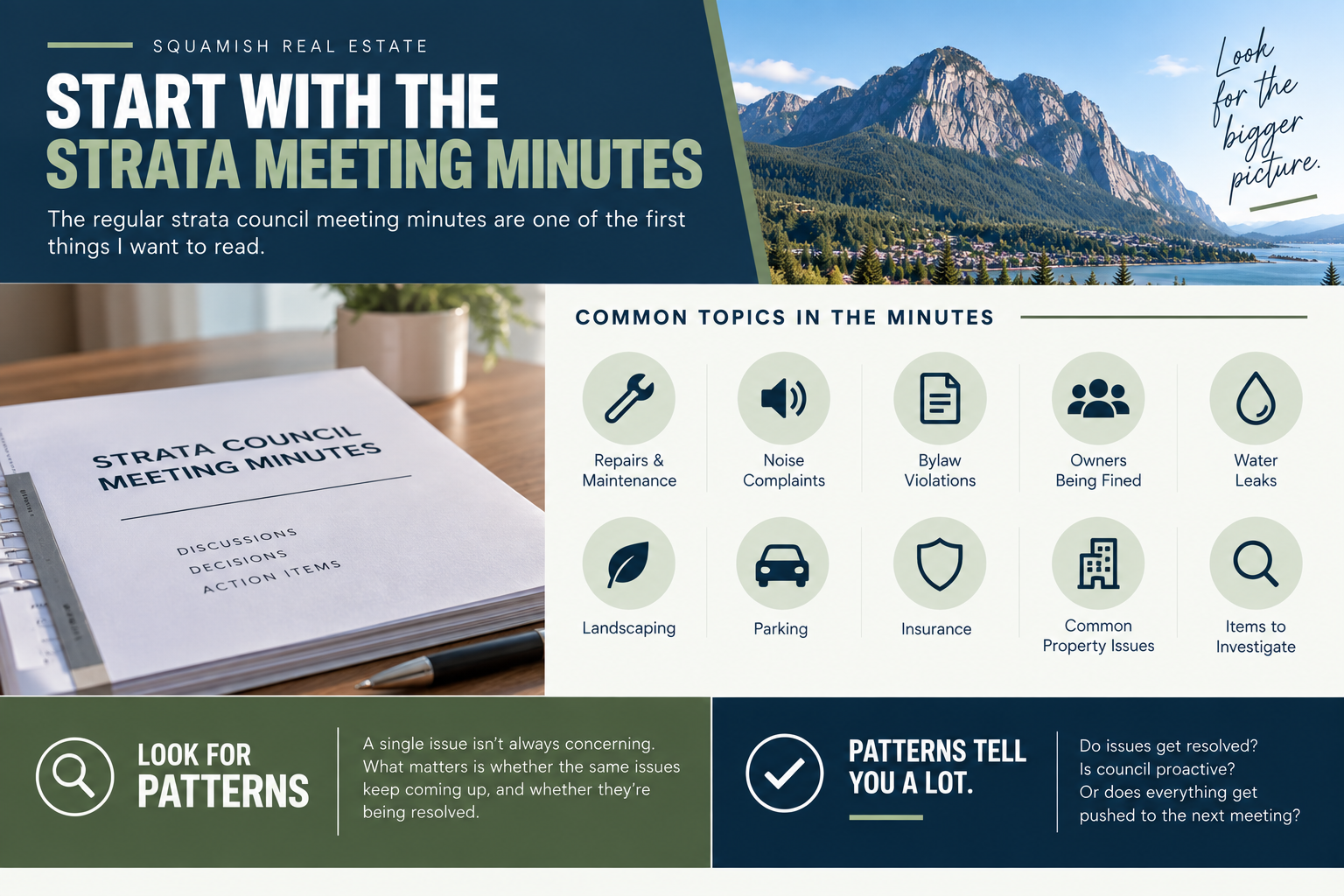
Start With the Strata Meeting Minutes
The regular strata council meeting minutes are one of the first things I want to read.
These meetings may happen monthly, every couple of months or on another schedule depending on the strata.
This is where the strata council and property manager deal with the ongoing business of the complex.
You may see discussions about repairs.
Maintenance.
Noise complaints.
Bylaw violations.
Owners being fined.
Water leaks.
Landscaping.
Parking.
Insurance.
Problems with common property.
Or decisions about something the strata needs to investigate further.
A single issue isn’t necessarily concerning.
What I’m looking for is patterns.
Does the same leak appear in the minutes over and over again?
Does a maintenance issue keep getting discussed without being resolved?
Is one owner repeatedly creating problems?
Are there constant noise complaints?
Does council seem proactive when something happens, or does everything get pushed to the next meeting?
Those patterns can tell you a lot.

AGM Minutes Show You the Bigger Decisions
Then I want to look at the Annual General Meeting minutes.
The AGM is where owners deal with some of the larger decisions affecting the strata.
That includes things such as budgets, elections to strata council, bylaw changes and significant expenditures that require owner approval.
Special General Meetings can also be called when an important issue needs to be dealt with before the next AGM.
Those meetings can be particularly revealing because there’s usually a reason the strata didn’t want to wait.
Maybe a major repair came up.
Maybe there’s a proposed special levy.
Maybe owners need to vote on an important change.
The regular council minutes show you the day-to-day operation.
The AGM and Special General Meeting records often help show you the larger financial and governance decisions.
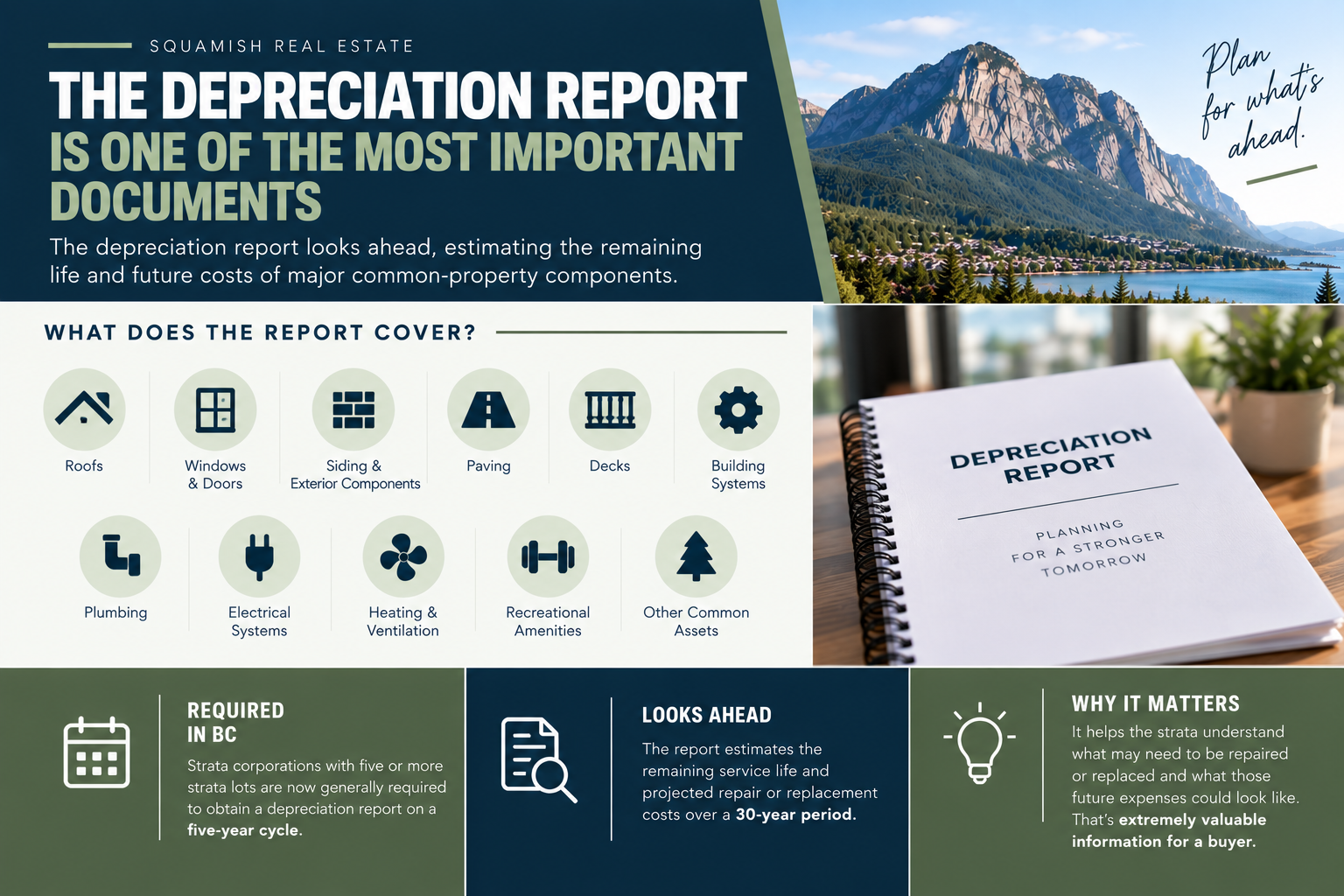
The Depreciation Report Is One of the Most Important Documents
Then there’s the depreciation report.
This deserves its own article because there’s a lot to understand, but at a basic level, the depreciation report looks ahead.
In BC, strata corporations with five or more strata lots are now generally required to obtain a depreciation report on a five-year cycle. The report looks at major common-property components and estimates their remaining service life and projected repair or replacement costs over a 30-year period.
That can include things such as:
roofs;
windows and doors;
siding and exterior components;
paving;
decks;
building systems;
plumbing;
electrical systems;
heating and ventilation;
recreational amenities;
and other common assets.
The report is supposed to help the strata understand what may need to be repaired or replaced and what those future expenses could look like.
That’s extremely valuable information for a buyer.
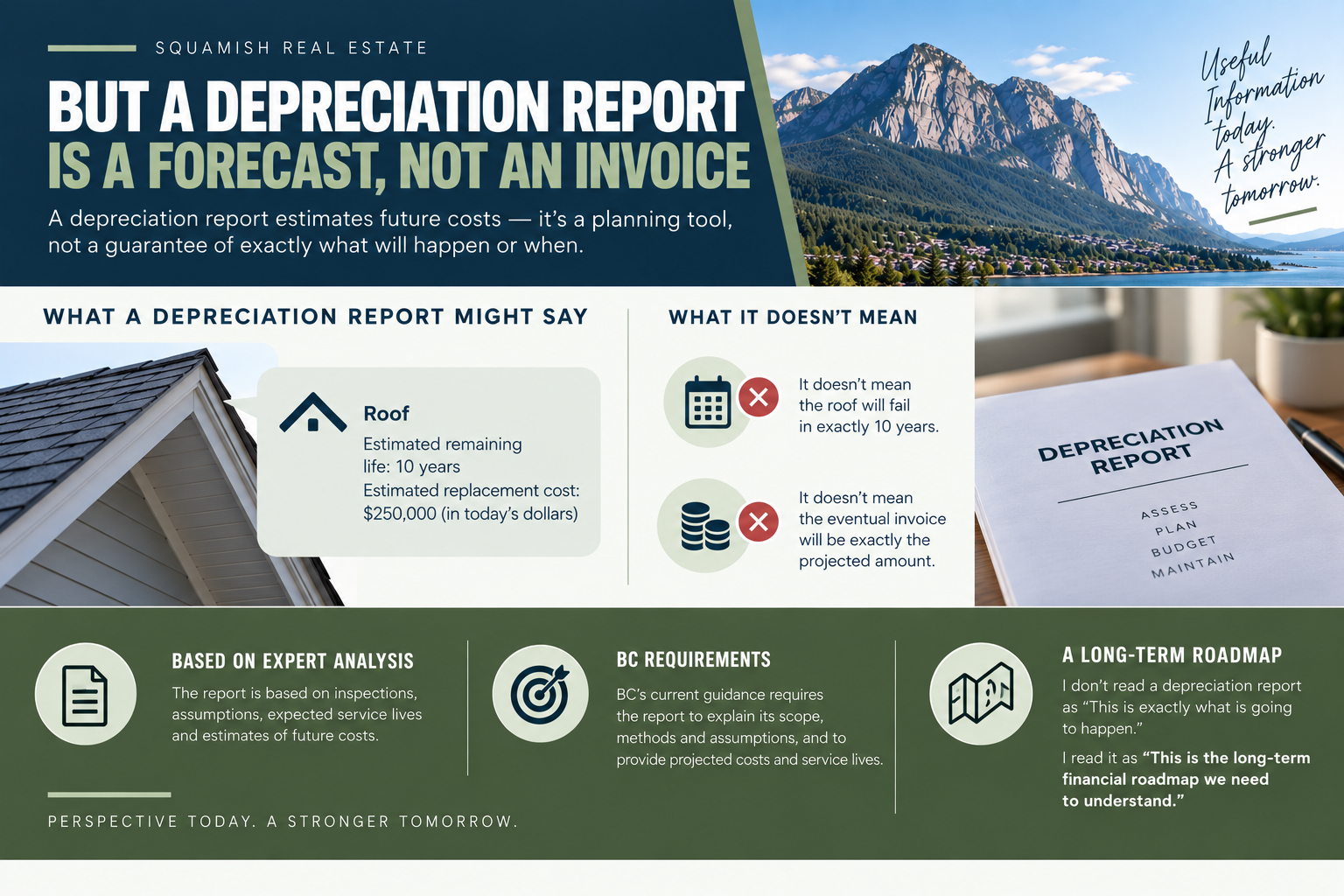
But a Depreciation Report Is a Forecast, Not an Invoice
This is where I think buyers need to keep some perspective.
A depreciation report may say a roof has an estimated remaining life of ten years and project what replacing it could cost at that time.
That doesn’t mean the roof will fail exactly ten years from now.
And it doesn’t mean the eventual invoice will exactly match the projection.
The report is based on inspections, assumptions, expected service lives and estimates of future costs. BC’s current guidance specifically requires the report to explain its scope, methods and assumptions, and to provide projected costs and service lives.
So I don’t read a depreciation report as:
“This is exactly what is going to happen.”
I read it as:
“This is the long-term financial roadmap we need to understand.”
That’s a very different way of looking at it.
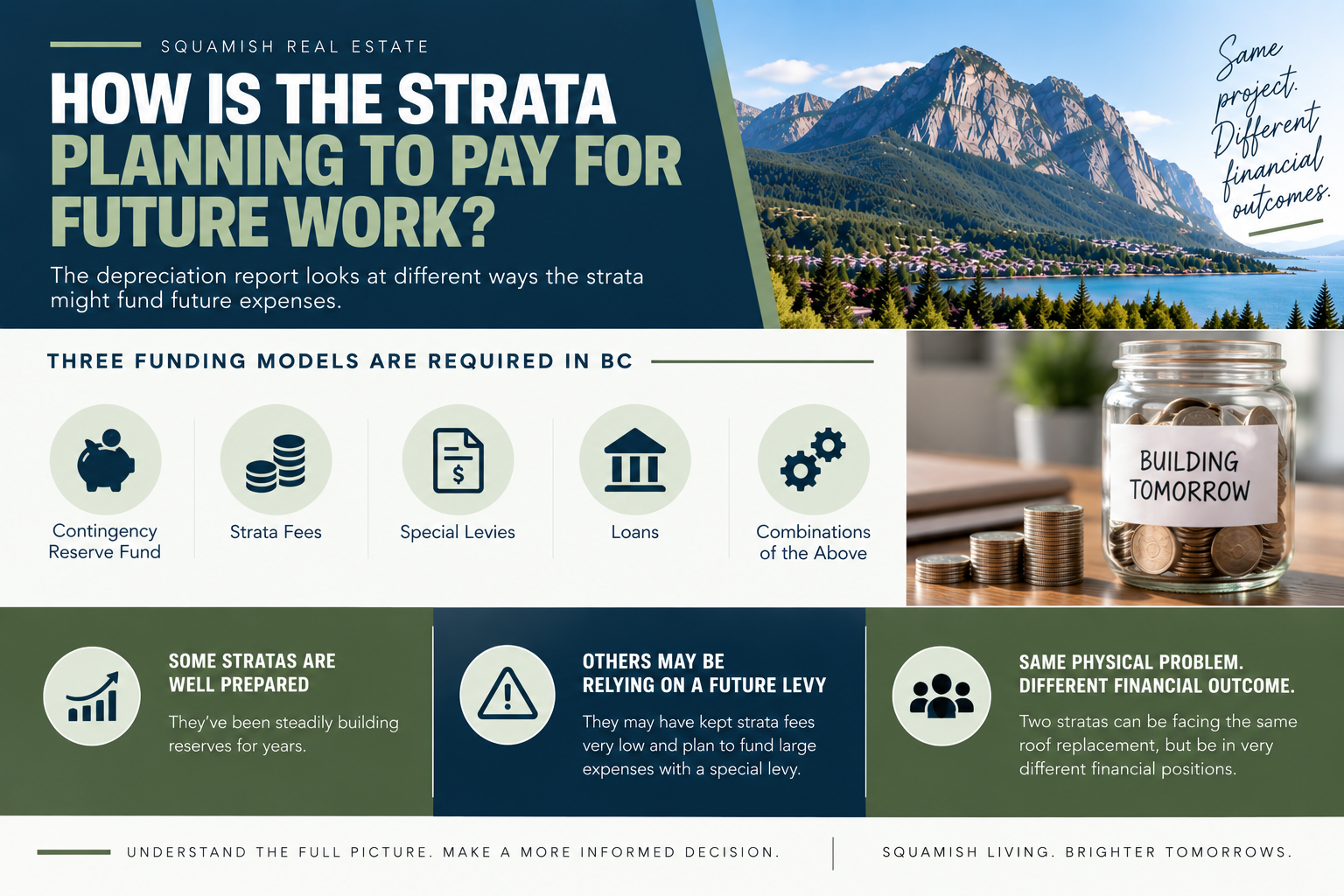
How Is the Strata Planning to Pay for Future Work?
The depreciation report doesn’t just identify future expenses.
It also considers different ways the strata might fund them.
BC’s current requirements call for three funding models to be presented, which may involve the contingency reserve fund, strata fees, special levies, loans or combinations of those approaches.
That matters because two strata corporations can be facing the same future roof replacement and be in completely different financial positions.
One may have been steadily building reserves for years.
Another may have kept strata fees very low and be relying on a future special levy.
The physical problem may be identical.
The financial experience for the owner may not be.
That’s why I don’t just look at the projected expense.
I want to understand how prepared the strata is for it.
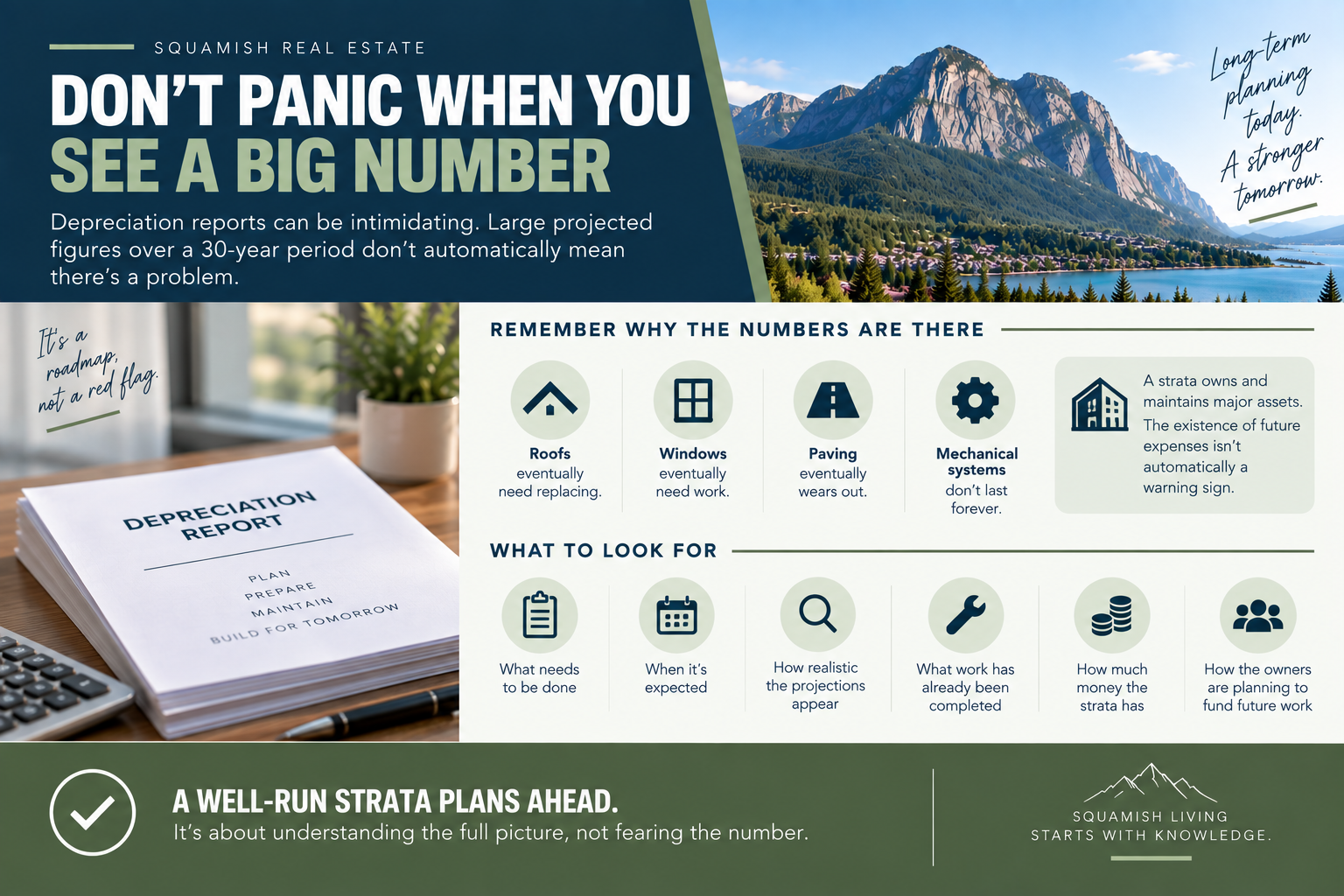
Don’t Panic When You See a Big Number
Depreciation reports can be intimidating.
You might see very large projected figures over a 30-year period and think:
“This building is going to cost a fortune.”
Remember what you’re looking at.
A strata owns and maintains major assets.
Roofs eventually need replacing.
Windows eventually need work.
Paving eventually wears out.
Mechanical systems don’t last forever.
The existence of future expenses isn’t automatically a warning sign.
What matters more is:
what needs to be done;
when it’s expected;
how realistic the projections appear;
what work has already been completed;
how much money the strata has;
and how the owners are planning to fund future work.
A well-run strata should be planning for those expenses rather than pretending they won’t happen.

Read the Bylaws Before You Fall in Love With the Property
The financial documents matter, but so do the bylaws and rules.
Because these answer a very practical question:
Can you actually live here the way you intend to?
Pets are a great example.
Suppose you have two large dogs.
You buy the unit, move in and then discover that the strata’s bylaws don’t permit what you thought they did.
That’s not a small issue.
The same applies to smoking restrictions, parking rules, use of common areas and other lifestyle requirements.
Buyers should understand the rules that will apply to them before they remove conditions.
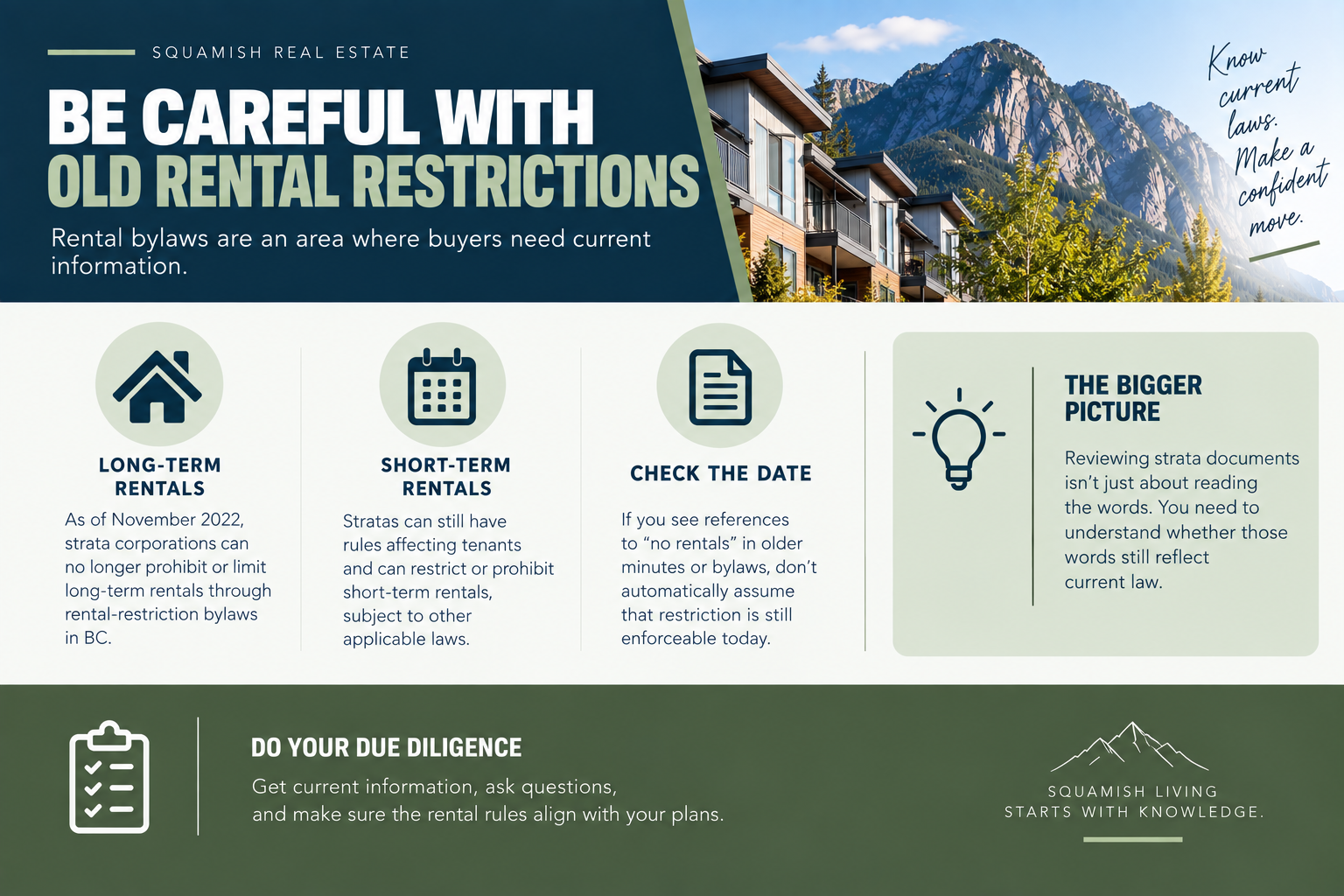
Be Careful With Old Rental Restrictions
Rental bylaws are an area where buyers need current information.
BC changed the law in November 2022 so strata corporations can no longer prohibit or limit long-term rentals through rental-restriction bylaws. Stratas can still have rules affecting tenants and can restrict or prohibit short-term rentals, subject to other applicable laws.
So if you’re reading older strata minutes or older bylaws and see references to “no rentals,” don’t automatically assume that restriction is still enforceable today.
That’s a perfect example of why reviewing strata documents isn’t just about reading the words.
You need to understand whether those words still reflect current law.

The Minutes Can Tell You What the Neighbours Are Like
This is one of the things I think buyers underestimate most.
If you read enough strata meeting minutes, you start getting a sense of the community.
Is there somebody who appears in almost every set of minutes because of noise complaints?
Does council spend an enormous amount of time fighting with owners?
Are the same disputes coming up again and again?
Does council seem reasonable?
Do they try to solve problems?
Are owners generally working together?
I’ve lived in more than one strata myself over the years, and I’ve experienced both sides of this.
I’ve lived in a strata that was poorly managed and where problems became unnecessarily difficult.
I’ve also lived in one where the council was proactive, engaged and reasonable.
The difference in day-to-day quality of life was significant.
That’s something you can’t necessarily see when you’re standing in the kitchen during a showing.
But you may be able to see hints of it in the minutes.
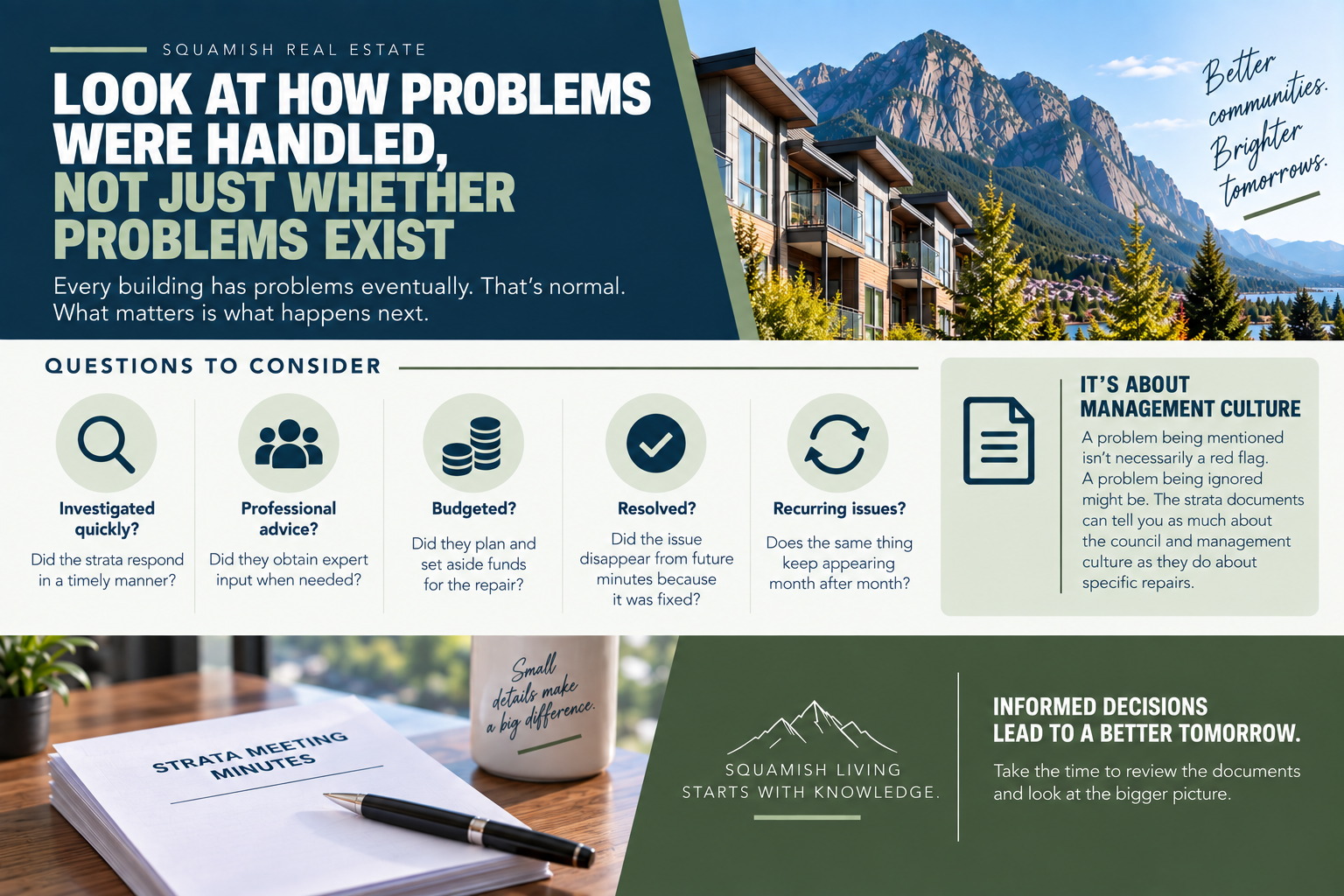
Look at How Problems Were Handled, Not Just Whether Problems Exist
Every building has problems eventually.
That’s normal.
A roof leaks.
A pipe fails.
Someone complains about noise.
A maintenance issue comes up.
What interests me is what happens next.
Did the strata investigate quickly?
Did they obtain professional advice?
Did they budget for the repair?
Did the issue disappear from future minutes because it was resolved?
Or does the same thing keep appearing month after month?
A problem being mentioned isn’t necessarily a red flag.
A problem being ignored might be.
That’s why I think the documents tell you as much about management culture as they do about specific repairs.
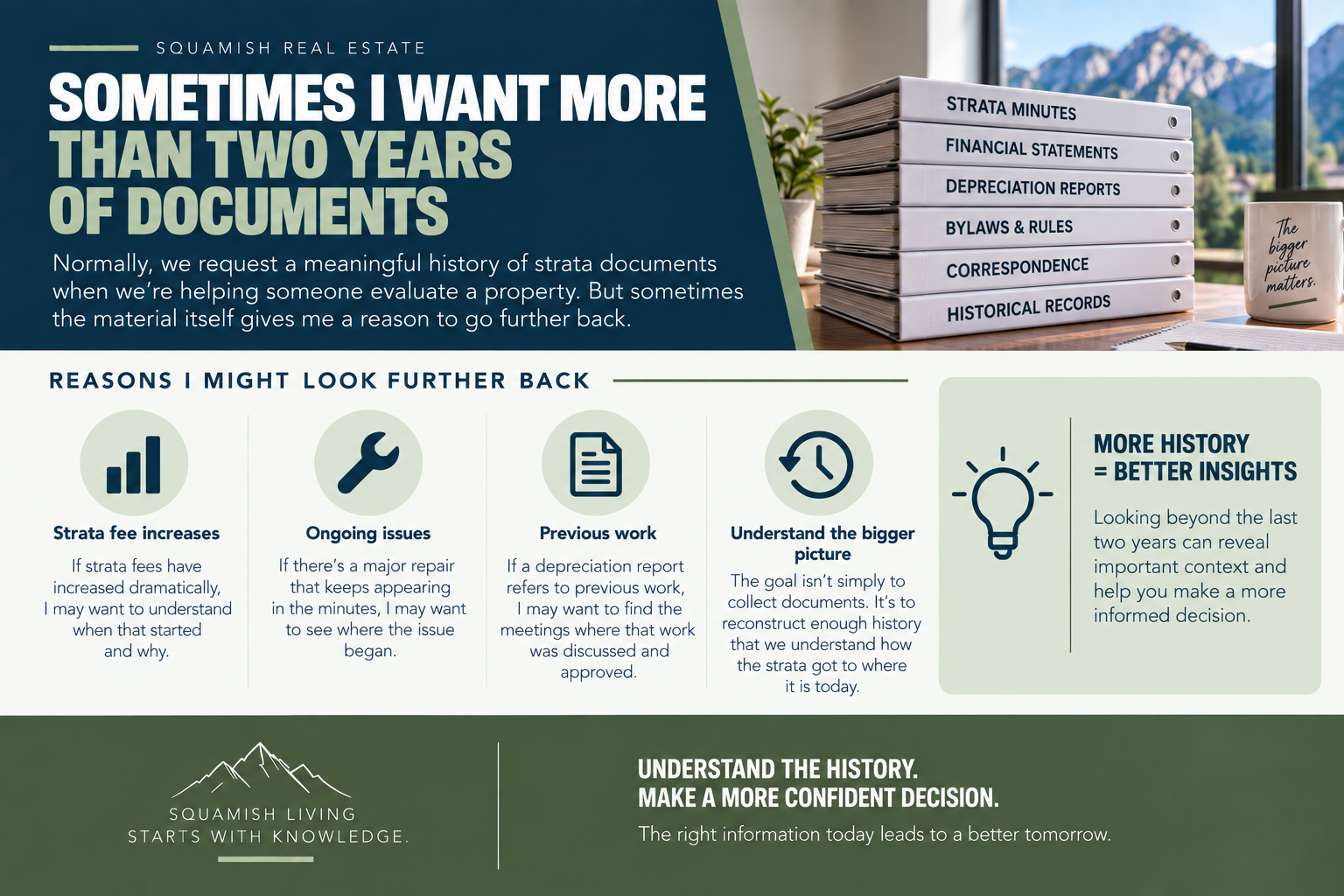
Sometimes I Want More Than Two Years of Documents
Normally, we’re going to request a meaningful history of strata documents when we’re helping somebody evaluate a property.
But sometimes the material itself gives me a reason to go further back.
If strata fees have increased dramatically, for example, I may want to understand when that started and why.
If there’s a major repair that keeps appearing in the minutes, I may want to see where the issue began.
If a depreciation report refers to previous work, I may want to find the meetings where that work was discussed and approved.
The goal isn’t simply to collect documents.
It’s to reconstruct enough history that we understand how the strata got to where it is today.
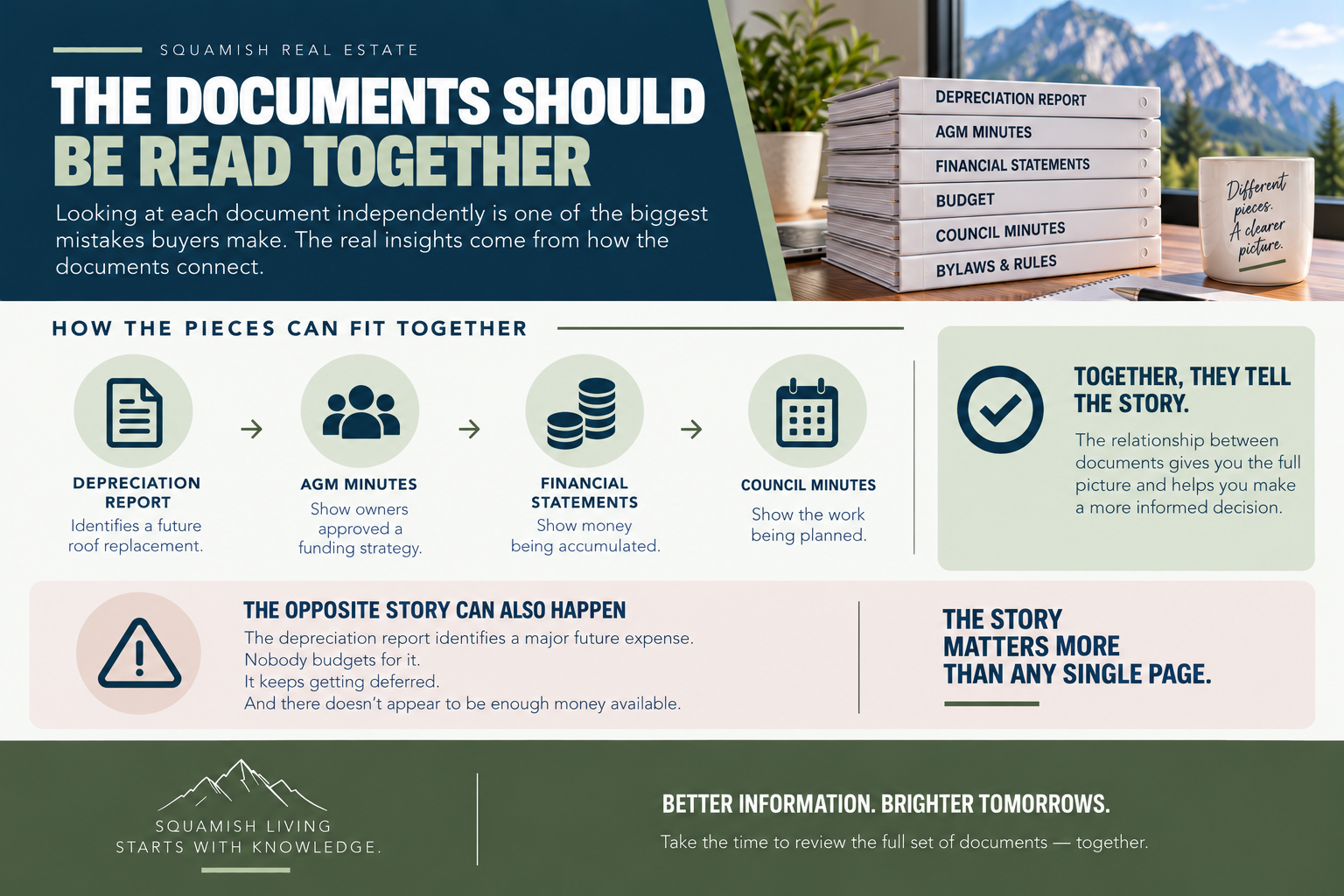
The Documents Should Be Read Together
This is probably one of the biggest mistakes buyers make.
They look at each document independently.
The depreciation report says something.
The AGM says something.
The budget says something else.
But often the useful information is in the relationship between them.
For example:
The depreciation report says a roof will need replacement.
Then you read the AGM minutes and discover owners approved a funding strategy.
Then the financial statements show money being accumulated.
Then later council minutes show the work being planned.
That tells you a very different story from:
The depreciation report identifies a major future expense.
Nobody budgets for it.
It keeps getting deferred.
And there doesn’t appear to be enough money available.
The story matters more than any single page.
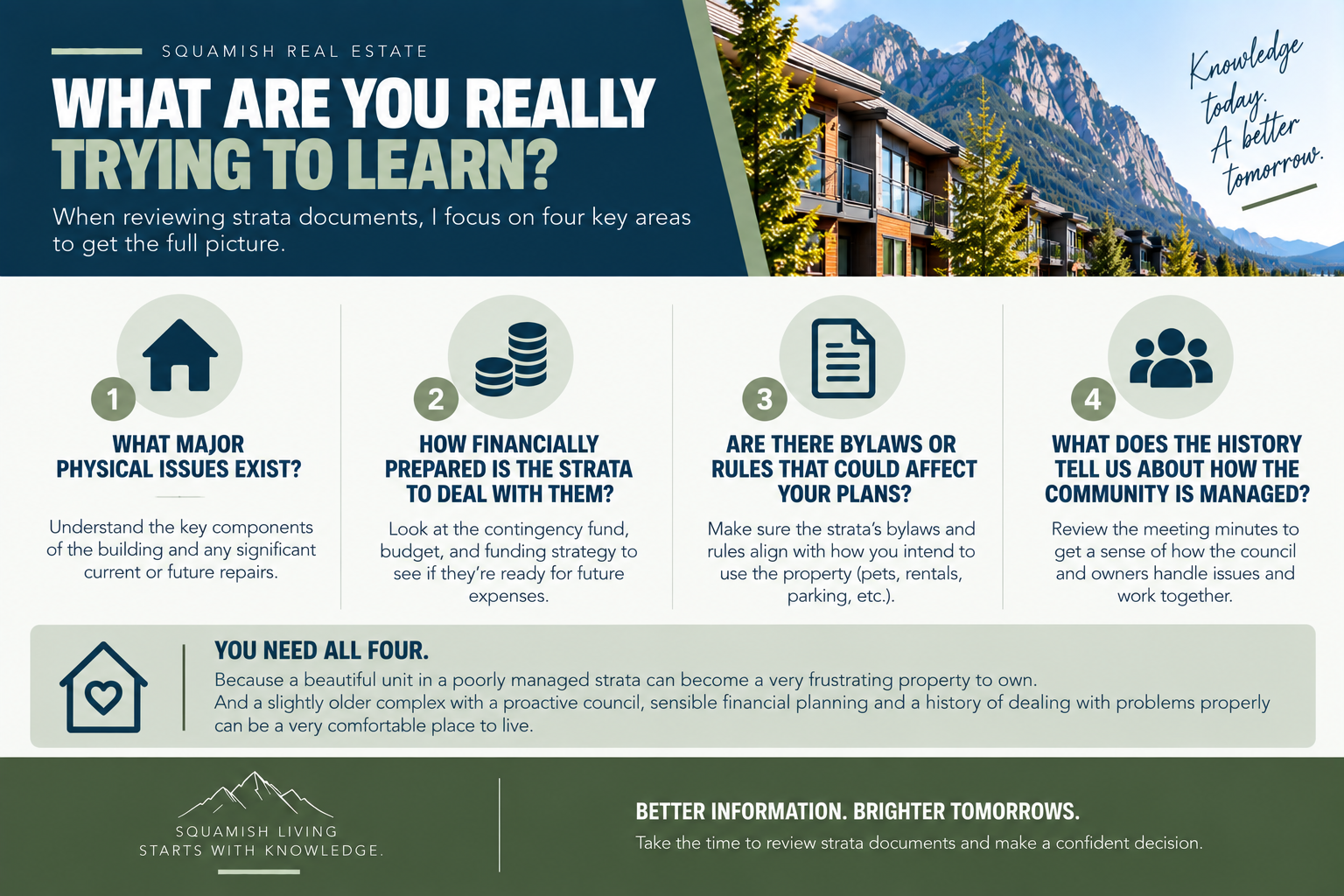
What Are You Really Trying to Learn?
When I’m reviewing strata documents with a buyer, I’m essentially trying to understand four things.
First: What major physical issues exist?
Second: How financially prepared is the strata to deal with them?
Third: Are there bylaws or rules that could materially affect how the buyer intends to use the property?
Fourth: What does the history of the strata tell us about how the community is managed?
You need all four.
Because a beautiful unit in a poorly managed strata can become a very frustrating property to own.
And a slightly older complex with a proactive council, sensible financial planning and a history of dealing with problems properly can be a very comfortable place to live.
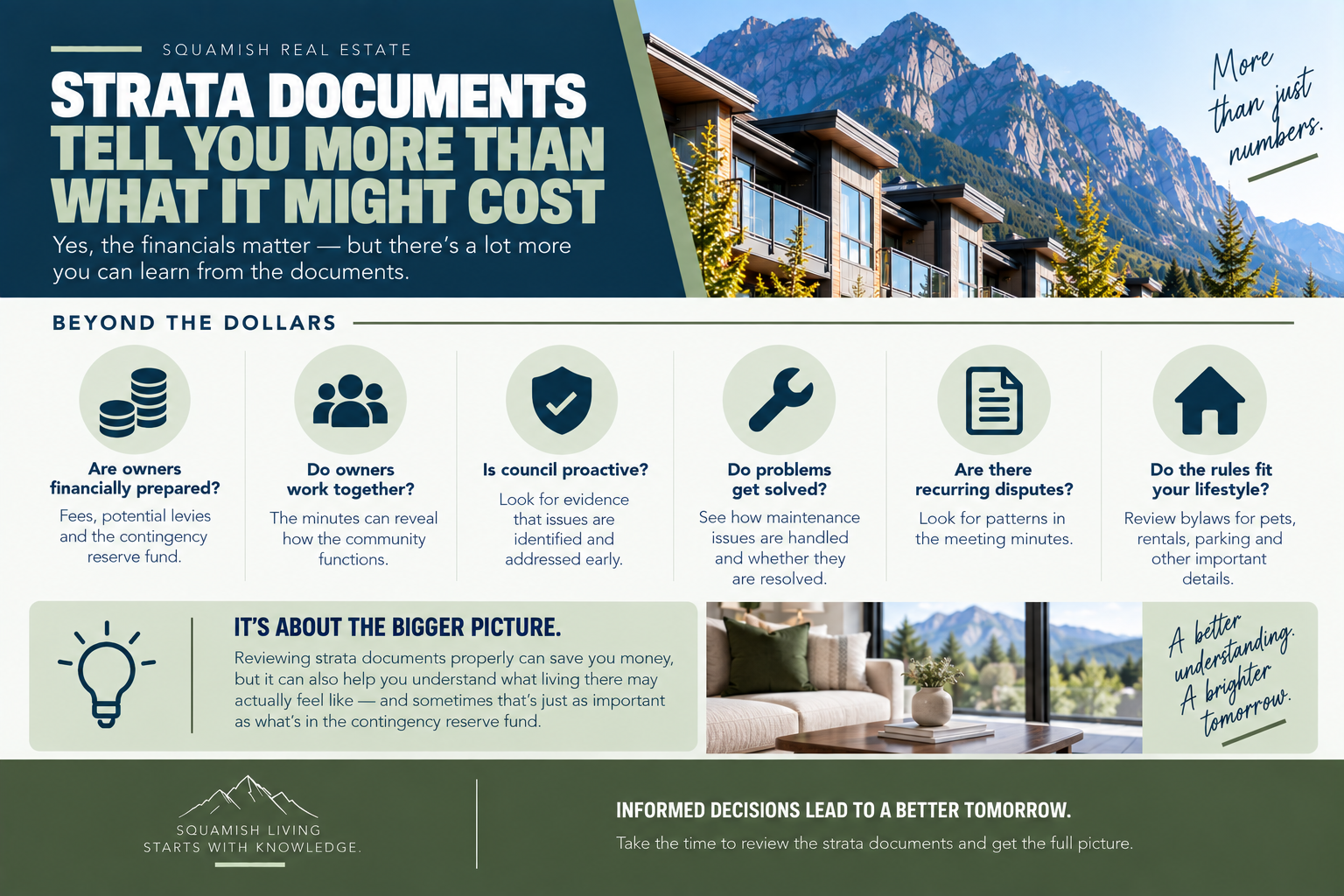
Strata Documents Tell You More Than What It Might Cost
Most buyers naturally focus on money.
Is there a special levy coming?
Are the strata fees going up?
Does the contingency reserve fund have enough money?
Those questions matter enormously.
But I wouldn’t stop there.
The strata documents may also tell you whether owners work together.
Whether council is proactive.
Whether problems get solved.
Whether there are recurring disputes.
Whether the rules fit the way you want to live.
And whether you’re buying into a community that appears organized and reasonably well managed.
That’s why reviewing the documents properly can potentially save you money.
But it can also do something else:
It can help you understand what living there may actually feel like.
And sometimes that’s every bit as important as what’s sitting in the contingency reserve fund.
 The data relating to real estate on this website comes in part from the MLS® Reciprocity program of either the Greater Vancouver REALTORS® (GVR), the Fraser Valley Real Estate Board (FVREB) or the Chilliwack and District Real Estate Board (CADREB). Real estate listings held by participating real estate firms are marked with the MLS® logo and detailed information about the listing includes the name of the listing agent. This representation is based in whole or part on data generated by either the GVR, the FVREB or the CADREB which assumes no responsibility for its accuracy. The materials contained on this page may not be reproduced without the express written consent of either the GVR, the FVREB or the CADREB.
Comments:
Post Your Comment: