

When buyers are looking at properties, I think there's a natural tendency to overpay for aesthetics and underpay for location and functionality. And when I say location, I'm not necessarily talking about whether one Squamish neighbourhood is better than another. I'm talking about the actual position and orientation of the property, how much sunlight it gets, what surrounds it, what might eventually be built around it, where the roads are going to go, and what that property is likely to feel like five or ten years from now.
The irony is that these are often the things that ultimately matter most to people, but they're not necessarily the things that impress them when they first walk through the front door. A bright, shiny new kitchen, beautiful floors and freshly painted walls are immediately noticeable. They make a home look fantastic during a showing, and buyers can become emotionally attached to them very quickly. But a kitchen gets used. Floors get scratched. Paint gets marked. By the time you eventually sell the property, those beautiful new finishes you paid a premium for may no longer look new at all.
That's one of the reasons sellers often do some cosmetic work before putting a property on the market. Fresh paint, attractive flooring, good staging and other relatively simple improvements can make a property feel considerably better during a showing. They can absolutely help sell a home. But buyers need to understand the difference between something that makes a property look better today and something that fundamentally makes it a better property.
Pay Attention to the Things You Can't Easily Change
If I'm helping somebody evaluate a home, I'm much more interested in the things that are difficult or impossible to change. You can replace a kitchen. You can change the floors. You can repaint the walls. You can't easily change which direction the property faces, where the windows are, what's next door, how much sunlight reaches the home or where the property sits within a development.
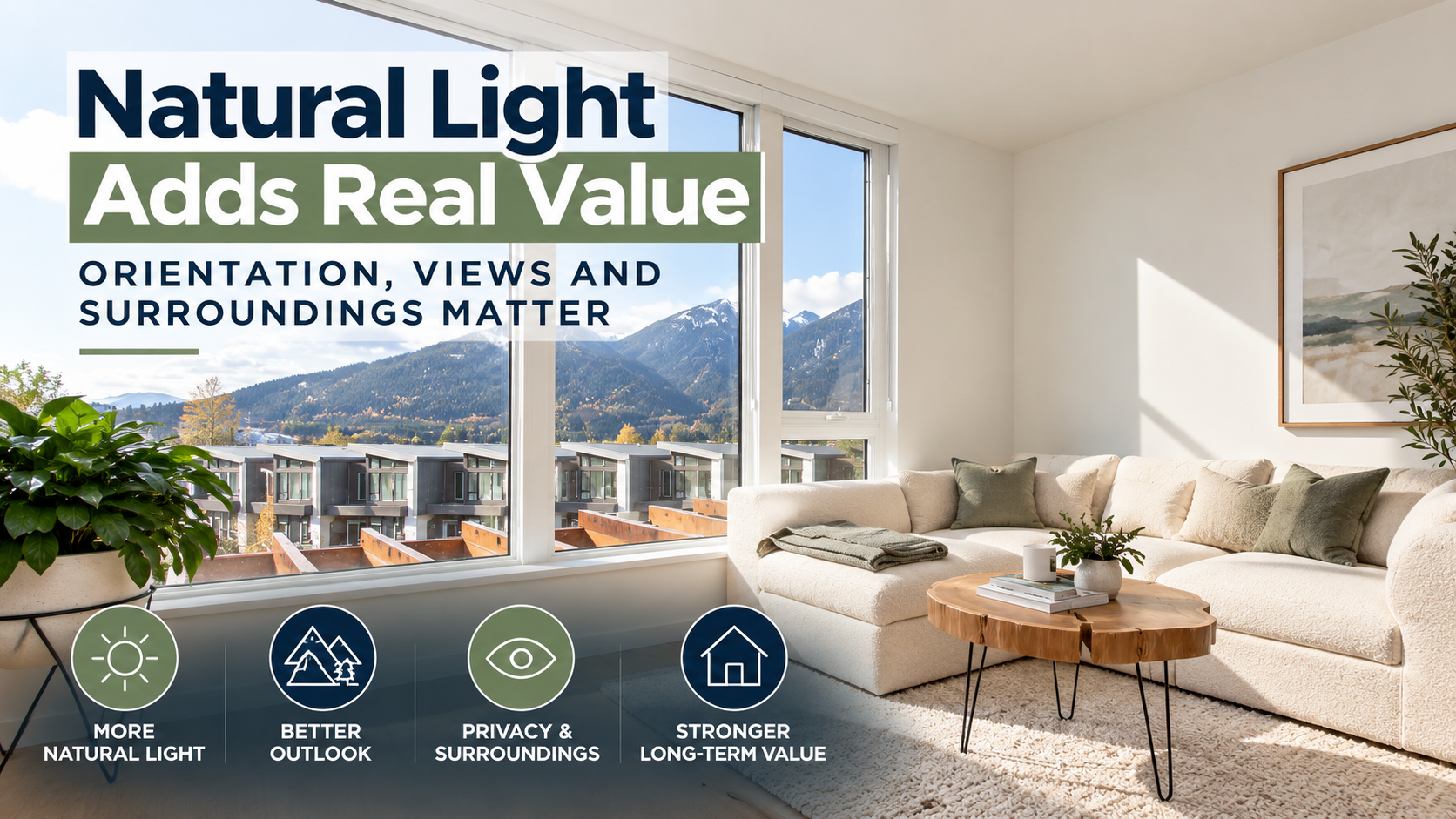
Natural light is a good example. Two properties can have very similar floor plans and square footage, but one can feel substantially better because of its orientation and the amount of light it receives. Even then, you need to think beyond what you're seeing during the showing. Are there large trees that block the low winter sun? Is there undeveloped land nearby? Could another building eventually be constructed between you and the light or view you're enjoying today?
That's why I think buyers should spend less time asking only what a property looks like now and more time asking what it's likely to look and feel like in the future.
The View You're Buying Today May Not Be the View You Have Tomorrow
This is particularly important in a growing community like Squamish. There is a lot of development taking place, especially in and around Downtown, and buyers need to understand that an open outlook today doesn't necessarily mean an open outlook forever.
You can walk into a condo and think it has a fantastic view, lots of natural light and a wonderful feeling of openness. But if there is vacant or underdeveloped land across the street, you need to understand what could eventually happen there. Maybe another building is proposed or permitted. Maybe something will eventually be built that changes the outlook. The important issue isn't necessarily just losing the view. A new building can also change how much light reaches the unit, how private it feels and the entire experience of living there.
Sea and Sky is another example where buyers need to understand the broader development plan rather than judging an individual townhouse only by what surrounds it today. The community is still evolving, so the relationship between particular homes, future buildings, views and sunlight needs to be considered in the context of what is ultimately planned. I'm not saying that makes a property good or bad. I'm saying you need to know what you're actually buying.
This is why I think a good Realtor should be talking about more than what you can see standing in the living room. If there's known or proposed development nearby, that should become part of the conversation about the property.
Trees Change Too
Buildings aren't the only thing that can change a view. Trees grow.
We've seen this in parts of the Garibaldi Highlands. There are properties that historically had beautiful views toward Howe Sound, but over many years trees on lower properties grew taller. Gradually, those trees began entering the view, and in some cases a property that once had a much clearer outlook no longer has the same view it had years earlier.
That's a difficult thing for buyers to quantify because when you're standing in a house looking at an incredible view, you're naturally thinking about what you're seeing right now. You're not necessarily imagining what those trees will look like in another 10 or 15 years.
But that's exactly the type of question you should be asking. What can change around this property that I don't control?
Think About Where Squamish Is Going
The same principle applies beyond views and sunlight. You need to think about where the community itself is going.
What amenities might eventually be built nearby? Is a currently quiet road likely to remain quiet? Could it become a more important route as surrounding areas develop? Is there undeveloped land behind the property? What is it zoned for, and what might eventually happen there?
Sometimes those changes can improve a location. New shops, services, parks, schools or transportation connections can make an area more convenient. Other changes can increase traffic, reduce privacy or change an outlook.
None of us can perfectly predict what Squamish will look like ten years from now. Plans change and developments change. But there's a big difference between trying to predict the future and simply ignoring information that's already available.
Sometimes It's Okay to Pay for Something That Won't Last Forever
There's an important nuance here because I don't want buyers to become so focused on future resale that they forget they're buying somewhere to live.
Let's say you're considering a property that backs onto undeveloped land, but you know that land will probably be developed eventually. You may get ten years of peace, privacy and an open outlook before anything happens.
Then development starts.
Maybe the property becomes less private. Maybe when you eventually sell it, a future buyer isn't prepared to pay as much as they would have when there was nothing behind it.
Does that mean you made a bad purchase?
Not necessarily.
You got ten years of enjoyment from something that had real value to you. In a sense, part of the premium you paid was the cost of having that experience while you owned the home.
I think that's perfectly reasonable as long as you understood the trade-off when you bought it. The problem is when someone pays a premium because they believe the open space, view or privacy is permanent when it isn't.
Buyers Also Underpay for How They're Actually Going to Live
There's another side of this that I think buyers overlook in a big way, and that's the simple functionality of a home.
Take a townhouse with underground parking compared with a townhouse with its own attached garage. A buyer who has previously lived in a condo might say that underground parking doesn't bother them at all. They've done it before, so what's the difference?
But think about how you actually live.
With underground parking, you park the car, get your things out, walk through the parkade, enter the building or townhouse access, and then potentially go up another set of stairs before you're actually in your living space. Now do that with groceries. Do it with children. Do it when it's raining. Do it twice a day for years.
Compare that with pulling directly into your own garage, closing the door and walking straight into your home.
During a showing, that difference may not seem particularly exciting. After you've lived there for five years, it can become extremely important.
In Squamish, a Garage Isn't Just Somewhere to Put the Car
This becomes even more significant in Squamish because of how people live here.
If you're a mountain biker, imagine finishing a ride covered in mud and riding directly home. If you have your own garage, you can put the bike away, store your equipment and deal with everything relatively easily. If you don't have a garage, maybe the bike has to go into a shared bike room. Maybe there's another storage arrangement. In some properties, you may end up bringing equipment into your actual living space.
Then add skis, snowboards, camping equipment, climbing gear, paddleboards, tools and everything else people accumulate when they live the Squamish lifestyle.
Suddenly, the garage isn't simply a box where you park your vehicle. It's part of how the home functions.
That's something buyers can dramatically undervalue because storage isn't particularly impressive during a showing. A new kitchen is exciting. A place to put three muddy bikes isn't.
But which one are you going to appreciate more on a wet November afternoon?
Pay for the Things You'll Use Every Day
This is really where I think buyers need to change the way they evaluate properties. Don't just ask what impresses you when you walk through the door. Ask what you're going to interact with every single day.
Where do you park?
Where do the bikes go?
How do you carry groceries into the kitchen?
How many flights of stairs are you going to climb?
Where do you put your skis?
Does the living room get sunlight in December, or only when you're viewing the property in June?
Can people see directly into your home?
What's outside your windows?
What will probably be outside those windows ten years from now?
Those things don't necessarily photograph as well as quartz countertops, but they can have a much bigger effect on how much you enjoy owning the property.
So What Is Actually Worth Paying a Premium For?
I don't think there's one feature that's worth the same amount to every buyer. A garage may be incredibly important to one person and almost irrelevant to somebody else. A view might be worth a substantial premium to one buyer, while another person would rather have a larger yard. That's why I don't think the answer is simply to create a checklist and say a garage is worth this much and a south-facing backyard is worth that much.
Instead, I would divide the property into things you can change and things you can't, and then think very carefully about the things you're going to experience every day.
A dated kitchen can be replaced. Ugly flooring can be changed. Paint is easy.
Orientation is difficult to change. Natural light is difficult to change. The relationship with neighbouring properties is difficult to change. Your route from the car into the house is difficult to change. A lack of storage can be difficult to solve. Future development happening outside your property is completely outside your control.
That doesn't mean you shouldn't pay for a beautiful renovation. If you love the kitchen and don't want to spend the next two years renovating, there's real value in that. But understand what you're paying for.
Don't Just Buy the Property You See Today
When I look at a property with a buyer, I don't just want them thinking about how it looks during the 30 or 45 minutes we're inside it. I want them thinking about how they're actually going to live there and what the property could become over the years they own it.
What happens when the trees grow?
What happens when the neighbouring site is developed?
What happens if the road gets busier?
Where are you going to put all your stuff?
What's it like coming home every day?
Where does the winter sun come from?
And which of the things you're paying a premium for today will still matter to you five or ten years from now?
I think buyers often overpay for what impresses them during the showing and underpay for what will affect them every day after they move in.
So if you've got another $50,000 or $100,000 available in your Squamish buying budget, I wouldn't automatically spend it on the property with the nicest kitchen or the shiniest floors. I'd first look at the things that can't easily be changed, the things that affect how you're actually going to live, and the things that are likely to remain valuable to you long after the new-home shine has worn off.
Don't just ask what this home looks like today. Ask what it's going to feel like to live here in ten years.
 The data relating to real estate on this website comes in part from the MLS® Reciprocity program of either the Greater Vancouver REALTORS® (GVR), the Fraser Valley Real Estate Board (FVREB) or the Chilliwack and District Real Estate Board (CADREB). Real estate listings held by participating real estate firms are marked with the MLS® logo and detailed information about the listing includes the name of the listing agent. This representation is based in whole or part on data generated by either the GVR, the FVREB or the CADREB which assumes no responsibility for its accuracy. The materials contained on this page may not be reproduced without the express written consent of either the GVR, the FVREB or the CADREB.
Comments:
Post Your Comment: