

If I had to describe the Squamish real estate market right now in one word, I'd call it soft.
Buyers have more control. Inventory is relatively high. Properties are taking longer to sell. And probably the biggest challenge I'm seeing isn't simply a lack of buyers—it's a fairly significant gap between what sellers expect to receive and what buyers believe they should pay.
That can make this feel like a frustrating market.
But I don't think that necessarily makes it a bad market.
It's a market that has to be navigated carefully.

The Biggest Problem Is the Gap Between Buyers and Sellers
I'm seeing sellers who still expect their properties to achieve prices based on what they were worth in a stronger market.
At the same time, some buyers recognize that conditions have softened and go too far in the opposite direction. They assume that because buyers have negotiating power, they should be making offers substantially below asking price.
Then nothing happens.
The seller thinks the buyer's offer is unreasonable.
The buyer thinks the seller hasn't accepted that the market has changed.
And the two sides never get close enough to put a deal together.
But when you have a reasonable buyer and a seller who understands where the market is today, we're still putting deals together.
That's an important distinction.
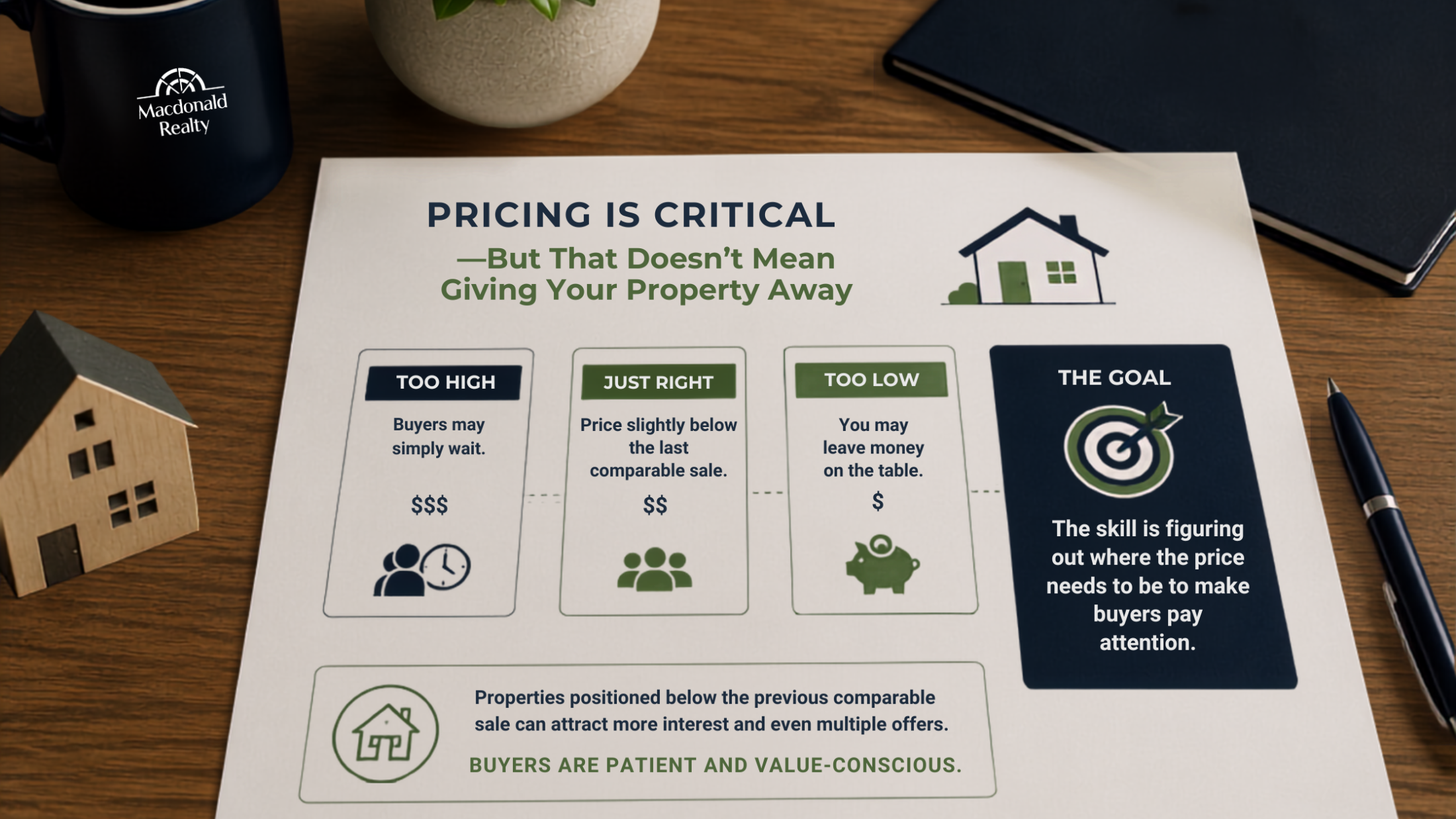
Pricing Is Critical—But That Doesn't Mean Giving Your Property Away
I've talked recently about why I think sellers need to be very careful about pricing in a declining or softening market.
But there's some nuance to that.
If the last comparable property sold at a certain price, I think there's a strong argument in this market for positioning the next property slightly below that sale.
The key word is slightly.
Go too high and buyers may simply wait.
Go unnecessarily low and you may leave money on the table.
The skill is figuring out where that price needs to be to make buyers pay attention.
We've seen situations where properties positioned below the previous comparable sale—or below where buyers perceive current market value—generate considerably more interest and can even end up with multiple offers.
That's telling us something important.
The buyers haven't all disappeared.
They're being patient.
And they're very sensitive to value.

Condos, Townhouses and Detached Homes Aren't Behaving the Same Way
Another thing that's easy to miss when people talk about “the Squamish market” is that we don't really have one market.
Condos can be behaving one way, townhouses another and detached houses differently again.
We've had a significant amount of townhouse and condo inventory available, and those properties have generally been taking longer to sell than we're accustomed to.
Detached homes have their own challenges. One thing I'm noticing is how important secondary-suite potential has become. In the transactions and buyer activity I'm seeing, homes with suites are getting considerably more attention because buyers are looking closely at the economics of carrying a detached home.
Even the higher end of the market—which can sometimes feel somewhat insulated from shorter-term swings—is being affected.
So simply saying, “Squamish prices are up” or “Squamish prices are down” doesn't tell you enough.
You need to know what's happening with the particular type of property you're buying or selling.
Some Sellers Are Choosing Not to Sell
There's another piece of this market that the basic sales numbers don't necessarily capture.
Some sellers aren't getting the price they want, so they're taking their properties off the market and renting them instead.
That matters.
A property disappearing from the MLS doesn't necessarily mean somebody bought it. And an unsold listing doesn't necessarily mean the owner has to keep reducing the price until somebody takes it.
Sometimes the seller has another option.
That can remove inventory, but it can also make interpreting the market more complicated.
Why I Think Vancouver Matters—But Doesn't Tell the Whole Squamish Story
I've always looked at Vancouver as one of the indicators for what may eventually happen here, but Squamish doesn't mirror Vancouver perfectly.
My experience has generally been that we can lag what is happening in Vancouver.
That's partly because of where a significant portion of our buyers come from.
When Vancouver homeowners can sell successfully and come to Squamish with substantial equity, that supports our market.
When they're having difficulty selling—or they sell for less than they expected—there are fewer of those buyers coming north, and the ones who do come may have less purchasing power.
That's one reason I think we're now feeling some of the effects of the weakness we've seen in the broader market.
But I wouldn't use a Vancouver headline to decide what your Squamish property is worth.
You still have to look at Squamish.
And more specifically, you have to look at the segment of the Squamish market you're actually in.
The Timing Isn't Particularly Helpful
One concern I have is the time of year.
We're heading toward fall and then winter, which is typically a quieter period in Squamish real estate.
A small market pullback heading into a seasonally slower period creates a different challenge than the same pullback heading into a strong spring market.
I think some sellers may be tempted to explain what's happening purely as seasonal:
“It's August.”
“People are away.”
“Things will pick up in the fall.”
There can certainly be seasonal effects.
But I don't think seasonality explains everything we're seeing right now.
There is a market-driven issue here as well.
What the Numbers Don't Show: There Are Still Buyers Out There
This may be the most interesting part of the market to me.
I think there are actually quite a few buyers out there.
They're just patient.
They don't feel an enormous amount of pressure to buy today because they can see the inventory, they know properties are sitting longer, and they believe they may have another opportunity tomorrow.
That changes buyer behaviour.
It also helps explain why pricing correctly can suddenly create so much activity.
If a well-positioned property comes along and those patient buyers collectively recognize the value, several of them can move at once.
That's when you can still see multiple offers in what otherwise looks like a slow market.

Buyers Have Leverage, But That Doesn't Mean Every Low Offer Will Work
Buyers absolutely have negotiating power right now.
But there's a difference between negotiating power and simply submitting an extremely low offer.
If a seller isn't under pressure to sell, an offer far below what they believe is reasonable may accomplish nothing.
That's where understanding the individual property and the individual seller becomes important.
How long has the property been listed?
What have comparable properties actually sold for?
Has the price already been reduced?
What other options does the seller have?
And what price would represent good value for the buyer without making it impossible to get the seller to the table?
Those questions matter more than simply saying, “It's a buyer's market, so offer low.”

I'm Watching February
Everybody wants to know what happens next.
Are prices going lower?
Does activity pick up?
Does this turn out to be a temporary soft patch?
I don't think we know yet.
One of the periods I'll be watching particularly closely is February.
That's when we typically start seeing a meaningful influx of new listings. Those new listings give us another opportunity to see how much buyer demand is actually waiting on the sidelines.
If new inventory arrives and buyers engage with it, we may start seeing transactions increase and get a clearer picture of the market's direction.
If inventory arrives and buyers remain patient, that's telling us something different.
Until then, I think it's dangerous to be overly confident about exactly where the market is headed.
This Isn't a Bad Market. It's a Market That Requires Precision.
That's probably the most important thing I'd leave people with.
If you're selling, don't panic and don't simply give your property away.
But don't price it based on what you wish the market still was.
Understand the recent sales, understand your competition and work out where your property needs to be positioned to make today's buyers respond.
And if you're buying, recognize that you have more negotiating power—but don't confuse that with assuming every seller will accept an unrealistic offer.
There's still a market here.
There are still buyers.
There are still sellers.
And there are still good transactions being put together.
Right now, the challenge is getting both sides to recognize where the market actually is.
 The data relating to real estate on this website comes in part from the MLS® Reciprocity program of either the Greater Vancouver REALTORS® (GVR), the Fraser Valley Real Estate Board (FVREB) or the Chilliwack and District Real Estate Board (CADREB). Real estate listings held by participating real estate firms are marked with the MLS® logo and detailed information about the listing includes the name of the listing agent. This representation is based in whole or part on data generated by either the GVR, the FVREB or the CADREB which assumes no responsibility for its accuracy. The materials contained on this page may not be reproduced without the express written consent of either the GVR, the FVREB or the CADREB.
Comments:
Post Your Comment: