

One of the challenges with real estate statistics is that they're telling you about something that has already happened.
A property gets listed. Buyers look at it. Offers may or may not come in. Negotiations happen. Eventually a property sells, and that transaction becomes another data point.
By the time you see a change clearly reflected in the sales statistics, I've often been watching the behaviour behind that change for weeks or months.
After 25 years in Squamish real estate, one of the things I pay particularly close attention to is buyer and seller behaviour.
There's a fairly simple sequence I watch:
Behaviour changes first. Negotiating leverage changes next. The statistics confirm it afterward.
Buyers and Sellers Don't Always See the Same Market
One of the first indications that a market may be changing is when buyers and sellers start seeing value very differently.
Sellers understandably have an emotional and financial attachment to their property.
They look at what has sold recently. They look at what's currently listed. And quite naturally, many believe their property should be worth at least as much—or perhaps a little more.
Buyers come at the same property from a completely different direction.
They're constrained by what they can actually afford.
They're thinking about their mortgage payment, interest rates, the economy, their income, what other properties are available and how much money they'll have left after they complete.
That's why changes in buyer behaviour can provide an early indication that the market's perception of value is changing.

One of the First Things I Notice Is Hesitation
Imagine buyers walking through a property they genuinely like.
In a strong market, the conversation might quickly become:
“How do we make sure we get this?”
In a softening market, I start hearing different questions:
“Do you really think it's worth that?”
“How long has it been listed?”
“What else could come up?”
“How much work does it need?”
“What do you think the seller would actually take?”
The house hasn't changed.
The buyer's perception of value and risk has.
One buyer hesitating doesn't tell me much. But when I start hearing the same hesitation repeatedly from different buyers looking at different properties, I pay attention.
Sometimes a $200 Repair Tells You More Than You'd Expect
There's another behavioural change I've noticed over the years, and it can become particularly obvious around inspections and closings.
Buyers start worrying more about relatively small problems.
Maybe it's a washer that needs attention.
Maybe it's a dryer.
Maybe there's a relatively inexpensive repair that, in another market, wouldn't have generated much discussion.
The interesting part isn't really the $200 repair.
It's what the concern may be telling us about the buyer.
When buyers have stretched as far as they comfortably can to purchase a property, they may not feel as though they have much money left for unexpected expenses.
Their financial margin is tighter.
When I start seeing that behaviour more frequently, it's another indication that affordability and buyer confidence may be affecting the market.
In a rapidly rising market, I've seen almost the opposite.
Buyers can become much less concerned about relatively minor expenses because their overriding concern is securing the property.
Whether a washer needs a small repair becomes far less important when they're worried somebody else will buy the house.
That change in attitude is worth watching.
Buyer Behaviour Can Change Before Seller Expectations Do
This is where a shifting market can become frustrating.
Buyers may already be behaving as though values have softened while sellers are still looking at yesterday's sales.
For a while, nothing happens.
Buyers hesitate.
Sellers hold firm.
Properties sit.
Then eventually somebody has to move.
And which side starts moving is one of the most important things I watch.
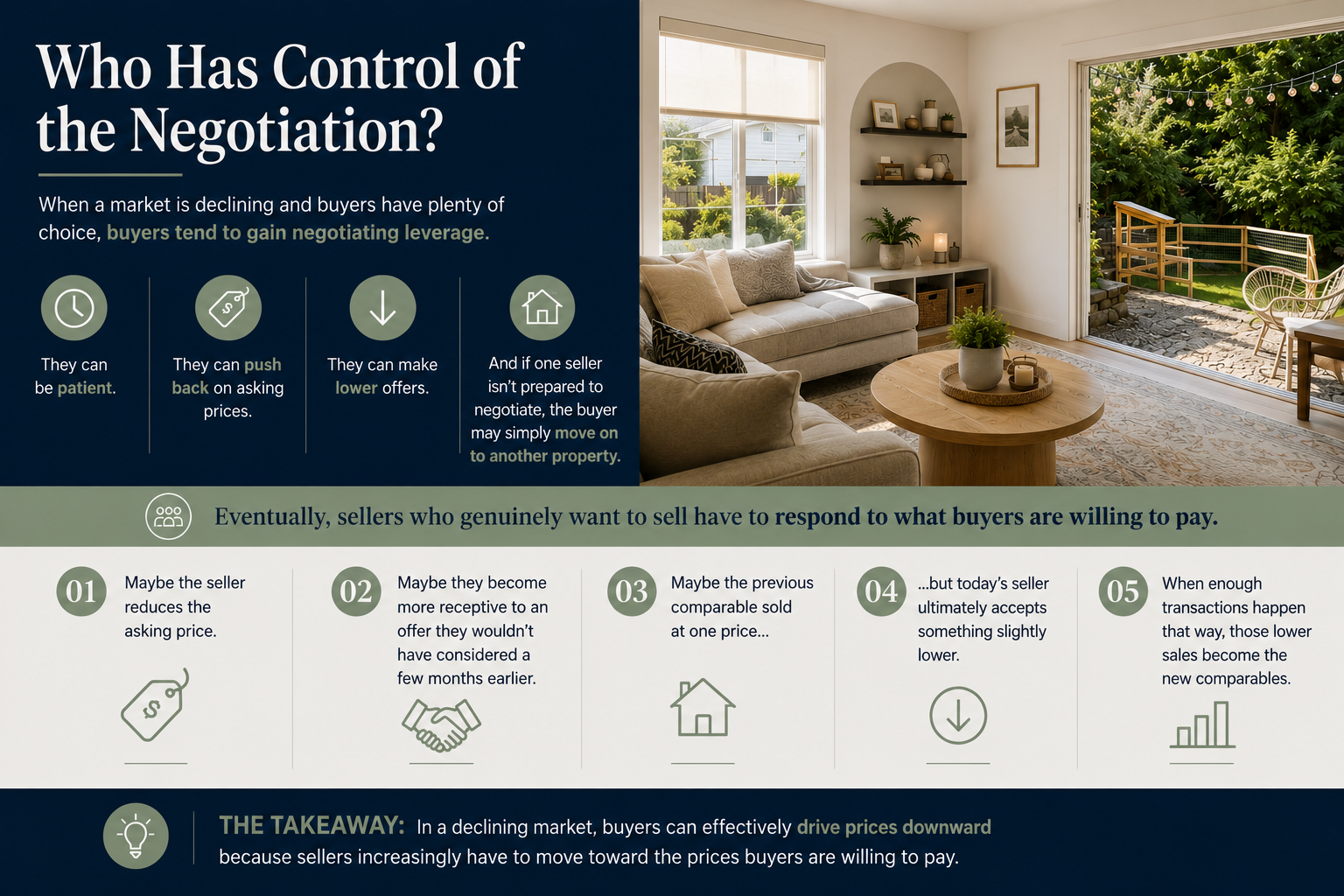
Who Has Control of the Negotiation?
When a market is declining and buyers have plenty of choice, buyers tend to gain negotiating leverage.
They can be patient.
They can push back on asking prices.
They can make lower offers.
And if one seller isn't prepared to negotiate, the buyer may simply move on to another property.
Eventually, sellers who genuinely want to sell have to respond to what buyers are willing to pay.
Maybe the seller reduces the asking price.
Maybe they become more receptive to an offer they wouldn't have considered a few months earlier.
Maybe the previous comparable sold at one price, but today's seller ultimately accepts something slightly lower.
When enough transactions happen that way, those lower sales become the new comparables.
So in a declining market, buyers can effectively drive prices downward because sellers increasingly have to move toward the prices buyers are willing to pay.
In a Rising Market, the Sellers Gain Leverage
When the market starts strengthening, the dynamic reverses.
Now the seller has more reason to hold out.
If there are more buyers looking for the same kind of property, the seller doesn't necessarily have to accept the first lower offer.
They may believe another buyer will come along.
Meanwhile, buyers begin realizing they have more competition.
That changes their behaviour.
Maybe they move closer to the asking price.
Maybe they're less aggressive in negotiations.
Maybe they're willing to compromise on some of the things they originally thought were essential.
And eventually, when enough buyers are competing for the same properties, you start seeing multiple offers.
At that point, buyers may actually bid the price higher.
Those higher transactions then become the next comparable sales.
So in a strengthening market, sellers have more ability to drive prices upward because buyers increasingly have to move toward them to secure the property.
Watch Who Is Making the Compromises
This is one of the simplest ways I know to think about market direction.
Who is having to compromise to get the deal done?
In a softening market, sellers may have to:
reduce their asking price;
accept less than they originally expected;
negotiate more aggressively;
or recognize that the previous sale may no longer represent today's value.
In a strengthening market, buyers may have to:
move closer to asking price;
compromise on neighbourhood;
accept a smaller bedroom;
give up a preferred orientation;
or become more flexible about other property characteristics.
Those compromises tell you something.
If sellers repeatedly have to move toward buyers, I start thinking about downward pressure.
If buyers repeatedly have to move toward sellers, I start thinking about upward pressure.
Then the Statistic Finally Appears
This is where the sequence becomes important.
Suppose the previous comparable property sold for $1 million.
Buyer behaviour changes.
Buyers start resisting that price.
Listings sit longer.
Eventually a seller agrees to sell a similar property for less.
Now we have a new transaction.
Once that sale becomes part of the market data, everybody can point to it and say:
“Prices are softening.”
But the statistic didn't cause the change.
It recorded a negotiation that was itself the result of changing buyer and seller behaviour.
That's why I don't think you can understand a changing real estate market simply by looking backward at completed transactions.
Completed sales are extremely important.
But they're confirmation.
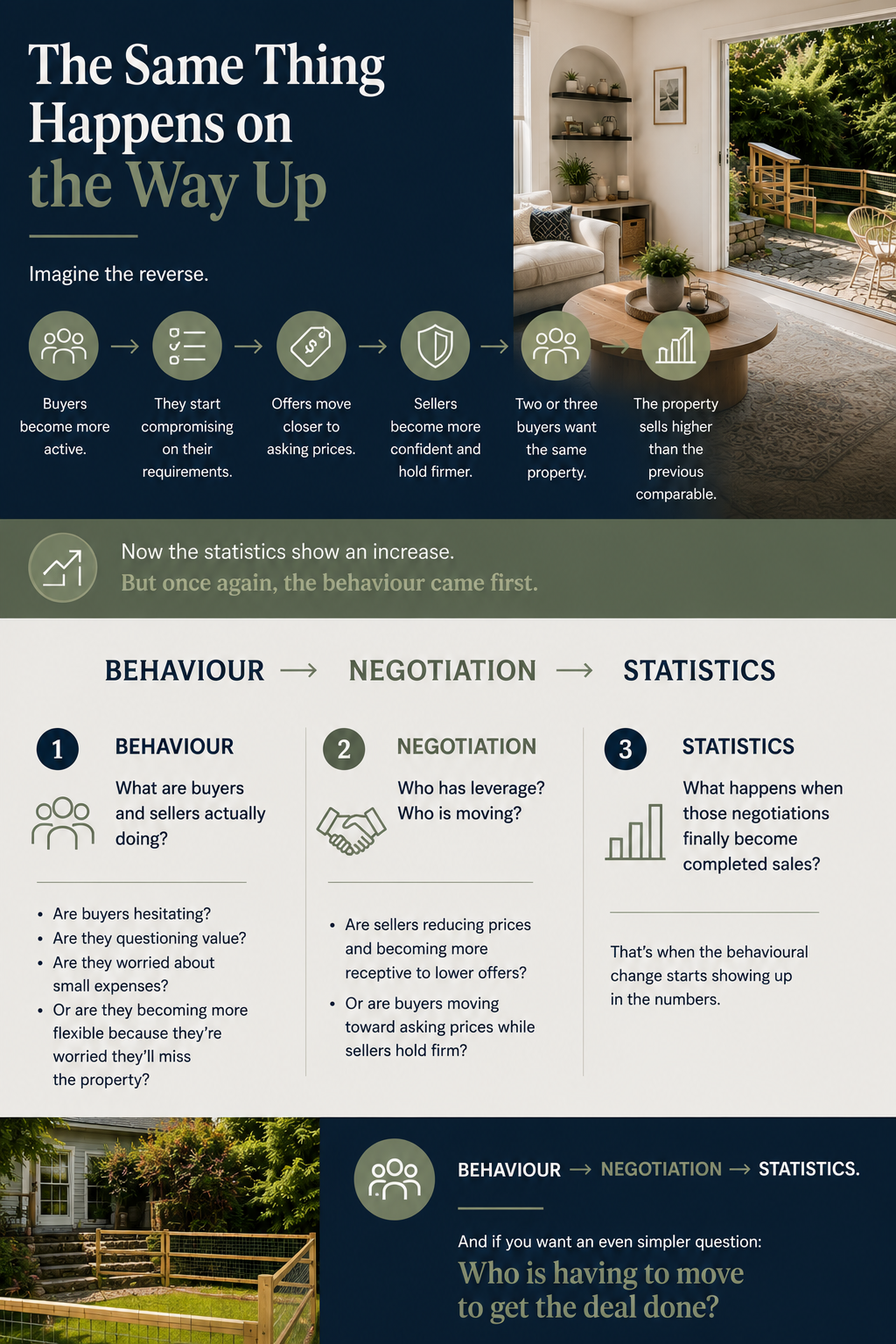
The Same Thing Happens on the Way Up
Imagine the reverse.
Buyers become more active.
They start compromising on their requirements.
Offers move closer to asking prices.
Sellers become more confident and hold firmer.
Then two or three buyers want the same property.
Multiple offers appear.
The property sells higher than the previous comparable.
Now the statistics show an increase.
But once again, the behaviour came first.
Behaviour → Negotiation → Statistics
That's the framework I use.
1. Behaviour
What are buyers and sellers actually doing?
Are buyers hesitating?
Are they questioning value?
Are they worried about small expenses?
Or are they becoming more flexible because they're worried they'll miss the property?
2. Negotiation
Who has leverage?
Who is moving?
Are sellers reducing prices and becoming more receptive to lower offers?
Or are buyers moving toward asking prices while sellers hold firm?
3. Statistics
What happens when those negotiations finally become completed sales?
That's when the behavioural change starts showing up in the numbers.
Behaviour → Negotiation → Statistics.
And if you want an even simpler question:
Who is having to move to get the deal done?
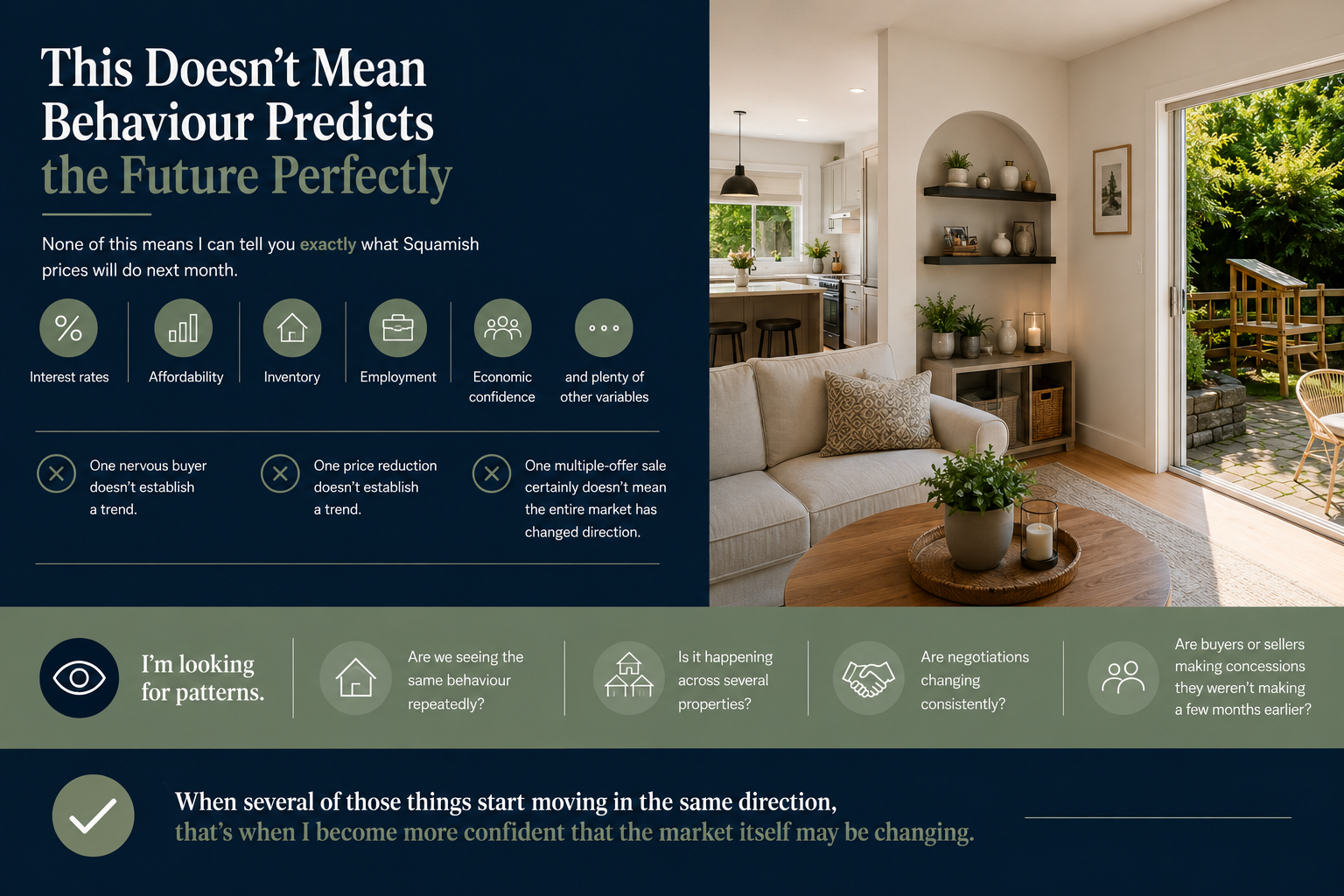
This Doesn't Mean Behaviour Predicts the Future Perfectly
None of this means I can tell you exactly what Squamish prices will do next month.
Markets are affected by interest rates, affordability, inventory, employment, economic confidence and plenty of other variables.
One nervous buyer doesn't establish a trend.
One price reduction doesn't establish a trend.
And one multiple-offer sale certainly doesn't mean the entire market has changed direction.
I'm looking for patterns.
Are we seeing the same behaviour repeatedly?
Is it happening across several properties?
Are negotiations changing consistently?
Are buyers or sellers making concessions they weren't making a few months earlier?
When several of those things start moving in the same direction, that's when I become more confident that the market itself may be changing.
Why I Watch Conversations as Closely as Statistics
This is one reason I spend so much time talking to buyers and sellers rather than simply waiting for the monthly statistics.
The numbers matter enormously.
But so do the conversations happening before those numbers are created.
If buyers repeatedly like properties but won't write offers at the asking prices, that's information.
If sellers begin accepting that the last sale may no longer represent today's value, that's information.
If buyers suddenly become more flexible because they're worried about missing out, that's information.
And if sellers can increasingly hold firm while buyers move toward them, that's information.
Eventually those behaviours affect negotiations.
Those negotiations produce transactions.
And those transactions become statistics.
So when somebody asks me how I can tell the Squamish real estate market may be changing before the statistics make it obvious, that's what I'm watching.
Behaviour first. Negotiating leverage second. Statistics last.
Because if you understand who's having to move to make the deal happen, you can often see the direction of the market before the sales numbers make it obvious to everyone else.
 The data relating to real estate on this website comes in part from the MLS® Reciprocity program of either the Greater Vancouver REALTORS® (GVR), the Fraser Valley Real Estate Board (FVREB) or the Chilliwack and District Real Estate Board (CADREB). Real estate listings held by participating real estate firms are marked with the MLS® logo and detailed information about the listing includes the name of the listing agent. This representation is based in whole or part on data generated by either the GVR, the FVREB or the CADREB which assumes no responsibility for its accuracy. The materials contained on this page may not be reproduced without the express written consent of either the GVR, the FVREB or the CADREB.