

If you're choosing between the better house and the better location in Squamish, in general I'd take the location.
The reason is actually very simple: you can change an enormous amount about a house, but you can't move the lot.
You can renovate a kitchen. You can replace the bathrooms, flooring and windows. Depending on the property and what current zoning and building regulations allow, you may be able to add an extension, create additional living space, build a garage or add some form of accessory dwelling. Some of those projects may be expensive and some may not be practical at all, but at least they're things you can investigate and potentially change.
What you can't do is pick up your property and put it somewhere else.
That's why, when the choice is reasonably close, I think location generally wins.
Location Doesn't Just Mean the Neighbourhood
When people hear Realtors talk about location, I think they sometimes interpret that as simply choosing which Squamish neighbourhood they prefer. Do you want to live in Brackendale, Garibaldi Highlands, Valleycliffe, Downtown or somewhere else?
That's part of it, but location is much more specific than that.
Two houses on the same street can have very different locations. One might have excellent sunlight while the other spends much of the winter in shade. One might back onto green space while the other backs onto another house. One might have considerably more road noise. One could have a view, better privacy or easier access to trails. Even the orientation of the house on the lot can change how it feels to live there.
So when I'm talking about paying for location, I'm really talking about all the characteristics of the property that come from where it physically sits and that you won't realistically be able to change later.
Those things deserve a lot of weight when you're deciding between two homes.
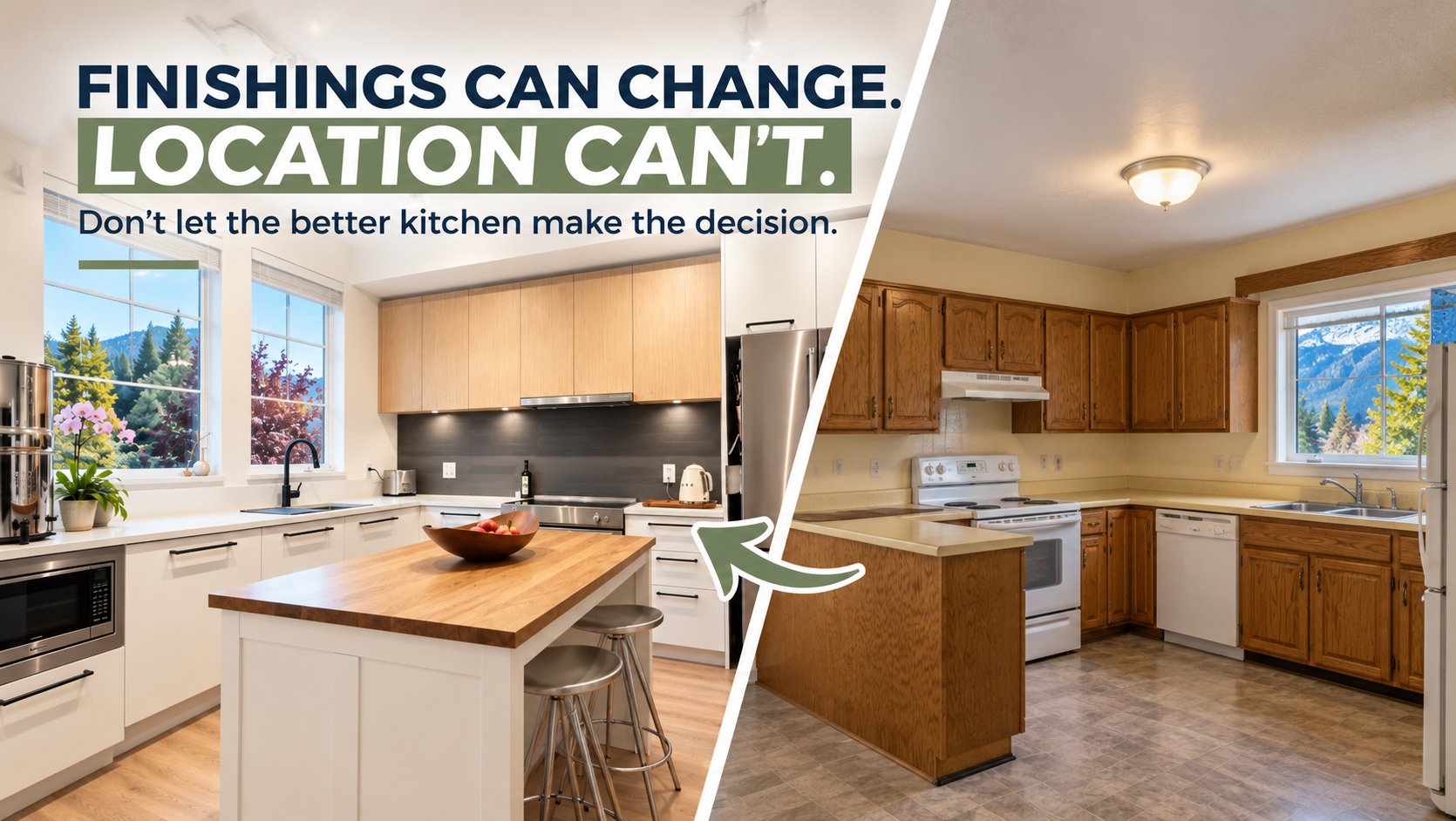
Don't Let the Better Kitchen Make the Decision for You
This is where buyers can get distracted.
Imagine two Squamish houses at roughly the same price. The first one has a beautiful renovated kitchen, new bathrooms, attractive flooring and everything looks finished. You walk through the door and immediately think, this is the better house.
The second property is in the location you prefer, but the house itself is dated. Maybe the kitchen is 20 years old. The flooring needs replacing. The bathrooms aren't particularly attractive. You can immediately see money you're going to have to spend after buying it.
Naturally, the renovated house feels like better value.
But what happens five years later?
The new kitchen in the first house isn't new anymore. The floors have been lived on and the bathrooms have aged. And you're still in exactly the same location.
Meanwhile, the buyer of the second property may have gradually changed everything they disliked about the house. They renovated the kitchen. They replaced the flooring. They updated the bathrooms. The property that didn't look as good on the day they bought it may now be exactly the home they wanted, and they still have the location they preferred in the first place.
That's why I wouldn't automatically pay a premium for the house that looks better today.
Some Problems Are Expensive to Fix. Others Can't Be Fixed.
There's obviously a financial reality to this. Saying you can renovate a house doesn't mean renovations are cheap, easy or always possible.
If one property needs hundreds of thousands of dollars of work and the other one is completely finished, that absolutely matters. If you're stretching financially just to buy the property, telling yourself you'll simply renovate everything later may not be realistic.
The same applies to additions and major structural changes. What you can build depends on the individual property and applicable zoning, setbacks, building regulations, site conditions and permitting requirements. You shouldn't buy a property assuming you can add another floor, build a garage or create additional living space without investigating whether that's actually possible.
But there's still an important distinction between something that is difficult or expensive to change and something you fundamentally cannot change.
A kitchen might cost a lot of money to replace, but it can be replaced.
Road noise isn't a renovation.
You can't move your lot farther away from a busy street. You can't rotate the property to get better sunlight. You can't create a completely different outlook. You can't move the house closer to the trail network, your children's school or the part of Squamish where you actually want to spend your time.
Those are permanent compromises, and buyers sometimes underestimate them because they're less obvious than a dated bathroom.
Sunlight Is a Good Squamish Example
Sunlight is something I think buyers need to pay particular attention to here.
Squamish has significant mountains surrounding it, trees, changing elevations and properties with very different orientations. How a home feels can therefore depend considerably on its particular position.
If you're viewing properties during a beautiful summer afternoon, almost everything can feel bright. But you're not buying the house for one afternoon in July. You're going to live there throughout the year.
Where does the sun come from in winter? What's between the house and that sunlight? How bright is the main living area? Which direction does the backyard face? Are there trees or buildings that affect the amount of natural light you receive?
If natural light is important to you, that's something I would put a lot higher on the list than whether you like the current countertops.
You can change the countertops.
You can't change where the sun comes from.
Think About How the Location Affects Your Actual Life
The same applies to lifestyle.
We've talked before about how different Squamish locations work for different people. Someone who wants to walk to coffee shops, restaurants and other amenities may put a much higher value on being Downtown. A mountain biker might care enormously about convenient trail access. Somebody else may prioritize privacy, a quieter street, a particular school or an easier connection to the highway.
There isn't one Squamish location that is automatically best for everybody.
The better location is the better location for you.
That's why I wouldn't tell a buyer to pay more for a particular neighbourhood simply because somebody has decided it's more prestigious. I want to understand how that buyer actually lives and which parts of the location are going to affect them every day.
If you're paying a premium for location, you should be getting something that matters to you.
Does Location Always Win?
This is where I would put an important qualification around the phrase “location always wins.”
As a general principle, yes, I put more weight on location because it can't be changed. But real estate decisions aren't made in a vacuum.
If two properties are the same price and one house is substantially better while the location difference is relatively minor, I might absolutely choose the better house.
Maybe one property is slightly closer to the trails, but the other has an extra bedroom, a garage, a much better floor plan and requires virtually no work. If the buyer doesn't particularly care about that small difference in trail access, it would be silly to tell them they should sacrifice all of those things simply because we're supposed to repeat “location, location, location.”
The size of the compromise matters.
So does the buyer.
What I don't like seeing is somebody giving up a location they clearly prefer because they've become emotionally attached to finishings that can eventually be changed.
Ask Yourself Which Compromise You'll Still Notice in Five Years
If you're struggling between two properties, I'd try to imagine both of them five years from now.
Take the house in the better location and mentally renovate it. Imagine the kitchen you want, the flooring you would choose and the improvements you'd realistically make over time. If the property would then become the obvious choice, that's telling you something.
Now do the opposite with the better house.
Imagine that the beautiful new kitchen is five years older. The floors aren't perfect anymore and the initial excitement of the finishings has worn off. You're still on the same street, with the same amount of sunlight, the same traffic, the same neighbours, the same view and the same distance from the places you regularly go.
How do you feel about the decision then?
That's the comparison I think matters.
Buy the Things You Can't Change
A home is obviously more than its location. Floor plan, size, condition, functionality and price all matter, and sometimes the better house really is better enough to justify compromising on location.
But if the decision is reasonably close, I'm going to put more weight on the property that's sitting on the better piece of real estate for that particular buyer.
Buyers can become very focused on what a home looks like on the day they see it. I think it's more useful to separate the property into two categories: the things you can change and the things you can't.
Then decide which category you're prepared to compromise on.
For me, the principle is pretty straightforward: you can renovate the house. You can't renovate the location.
 The data relating to real estate on this website comes in part from the MLS® Reciprocity program of either the Greater Vancouver REALTORS® (GVR), the Fraser Valley Real Estate Board (FVREB) or the Chilliwack and District Real Estate Board (CADREB). Real estate listings held by participating real estate firms are marked with the MLS® logo and detailed information about the listing includes the name of the listing agent. This representation is based in whole or part on data generated by either the GVR, the FVREB or the CADREB which assumes no responsibility for its accuracy. The materials contained on this page may not be reproduced without the express written consent of either the GVR, the FVREB or the CADREB.