

When you're buying a home, should you be thinking about what it's going to be worth when you eventually sell it?
Yes.
But probably not in the way most people think.
I see buyers become so concerned about resale value that they risk overlooking the most important question:
Are you actually going to enjoy living in this home?
Because ultimately, that's what you're buying.
You're not buying a stock that happens to have a kitchen and three bedrooms. You're buying the place where you're going to spend a significant part of your life.
So while I absolutely think buyers should consider resale, I wouldn't buy a home you don't particularly like simply because you think it might make you an extra $10,000 or $20,000 ten years from now.
If you spend those ten years living somewhere that doesn't really work for you, was that actually a good investment?
I don't think it was.
Start With How You're Going to Live
When I'm helping someone buy a home in Squamish, I want to understand how they're actually going to use it.
Where do you spend your time?
Do you need a garage for bikes, skis, tools or storage?
Do you want a yard?
Do you work from home?
Do you have children?
Do you entertain?
Do you want to be able to walk Downtown?
Do you care about being close to trails?
How important are sunlight, privacy and views?
Those questions should have a major influence on what you buy.
A property can look fantastic on a spreadsheet and still be completely wrong for the person who's going to live there.
Your home affects your life every single day.
That has value too.
Resale Value Isn't Actually the Question I Worry About Most
There's another question I think is more important:
Will you be able to sell this property when you need to?
That's different from asking whether the property will appreciate more than another property.
Imagine you buy something in a strong real estate market when inventory is limited.
Buyers are competing.
People are compromising.
Properties with unusual layouts, missing features or other disadvantages can still sell because buyers don't have many alternatives.
Then five years later, your circumstances change.
Maybe you've had another child.
Maybe your income has increased.
Maybe you want a detached house.
Your dream home comes onto the market.
There's just one problem.
The market has changed.
Buyers now have plenty of properties to choose from, and the compromises they were willing to make five years ago aren't compromises they need to make anymore.
Suddenly, the property you own is difficult to sell.
That can become a much bigger problem than whether your home appreciated by an extra percentage point or two.
The property you already own can prevent you from buying the property you actually want next.
That's why I think buyers should spend less time trying to predict which property will appreciate the most and more time thinking about whether the property will remain saleable under more difficult conditions.
Ask Yourself: Would I Buy This in a Bad Market?
This is one of the questions I like buyers to consider.
If the market wasn't strong, would you still be looking at this property?
In other words, if you had ten similar properties to choose from instead of two, would this one still make your shortlist?
That question can expose weaknesses that are easy to ignore when inventory is tight.
Maybe you're considering two otherwise similar Squamish townhouses.
One has a garage.
The other doesn't.
When buyers are desperate for townhouses, both may attract attention.
When the market becomes softer and buyers have six alternatives to choose from, the garage can become much more important.
The same thing can happen with a powder room on the main floor.
It may seem like a relatively minor feature when you're buying.
But put two similar townhouses beside each other in a slower market—one with a main-floor powder room and one without—and that difference can influence which property a buyer chooses to see, offer on or ultimately purchase.
The point isn't that every Squamish buyer must buy a townhouse with a garage and a powder room.
They don't.
The point is that you should understand when you're buying a feature—or the absence of a feature—that could reduce the future pool of buyers for the property.
Strong Markets Can Hide Weaknesses
This is where buyers need to be particularly careful.
A rising or highly competitive market can make almost every property look desirable.
If there aren't many homes available, buyers start compromising.
They accept the strange layout.
They accept limited parking.
They accept the tiny bedroom.
They accept the lack of storage.
They accept the awkward yard.
And because those properties are selling, it's easy to conclude that those characteristics don't matter.
They do.
You just may not see their effect until market conditions change.
When buyers regain negotiating power and inventory increases, they can become much more selective.
The better properties tend to attract attention first.
The compromised properties may require more time, a more aggressive price, or both.
That's why I want buyers to think about a property in more than today's market.
I want them to imagine trying to sell it in a difficult one.
This Doesn't Mean You Should Buy the Most Generic Home Possible
There's an important balance here.
I don't want somebody to read this and conclude that they should avoid anything unusual.
Sometimes the thing that makes a property unusual is exactly why you love it.
Maybe there's no garage, but the property has an incredible view.
Maybe the layout isn't conventional, but it works perfectly for your family.
Maybe the location wouldn't appeal to everybody, but it puts you exactly where you want to be.
That's fine.
You don't need every future buyer to want your property.
You just need to understand the trade you're making.
If a feature significantly improves your life while you own the home, accepting some potential resale disadvantage may be completely reasonable.
That's very different from buying a compromised property without realizing it's compromised.
How Long You Expect to Own the Property Matters
Your timeline also changes the conversation.
If you're buying something you expect to own for a relatively short period, I'd pay more attention to resale considerations.
There is less time for market appreciation, renovations or changing circumstances to compensate for a poor buying decision.
If you're planning to live somewhere for 10, 15 or 20 years, I become much more interested in whether the home works for your life.
Nobody knows exactly what the Squamish real estate market will look like that far into the future.
Your family may change.
Your career may change.
The community will change.
The property itself may change.
Trying to perfectly optimize a purchase today for a sale 20 years from now can lead you to sacrifice things that would improve your quality of life for the next two decades.
That's not a trade I'd make casually.
Resale Becomes More Important When You're Intentionally Creating Value
There's another type of buyer where I think resale deserves more attention.
That's somebody who goes into the purchase intending to improve the property and create value.
Maybe you buy an older home with a good main living area but an unfinished lower level.
You like the house already.
It works for your family.
But you also see the potential to create a secondary suite, subject of course to the applicable approvals and requirements.
Now we're having a different conversation.
You're not simply hoping the Squamish market increases the value of your property.
You're considering whether your own work and investment can improve its utility and potentially its future market value.
The same could apply to renovating an older kitchen, improving a poor layout, finishing unused space, improving landscaping or addressing deferred maintenance.
In that situation, I'd want to consider both sides of the decision:
Will you enjoy living here, and is there a realistic opportunity to improve the property while you own it?
That's a much more intentional approach to resale value.
Don't Confuse Renovation Cost With Added Value
There is an important caution here.
Spending $50,000 on a property doesn't automatically make it worth $50,000 more.
We've discussed this before in relation to renovating a Squamish home before selling.
The same principle applies when buying.
Some improvements create significant utility.
Others are mostly personal preference.
And some renovations cost considerably more than the market will ultimately pay you back for.
So if part of your buying strategy is to create value, the question isn't simply:
“What can I renovate?”
It's:
“What can I change that will make this a better property for me while also making it more useful or desirable to a future buyer?”
That's a much better test.
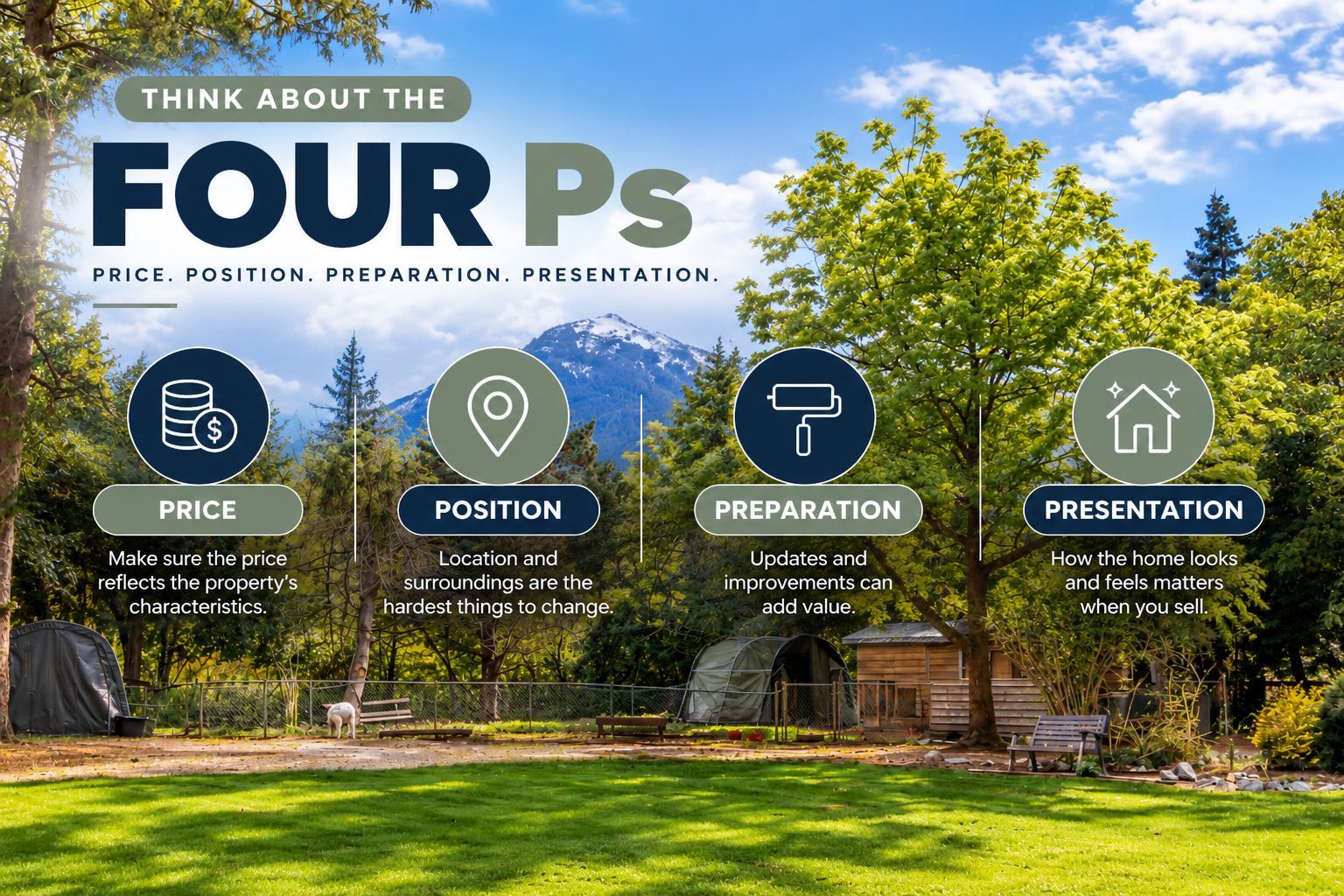
Think About the Four Ps
Our Four Ps framework is useful here as well:
Price. Position. Preparation. Presentation.
When you're buying, position deserves particular attention because it's usually the hardest thing to change.
You can renovate a kitchen.
You can improve landscaping.
You can repaint.
You can stage a home differently when you eventually sell.
You can't move the property.
You can't easily change what's next door.
You can't create a view that isn't there.
And you can't fundamentally change how the property sits within its neighbourhood.
So while I don't want buyers obsessing over future resale, I do want them to recognize characteristics that will remain with the property regardless of what they spend improving it.
Then you determine whether the price appropriately reflects those characteristics.
Five Questions I'd Ask Before Buying
If you're trying to balance lifestyle and resale, I'd come back to five questions:
1. How am I actually going to live in this home?
Does the property make your everyday life better?
2. How long do I realistically expect to own it?
The shorter the ownership period, the more attention I'd generally give to resale considerations.
3. Would buyers still want this property in a weaker market?
Not every buyer. Enough buyers.
4. Am I intentionally planning to add value?
If renovations, a suite or other improvements are part of your plan, understand what they might realistically accomplish.
5. What am I compromising on, and do I understand the consequence?
A compromise isn't automatically a problem. An unidentified compromise can be.
Buy for Your Life—But Don't Ignore the Next Buyer
I don't think you should buy a Squamish home primarily for the person who might own it after you.
You're the one who has to live there.
If one property is going to substantially improve your quality of life and another might theoretically produce a slightly better return ten years from now, I'm going to give a lot of weight to the property that makes your life better.
But I also don't want you trapped.
That's why the question I care about isn't simply:
“Will this property have good resale value?”
It's:
“If the market is difficult when you need to move, will there still be a buyer for this home?”
Buy something you enjoy.
Understand its compromises.
Think about how long you're likely to own it.
And make sure that when the time eventually comes to move on, the home you bought today doesn't unnecessarily prevent you from buying the home you want tomorrow.
 The data relating to real estate on this website comes in part from the MLS® Reciprocity program of either the Greater Vancouver REALTORS® (GVR), the Fraser Valley Real Estate Board (FVREB) or the Chilliwack and District Real Estate Board (CADREB). Real estate listings held by participating real estate firms are marked with the MLS® logo and detailed information about the listing includes the name of the listing agent. This representation is based in whole or part on data generated by either the GVR, the FVREB or the CADREB which assumes no responsibility for its accuracy. The materials contained on this page may not be reproduced without the express written consent of either the GVR, the FVREB or the CADREB.