

One of the questions buyers frequently ask when looking at detached homes in Squamish is whether they should buy a house with a secondary suite or look for something without one.
And I think there are two really important things to consider.
The first is how you want to live in the property. The second, and potentially more important from a financial perspective, is the flexibility and resale value that a secondary suite can provide.
Some buyers have a very clear opinion about suites. They say, "If I'm going to buy a detached house, I want to live in a detached house. I don't want somebody else living downstairs."
And I understand that argument.
If you're going to share a wall, floor or ceiling with another household, why not just buy half a duplex? After all, one of the reasons people pay more for a detached house is to have their own space and privacy.
But I think that argument overlooks one of the biggest advantages of buying a detached home with a secondary suite.
You're not simply buying a house with rental income. You're buying a property that has the potential to change as your life changes.
And over the course of owning a home for 10, 20 or 30 years, that flexibility can be extremely valuable.
A House With a Suite Can Grow With Your Financial Situation
Let's imagine you're buying your first detached house in Squamish.
You have a reasonable down payment, and you can qualify for the mortgage, but your monthly cash flow is going to be fairly tight. You want to own a detached property, but you also want to continue saving money and have some financial breathing room.
Now imagine you buy a house that has a well-designed lower level with the potential for a two-bedroom secondary suite.
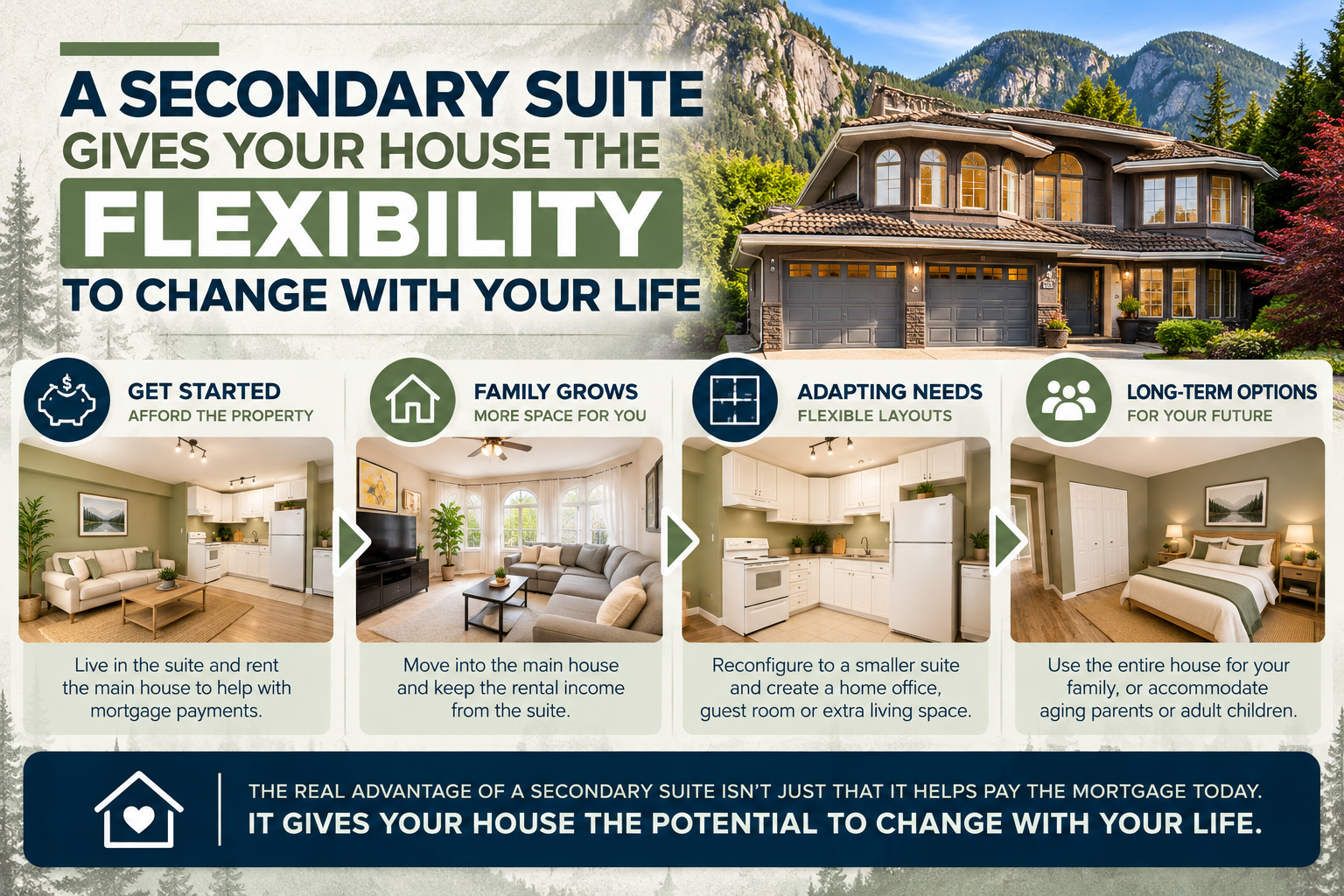
Rather than immediately moving into the main portion of the house, you might decide to live in the smaller suite and rent out the larger part of the property.
You're still the owner of a detached home, but you're using the property in a way that helps your financial position during those early years.
The rental income from the main house may cover a significant portion of your ownership costs, allowing you to save money, pay down your mortgage or simply avoid stretching yourself financially.
You're sacrificing some living space in the short term, but you're doing it with a longer-term plan.
Then, a few years later, things change.
Perhaps your income has increased, you've paid down some of the mortgage, or interest rates have become more favourable.
Now you decide you'd like to move into the main house.
You can live upstairs and rent out the two-bedroom suite downstairs.
You have more living space, but you're still receiving rental income to help with the cost of owning the property.
That's a completely different living arrangement, and it's happening within the same house.
Of course, these changes depend on the property's approved configuration and any existing tenancy obligations. But the point is that a house designed with flexibility in mind gives you options that a conventional single-family layout may not.
You Might Not Always Need a Two-Bedroom Suite
Let's take that example a little further.
You've been living in the main house for a few years and renting out the two-bedroom suite. Your financial position has continued to improve, and you no longer need as much rental income.
But you still like having some income coming in every month.
Depending on the layout of the property, you might have the ability to reconfigure the lower level so that you're renting out a one-bedroom suite instead of a two-bedroom suite.
Now you've reclaimed another room for your own use.
Maybe you turn that space into a home office, a guest bedroom, a workout room or somewhere to store all the outdoor equipment that tends to accumulate when you live in Squamish.
You still have rental income, but you've increased the amount of the property available to your family.
This is one of the reasons I particularly like houses where the lower level has a flexible layout.
A house that can accommodate a two-bedroom suite, a smaller suite or additional space for the main household offers more possibilities than a property with a layout that only works one way.
It doesn't mean every house can legally or practically be converted between these configurations. But when the layout and approvals allow it, that flexibility can be a major advantage.
Eventually, You Might Want the Entire House Back
Now let's say another five or ten years have passed.
Your children are getting older. They want somewhere to spend time with their friends, and you could really use a recreation room downstairs.
At this stage, perhaps you no longer need rental income at all.
You might decide that you'd rather use the entire property for your family.
If the tenancy arrangements and applicable rules permit it, you can plan to reclaim the suite space and incorporate it into your own living area.
Suddenly, the house that initially helped you manage your mortgage payments has become a larger family home.
You've gone from living in a small portion of the property while renting out the main house, to living in the main house with a two-bedroom rental suite, to potentially having a smaller suite, and eventually to using the entire house yourself.
And you've accomplished all of that without necessarily having to sell and buy another property every time your circumstances changed.
I think that's a pretty significant advantage.
One important consideration is that ending a tenancy or changing the use of a rental unit in British Columbia isn't simply a matter of deciding you want the space back. There are legal requirements, notice provisions and tenant protections that need to be considered. The flexibility I'm describing is a long-term ownership advantage, not a guarantee that a suite can be reclaimed immediately whenever you want.
A Secondary Suite Can Also Work for Aging Parents
There's another situation that I think becomes increasingly relevant as people get older.
What happens when your parents need somewhere to live?
Maybe they're getting to the point where maintaining their own house is becoming difficult. Perhaps they'd like to be closer to their children and grandchildren, but they still want their independence.
If you own a house with a well-designed secondary suite, you may already have a solution.
Your parents could potentially live downstairs while you continue living in the main house.
They have their own kitchen, bathroom and living space, but they're still close enough that you can help when needed.
For some families, that's a very attractive arrangement.
And it's another example of why I think the value of a suite extends well beyond the rent it can generate.
You might spend years renting it to tenants, and then eventually use it for family members.
Or perhaps an adult child needs somewhere to live while saving for their own property.
The same space that once helped you afford your mortgage could eventually help somebody else in your family.
That's a level of flexibility that can be difficult to achieve in a home without a separate living area.
What If You Want to Travel for Six Months or a Year?
Here's another possibility that people don't always think about when they're buying a house.
What if, later in life, you decide you want to travel?
Maybe your children have moved out, you're working less, or you've reached a point where you'd like to spend six months travelling. Perhaps you even want to travel for a year or two.
You might not want to sell your Squamish home. You still love living here, and you want somewhere to come back to.
But leaving a large detached house sitting empty while you're away can be expensive.
If your house has a flexible secondary suite, you may have another option.
Depending on the configuration and applicable rental rules, you could potentially rent out the main portion of the house while retaining the smaller suite for your own use.
That could allow you to generate income from the larger part of the property while maintaining a smaller home base in Squamish.
You'd need to plan the tenancy arrangements carefully, particularly if you wanted occasional access to your own space while travelling. But it's an interesting possibility.
And again, it's something you might not have considered when you originally purchased the property.
That's the whole point.
A house with a flexible secondary suite gives you choices that may become valuable at different stages of your life.
But What About Privacy?
Now, I don't want to pretend there aren't disadvantages to having a suite.
There certainly can be.
If you have tenants living downstairs, you're sharing part of your property with another household. Depending on the layout, you may hear noise between floors. You may have to share portions of the driveway or yard, and there may be additional considerations around parking, entrances and outdoor space.
For somebody who specifically wants a detached home because they don't want to live close to other people, those compromises can be significant.
And I think that's a perfectly legitimate reason to prefer a house without a suite.
But not all suited houses are created equal.
Some have very good separation between the main house and the suite. Others have awkward layouts where tenants need to walk past the main living areas, parking is difficult, or noise travels easily between floors.
Those details make a substantial difference to how enjoyable the property is to live in.
When I'm looking at a house with a buyer, I want to understand how the suite actually functions.
Where is the entrance? How is the parking arranged? Is there good separation between the living spaces? How much of the yard does each household use? And if you eventually wanted to use the suite space yourself, would the layout make that practical?
A well-designed secondary suite can be a tremendous asset. A poorly designed one can create compromises that you may not be happy living with.
The Biggest Financial Advantage May Come When You Sell
Now, we've talked quite a bit about flexibility, but there's another reason I think secondary suites are so valuable in Squamish.
And that's resale.
In my experience, a detached house with a well-designed, usable secondary suite generally has a significant advantage when it comes time to sell.
The reason is fairly straightforward.
You're appealing to a broader range of potential buyers.
Some buyers want the rental income because it helps them afford the property. Others want the flexibility of having family members live in a separate space. Some buyers may not need the suite immediately but like knowing that it's available if their circumstances change.
And some buyers, particularly those trying to move into the detached housing market, may find that having potential rental income makes the purchase financially possible.
That's a substantial benefit.
In certain circumstances, lenders may recognize some of the rental income when assessing a buyer's mortgage qualification. The amount they'll recognize varies depending on the lender, the borrower and the property, so it shouldn't be assumed that every suite will increase somebody's borrowing capacity by a particular amount.
But the underlying principle remains important.
A property that can generate income may be affordable to buyers who would struggle to carry the same mortgage without that income.
And that can make a meaningful difference to the number of people who are interested in purchasing the home.
Does a House With a Suite Always Sell for More?
I would generally expect a comparable detached house with a well-designed, properly authorized secondary suite to have stronger market appeal than one without that flexibility.
But I wouldn't suggest that every suited house automatically sells for more than every house without a suite.
There are too many other variables.
Location, lot size, condition, layout, privacy and the quality of the suite all matter.
A house with an awkward basement suite that compromises the main living space may not be as attractive as a house without a suite that has an excellent layout and better overall functionality.
And the cost of adding or maintaining a suite also needs to be considered.
But if we're comparing two otherwise similar detached properties, and one has a functional, properly authorized secondary suite while the other doesn't, I would generally consider the suited property to have a meaningful resale advantage.
That advantage isn't simply the rental income.
It's the additional flexibility and the broader range of buyers who may find the property suitable.
Look for a Suite That Can Change With Your Needs
If you're considering buying a house with a suite in Squamish, I would encourage you to look beyond what the current rental arrangement happens to be.
Think about what the property could look like five, ten or twenty years from now.
Could you live in the smaller portion of the house while renting out the main living area?
Could you eventually move into the main house and continue renting the suite?
Does the lower-level layout provide opportunities to change how much space is used by the main household?
Could it accommodate family members later in life?
And if you eventually wanted the entire house for yourself, would the layout make that practical?
Those are important questions because not every house with a suite provides the same degree of flexibility.
I would also want to verify that the suite is permitted for its intended use, understand any relevant building and safety requirements, and review existing tenancy arrangements before making assumptions about what can be changed.
A property might physically appear capable of several different configurations, but that doesn't mean every configuration is automatically permitted.
The goal is to understand the real options the property provides rather than simply imagining what might be possible.
So, Should You Buy a House With a Secondary Suite in Squamish?
I think that for many buyers, the answer is yes, particularly if the suite is well designed and the layout allows the property to adapt to different needs over time.
There are certainly people who would prefer to have a detached house entirely to themselves, and I understand that. Privacy and having full use of your property are important considerations.
But I think the financial flexibility of a secondary suite is something buyers should take seriously.
You might initially use the rental income to help afford the property. Later, you might need less rental income and want more space for your family. Eventually, you might use the suite for aging parents, adult children or another family arrangement.
And when it comes time to sell, the ability to generate rental income and accommodate different living arrangements can make the property attractive to a broader range of buyers.
The real advantage of a secondary suite isn't simply that it helps pay the mortgage today. It's that it gives your house the potential to change with your life.
And when you're making a substantial investment in a detached home in Squamish, I think that flexibility can be worth a great deal.
 The data relating to real estate on this website comes in part from the MLS® Reciprocity program of either the Greater Vancouver REALTORS® (GVR), the Fraser Valley Real Estate Board (FVREB) or the Chilliwack and District Real Estate Board (CADREB). Real estate listings held by participating real estate firms are marked with the MLS® logo and detailed information about the listing includes the name of the listing agent. This representation is based in whole or part on data generated by either the GVR, the FVREB or the CADREB which assumes no responsibility for its accuracy. The materials contained on this page may not be reproduced without the express written consent of either the GVR, the FVREB or the CADREB.