

There's an old piece of real estate advice that says you should buy the cheapest house in the best neighbourhood. The thinking is that if you're buying at the lower end of the market in a desirable area, you're getting a good deal and there's more potential for the property to increase in value.
But is buying the cheapest property in a Squamish neighbourhood actually a smart idea?
Well, sometimes. But I think we're asking the wrong question.
Rather than looking for the cheapest property, I think buyers should be looking for the best value. And those are two very different things.
A property can be cheap for a very good reason. It might be in terrible condition, have an undesirable location, be considerably smaller than comparable properties or have some other disadvantage that will always affect its value.
On the other hand, a property might be priced below what it's genuinely worth because the seller is motivated or because the market hasn't recognized its value.
The important thing is understanding the difference.
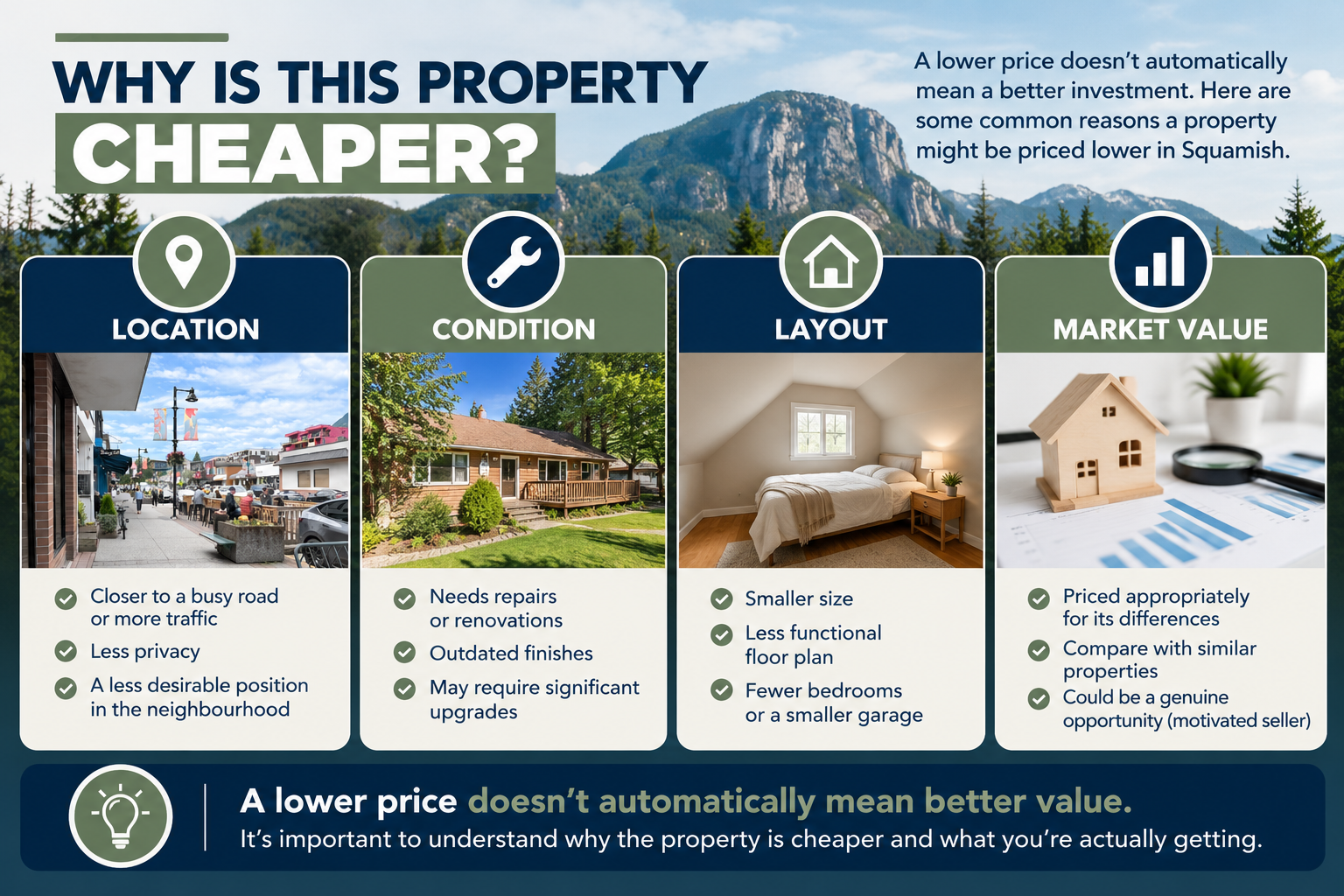
Why Is the Property the Cheapest?
The first thing I want to establish is why a particular property costs less than the others around it.
Let's say you're comparing detached houses in a Squamish neighbourhood. One property is considerably cheaper than everything else, but the house is in such poor condition that it really needs to be torn down.
Well, of course it's cheaper. You're potentially buying something where the existing building contributes little or no value, and you're going to have to spend a substantial amount of money to do anything with it.
That doesn't mean it's a bad purchase. The land itself might represent excellent value. But you can't simply compare its purchase price with the price of a house that's in good condition and conclude that you've found a bargain.
The same thing happens with townhouses and condos.
Imagine you're looking at a particular townhouse complex in Squamish. There are several units available, and one is noticeably cheaper than the others.
Maybe that unit faces the highway while the others face a quiet courtyard. Maybe it's the smallest floor plan in the complex. Maybe it has an awkward layout, a smaller garage or needs a substantial amount of work.
Those are all legitimate reasons for a property to be worth less.
If you're buying the cheapest unit simply because it's the cheapest, you might not be getting a particularly good deal. You might just be paying an appropriate price for an inferior property.
That's why we need to understand what we're actually buying before we start talking about value.
The Cheapest Property and the Best-Value Property Are Not the Same Thing
When I'm helping somebody evaluate a property, I'm not particularly interested in whether it's the cheapest in the neighbourhood. I'm interested in whether it's worth more than we're being asked to pay for it.
That's the distinction.
A townhouse priced at $800,000 isn't necessarily better value than one priced at $850,000. If the more expensive property has a much better location within the complex, a more functional layout, better sunlight and a larger garage, it might actually represent better value.
Equally, if the cheaper property is very similar to the more expensive one and the only real difference is that the seller is anxious to get it sold, that could be an excellent opportunity.
The price alone doesn't tell us which property is the better purchase.
We need to look at the property's features, condition, location and comparable sales to establish what it should reasonably be worth. Then we can decide whether we're getting good value.
But there's another part of this that I think is equally important, particularly if you're buying the property to live in.
If You're Going to Live There, Value Isn't Just About Money
When somebody is buying a home for their own use, I think it's important to remember that they're actually going to be living in the property.
That might sound obvious, but sometimes people get so focused on getting a good deal that they forget to consider whether they're going to enjoy living there.
Let's say you've found a townhouse that represents very good financial value, but it doesn't have the two-car garage you originally wanted.
Maybe it has a smaller third bedroom. Maybe the kitchen isn't quite as functional as you'd like, or there's something about the layout that isn't ideal.
Now, those things don't necessarily make it a bad purchase. If you can comfortably live with those compromises and you're getting an attractive price, it might make perfect sense.
But if those compromises are going to bother you every day, I think you need to consider what you're actually saving.
There's no point congratulating yourself on getting the cheapest property in the complex if you've bought somewhere that doesn't really work for the way you want to live.
And this is where I like to change the way buyers think about the difference in price.
What Does the Better Property Actually Cost You Each Month?
Rather than looking exclusively at the difference between two purchase prices, I like to work out what that difference means in terms of the monthly cost of living in the property.
Let's say you're comparing two homes. One is cheaper, but it has a smaller third bedroom that isn't quite what you want. The other has a much better bedroom, but the purchase price is higher.
The immediate reaction might be that the cheaper property is the better financial decision because you're saving money.
But what if, after looking at your financing and the other ownership costs, the difference between the two properties works out to approximately $100 per month?
Now the question becomes much more practical.
Is having that larger bedroom worth $100 a month to you?
If you're going to use that bedroom every day, perhaps as a home office or a child's bedroom, you might decide that it absolutely is.
If it's a room you're only going to use occasionally, perhaps it isn't.
Neither answer is wrong.
The important thing is that you've stopped looking at the purchase price in isolation and started thinking about what you're actually getting for the additional money.
Of course, that monthly comparison needs to be calculated properly. A higher purchase price can mean a larger down payment, additional mortgage interest, different ownership expenses and potentially other financial consequences. You also need to consider what happens when you eventually sell the property.
But as a way of comparing the cost of different living arrangements, I think it's extremely useful.
You're not simply asking whether one property is cheaper. You're asking whether the additional cost of the better property is worth the improvement in your everyday life.
Sometimes the Compromise Is Worth Making
There are certainly situations where I think buying the less expensive property makes perfect sense.
Maybe you originally wanted a two-car garage, but you realize that a single garage is perfectly adequate for your needs. Maybe the third bedroom is smaller than you'd prefer, but you rarely use it. Or perhaps the property doesn't have the best position in the complex, but the difference doesn't particularly bother you.
If those compromises allow you to purchase a property at a genuinely attractive price, that's worth considering.
The key is being realistic about what you're giving up.
A feature that one buyer considers essential might have very little value to somebody else. That's one of the reasons two people can look at exactly the same property and come to completely different conclusions about whether it's a good purchase.
And that's fine.
If you're buying a home to live in, your personal preferences have to be part of the equation.
The mistake is assuming that because a property is cheaper, it must automatically be the smarter purchase.
What If You're Buying the Property as an Investment?
Now, if you're buying a property primarily as an investment rather than somewhere to live, the analysis changes.
You're no longer asking whether you're going to enjoy having a larger bedroom or whether the garage is big enough for your bikes and other equipment.
Instead, you're looking at what the property is going to cost, what rental income it can reasonably generate, what expenses you'll have and what the property might be worth when you eventually sell it.
And once again, buying the cheapest property isn't necessarily the best strategy.
Let's say there are two condos in the same Squamish development. One is considerably cheaper because it's in a less desirable location, perhaps facing a busy road rather than a quieter part of the complex.
At first glance, the cheaper unit might look like the obvious investment.
But what if that location also means it's more difficult to rent, or that tenants are only prepared to pay a lower monthly rent?
What if the property's disadvantages also make it harder to sell in the future?
Suddenly the lower purchase price doesn't look quite as attractive.
You need to understand whether the discount you're getting is enough to compensate for those disadvantages.
A cheaper property that produces substantially less rental income isn't automatically better value than a more expensive property that rents more easily and generates a stronger return.
When a Cheaper Investment Property Really Can Be Better Value
Now let's look at the opposite situation.
Suppose you're comparing two similar condos in the same development. They're essentially the same size, have comparable layouts and should attract approximately the same rental income.
One seller is prepared to accept a lower price because they want to get the property sold quickly.
In that situation, the cheaper property could represent a very good investment opportunity.
If both properties can generate the same rent, but one costs substantially less to purchase, the cheaper property may offer a better rental yield and a stronger return on the money you've invested.
That's genuine value.
But we still need to do the work.
We need to look at strata fees, property taxes, insurance, maintenance, potential vacancies and the other costs associated with owning a rental property. We also need to consider the property's condition, any significant upcoming expenses and its likely resale appeal.
A lower purchase price doesn't automatically make an investment profitable. It simply gives us a potentially better starting point.
The important thing is that we're comparing what we're paying with what we're actually getting in return.
Future Resale Value Still Matters
Whether you're buying a property to live in or buying it as an investment, I think you also need to consider what happens when you eventually sell.
Some disadvantages are relatively easy to change. You can renovate a kitchen, replace flooring or improve the overall presentation of a property.
Other disadvantages are much more permanent.
You generally can't change the position of a townhouse within a complex. You can't make a small floor plan substantially larger without significant work, if it's possible at all. And you can't move a property away from a busy highway.
Those disadvantages can affect the property's value when you buy it, while you own it and when you eventually sell it.
That doesn't mean you should never buy a property with a disadvantage. If the price properly reflects that disadvantage, it could still represent excellent value.
But you need to recognize that the next buyer is probably going to notice the same things you noticed.
If you buy a property at a discount because of an undesirable feature, you may also need to sell it at a discount relative to more desirable properties in the future.
The question is whether the discount you're receiving today adequately compensates you for that limitation.
Buying the Best Value Doesn't Mean Buying the Perfect Property
I don't think the goal should necessarily be to find a property without any compromises.
Most buyers have a budget, and virtually every property involves some kind of trade-off.
The important thing is understanding which compromises matter to you and which ones don't.
If you're buying a home for your family, perhaps a functional layout and comfortable bedrooms are worth paying more for. Maybe you don't particularly care about having the largest garage or the best finishes.
If you're buying an investment property, perhaps you're much more interested in the relationship between the purchase price, rental income and ongoing expenses.
The same property could be a very good purchase for one buyer and completely unsuitable for another.
That's why I think it's important to establish what you're trying to accomplish before deciding whether a particular property represents good value.
So, Should You Buy the Cheapest Property in a Squamish Neighbourhood?
My answer is that I wouldn't make buying the cheapest property a strategy in itself.
There are simply too many reasons why one property might cost less than another, and some of those reasons are legitimate disadvantages that will continue to affect its value.
What I would encourage buyers to do is look for properties that are genuinely undervalued relative to what they're getting.
If you're buying a home to live in, consider both the financial value and the quality of life the property offers. Sometimes paying a little more each month for a home that works substantially better for you is absolutely worthwhile.
If you're buying an investment property, focus on what the property can realistically earn, what it costs to own and how its characteristics may affect its future resale value.
And if you find a property that's cheaper simply because the seller is motivated, rather than because there's something fundamentally inferior about the property, that's when you may have found a particularly good opportunity.
The goal isn't to buy the cheapest property. It's to buy the property that represents the best value for what you're trying to accomplish.
That's a much better way to approach buying real estate in Squamish.
 The data relating to real estate on this website comes in part from the MLS® Reciprocity program of either the Greater Vancouver REALTORS® (GVR), the Fraser Valley Real Estate Board (FVREB) or the Chilliwack and District Real Estate Board (CADREB). Real estate listings held by participating real estate firms are marked with the MLS® logo and detailed information about the listing includes the name of the listing agent. This representation is based in whole or part on data generated by either the GVR, the FVREB or the CADREB which assumes no responsibility for its accuracy. The materials contained on this page may not be reproduced without the express written consent of either the GVR, the FVREB or the CADREB.