

If you're planning to sell your current home and buy another one in Squamish, should you sell first or buy first?
It sounds like a fairly straightforward question, but it really isn't. There are risks on both sides, and I don't think there's a blanket rule that says everybody should always sell first or everybody should always buy first.
Before deciding, I want to know two things: How difficult will your current property be to sell, and how difficult will the property you want to buy be to replace?
Those two questions usually tell us a lot about which direction we should go.
Start With the Property You Already Own
Let's say somebody comes to me and says, “We want to buy another house, but we need to sell our current home. Which should we do first?”
Before worrying about the property they're going to buy, I want to understand what they're selling.
Is it a detached house, townhouse or condo? Where is it? If it's a townhouse, which complex is it in? What are comparable properties selling for? How much competition is currently on the market? How long are properties in that category taking to sell? Most importantly, how confident are we that we can get this property sold within the time available to us?
Then I want to establish more than one potential sale price.
There's the price I think the property is likely to achieve if we have a normal marketing period for that particular market. As an example, perhaps our analysis tells us we should expect roughly 21 days to properly expose the property and attract the right buyer.
But there's another number I want to know as well.
What price would we need to be at if this property absolutely had to sell quickly?
Those can be two quite different numbers.
If you're going to buy another home before selling yours, I want you to understand that difference before you make the commitment. Once you've purchased something and have a completion date approaching, your relationship with the sale of your existing home changes. You no longer simply want to sell it. You may need to sell it.
That distinction matters enormously.
Then We Need to Look at What You're Trying to Buy
Once we understand the property you're selling, the next question is what you're trying to purchase.
This is where I think the conversation becomes much more interesting.
Is the property you're considering your dream home? Is it something you've been waiting years to find? Is there something about it that makes it genuinely difficult to replicate?
Maybe it's a particular house with an incredible view. Maybe it's a corner lot on the exact street you want. Maybe it backs onto a park. Maybe the combination of the lot, location, house and price is something we simply don't expect to see again anytime soon.
If that's the property you've found, telling you to sell your home first and hope something similar comes along later may not make much sense.
On the other hand, maybe you're looking for a type of townhouse where there are 50 similar units in the development. You're not particularly concerned about whether it's an end unit or middle unit, and historically another suitable property comes onto the market every few months.
That's a completely different situation.
If the home you want is relatively replaceable, why take unnecessary risk to secure this particular one?
The More Irreplaceable the Property, the More I Consider Buying First
If my client has found something genuinely special, I become much more open to figuring out how we can secure that property before their existing home has sold.
But that doesn't mean we blindly write an offer and figure out the sale afterward.
Before writing the offer, I want to have already done the work on the existing property.
We should know what we're going to list it for. We should understand the likely market value. We should know what price we'd be prepared to accept if we had to sell it quickly. We should know how we're going to market it and how quickly we can bring it to market.
Ideally, I want the listing preparation well underway. That can mean having the photography completed, the marketing strategy established and everything ready so that if we successfully negotiate the purchase, we're in a position to launch the existing property immediately.
There's a big difference between writing an offer subject to the sale of a home that isn't remotely ready for market and writing one where we've already done the analysis and preparation and can explain exactly how that property will be brought to market.
We're still asking the seller to accept additional uncertainty, but at least we can demonstrate that there's a serious plan behind it.
Know Your “If We Have to Sell” Number Before You Buy
This is probably one of the most important parts of the entire conversation.
Suppose we think your existing home could sell for a certain amount if we're able to market it normally and wait for the right buyer. But if you've already bought another property and we have a limited window to get your existing home sold, we may need to be more aggressive.
How much could that cost you?
Maybe the difference is relatively small and you're completely comfortable with it. Maybe it's significant enough that buying first no longer makes sense.
That's a decision you should make while you're calm and have options, not three weeks before a completion date when you're suddenly worried about owning two properties.
I want the client to understand the potential spread before we commit to the purchase.
If securing a genuinely irreplaceable home potentially means accepting less for your existing property, that isn't automatically a bad decision. You might decide the opportunity is easily worth the difference.
But you should know the potential cost of that decision before you make it.
If the Property Is Replaceable, Selling First Often Makes More Sense
Now let's take the opposite example.
You want to buy a townhouse in a particular Squamish development. There are plenty of similar units, you aren't especially concerned about the exact position within the complex, and suitable properties come onto the market with some regularity.
In that situation, I would be much more inclined to get your existing property onto the market first.
Why create pressure if we don't need to?
If we sell your property and the townhouse you were originally looking at disappears, there's a reasonable chance another suitable one will eventually become available. You have given up a particular property, but you haven't necessarily given up a unique opportunity.
That's very different from losing the only house with the particular lot, location and view you've been waiting years to find.
This is why I don't think “always sell first” or “always buy first” is particularly useful advice. We need to understand what you're risking on both sides.
Subject-to-Sale Offers Affect Your Negotiating Position
There is another reality we need to consider. If you write an offer to purchase a property and your offer is subject to selling your existing home, you're introducing another layer of uncertainty for the seller.
All else being equal, a seller may prefer an offer that doesn't depend on another property selling.
That doesn't mean a subject-to-sale offer can't work. It means we need to understand that the condition can affect our negotiating position.
Price may become part of that equation. The seller may be less willing to negotiate because we're already asking them to accept additional uncertainty. If there are competing buyers without the same condition, that can obviously make the situation more difficult.
Again, this comes back to how badly you want this particular property and how replaceable it is.
If it's one of many homes that would work for you, perhaps there's no reason to weaken your negotiating position by buying before you're ready.
If it's the one property you've been waiting for, perhaps accepting some additional negotiating disadvantage is worth it.
Selling First Has Risks Too
It's easy to focus on the risks of buying first because they're obvious. You could temporarily own two properties. You could find yourself under pressure to sell. You could have less negotiating flexibility on your existing home.
But selling first isn't risk-free.
Once you've sold, you need somewhere to go.
If you're highly specific about the home you want next, there's no guarantee the right property will appear on your preferred timeline. You may end up compromising on the purchase simply because you've created a deadline for yourself.
There can also be ways to structure timing to give yourself more room, depending on the transaction and what the other parties will agree to. But ultimately, if you've sold your home, you have created a requirement to solve the next part of the puzzle.
So the question isn't which option has no risk.
The question is which risk you're more comfortable taking.
How Important Is the Price You Get for Your Existing Home?
This is another part of the decision that people sometimes underestimate.
Some sellers have considerable financial flexibility. If they buy the perfect property and ultimately need to be more aggressive when selling their existing home, they can tolerate that.
Other sellers need a very specific amount from their current property to make the next purchase work.
Those two clients shouldn't necessarily follow the same strategy.
If getting maximum value from your existing home is essential, I become much more cautious about putting you into a situation where you have to sell by a particular date. Time pressure and negotiating leverage generally don't make comfortable companions.
If you have more flexibility and the property you're trying to buy is extremely difficult to replace, the calculation may be different.
That's why this is ultimately a financial decision as much as a real-estate decision.
You're Really Comparing Two Types of Scarcity
When I think about whether somebody should buy or sell first, I'm really looking at scarcity on both sides.
How scarce are buyers for the property you're selling?
And how scarce are suitable properties for you to buy?
If you own something that's highly saleable and you've found something extremely difficult to replace, buying first may make sense.
If your existing property could take considerable time to sell and what you're looking to buy is readily available, selling first may be the much safer approach.
If both properties are difficult, then we need to be extremely careful.
And if both are relatively easy, we have much more flexibility.
That analysis is considerably more useful than simply following a rule that says you should always do one transaction before the other.
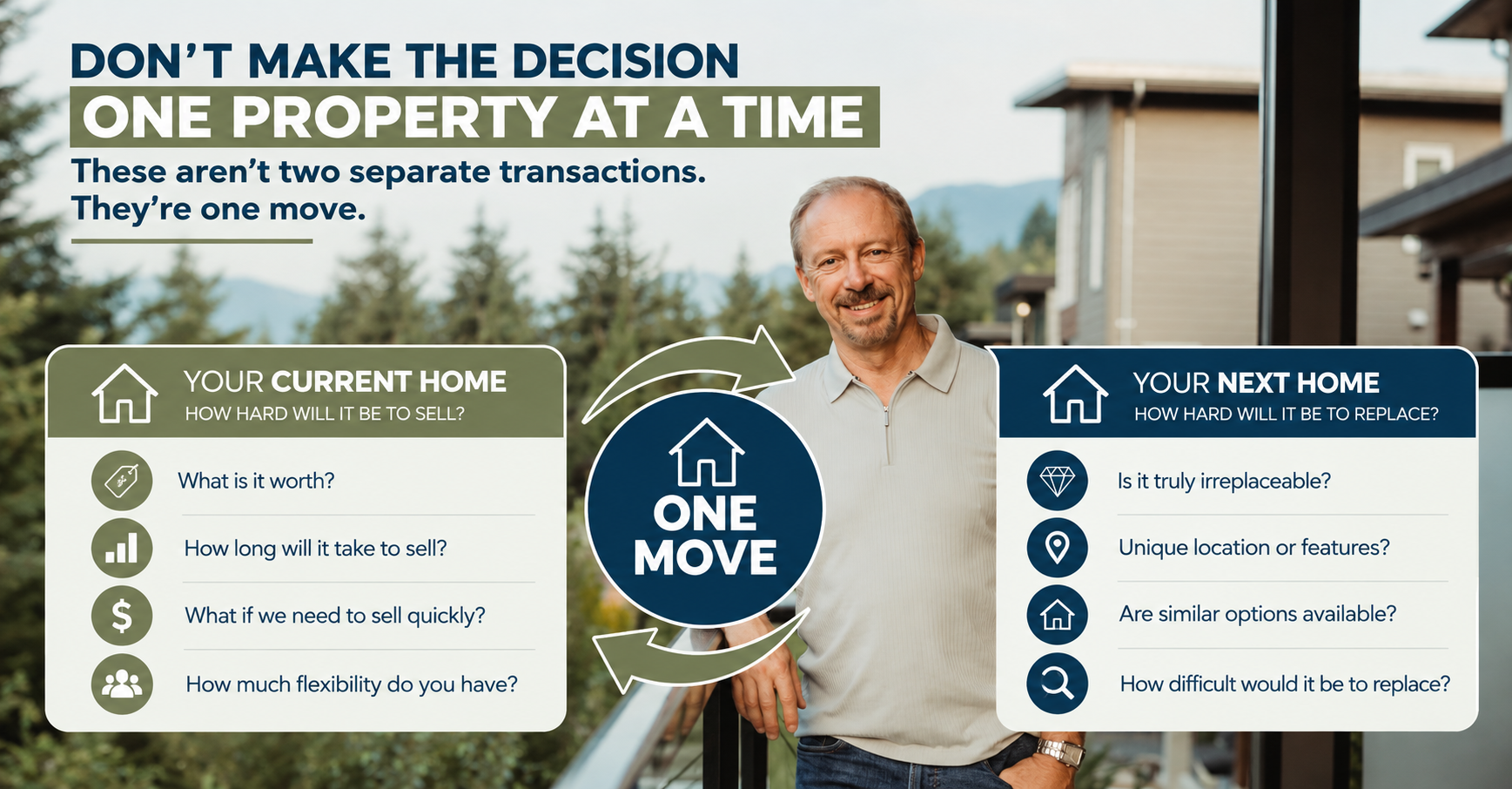
Don't Make the Decision One Property at a Time
The biggest mistake would be looking only at the home you want to buy and becoming so excited about it that you forget to analyze the property you need to sell.
These aren't really two independent transactions.
They're one move.
Before you make an offer, you should understand what your current home is worth, how long it's likely to take to sell, what you'd need to price it at if time became critical and how much flexibility you have if the market doesn't behave exactly as expected.
At the same time, you need to understand how difficult the property you're buying would be to replace.
Once we know those things, the decision usually becomes much clearer.
So should you buy your next Squamish home before you sell your current one?
Sometimes, absolutely.
If you've found something truly irreplaceable and we've already established a realistic plan for selling your existing property, I don't necessarily want you losing the home you've been waiting years to find simply because somebody told you that you're always supposed to sell first.
But if you're choosing between properties where another suitable option is likely to appear in a few months, there's much less reason to put yourself under unnecessary pressure.
Before deciding whether to buy first or sell first, ask two questions: How hard will my current home be to sell, and how hard will the home I want to buy be to replace?
Those answers—not a generic rule—should determine which move comes first.
 The data relating to real estate on this website comes in part from the MLS® Reciprocity program of either the Greater Vancouver REALTORS® (GVR), the Fraser Valley Real Estate Board (FVREB) or the Chilliwack and District Real Estate Board (CADREB). Real estate listings held by participating real estate firms are marked with the MLS® logo and detailed information about the listing includes the name of the listing agent. This representation is based in whole or part on data generated by either the GVR, the FVREB or the CADREB which assumes no responsibility for its accuracy. The materials contained on this page may not be reproduced without the express written consent of either the GVR, the FVREB or the CADREB.