

Why interest rates, fuel prices, global events and migration can have such a significant impact on a small community.
One of the things I think people misunderstand about the Squamish real estate market is just how much we're affected by what's happening in the broader Canadian economy.
There's sometimes a perception that because Squamish is a desirable community, surrounded by mountains, with an incredible lifestyle and a relatively limited supply of housing, we're somehow insulated from what's happening elsewhere.
But I actually think the opposite can be true.
In my experience, Squamish can be particularly sensitive to changes in the Canadian economy precisely because we're a relatively small real estate market.
We don't have the enormous pool of potential buyers that you would find in a major metropolitan centre. So when something happens that changes the financial circumstances or confidence of even a relatively small number of buyers, we can notice that change quite quickly.
And those events don't necessarily have to happen in Squamish.
They might be a Bank of Canada interest rate announcement, a conflict on the other side of the world that increases fuel prices, a change in employment conditions or a shift in where Canadians want to live.
All of those things can influence our housing market, sometimes quite dramatically.
I think there are several good examples that help explain why.
Why a Small Buyer Pool Makes Squamish Sensitive to Economic Changes
Let's start with the size of our market.
Squamish is a relatively small community compared with Vancouver or other major Canadian cities. Although we've grown considerably, we still have a much smaller number of people actively buying and selling real estate.
That matters because real estate prices are influenced by the balance between buyers and sellers.
Imagine there are a certain number of buyers actively looking for entry-level properties in Squamish. Those buyers might be considering condos, smaller townhouses or their first detached home.
Now suppose something changes in the economy that causes a portion of those buyers to step away from the market.
Maybe their mortgage qualification changes. Maybe they're worried about their jobs. Or perhaps their monthly living expenses have increased enough that they're no longer comfortable purchasing.
In a large market, there may be enough other buyers to absorb some of that change without it being particularly noticeable in every neighbourhood or property category.
But in a smaller market like Squamish, losing even a handful of active buyers from a particular price range can have a meaningful effect.
Suddenly, properties that might previously have attracted several interested buyers are receiving fewer showings. Offers become less frequent, and sellers may have to adjust their expectations.
Of course, the reverse can also happen.
If economic conditions improve and a relatively small number of additional buyers enter the market, competition can increase quite quickly, particularly when there aren't many suitable properties available.
That's one of the reasons I pay close attention to changes in buyer activity rather than looking exclusively at the latest sales statistics.
By the time a change is clearly visible in average or benchmark prices, buyer behaviour may already have been changing for some time.
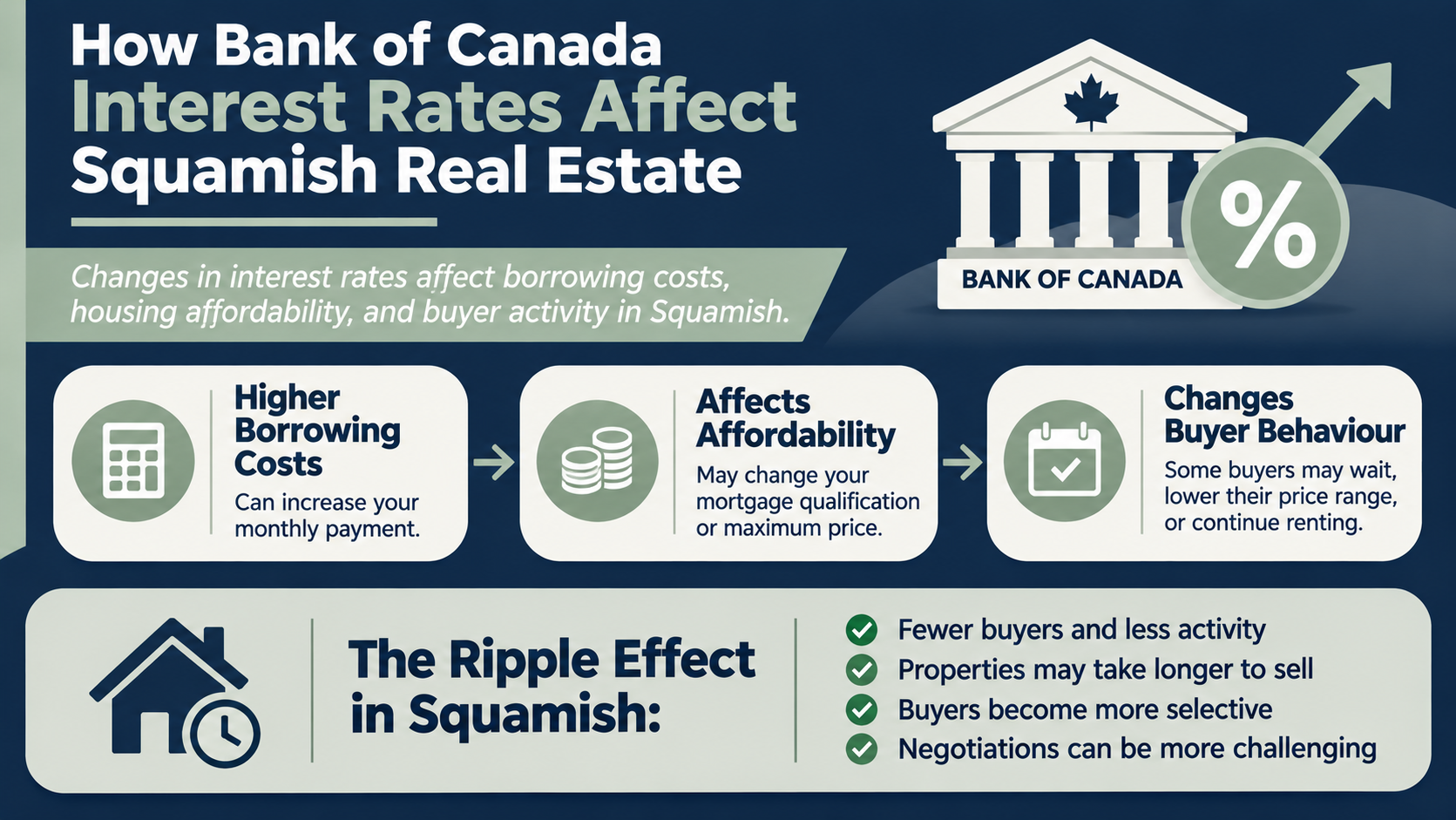
How Bank of Canada Interest Rates Affect Squamish Real Estate
Interest rates are probably the most obvious example of how the national economy influences our local housing market.
When the Bank of Canada changes its policy interest rate, that can affect the borrowing costs offered by financial institutions.
The relationship isn't identical for every mortgage product. Variable mortgage rates are generally more directly influenced by changes in lenders' prime rates, while fixed mortgage rates are also influenced by bond markets and other factors.
But the broader point is that changes in borrowing costs affect housing affordability.
And I think that effect can be particularly noticeable among first-time buyers and people purchasing at the more affordable end of the Squamish market.
These are often buyers who are already working close to the limits of what they're comfortable spending.
A change in interest rates might affect their mortgage qualification, their expected monthly payments or simply their confidence in making a substantial financial commitment.
For example, if a buyer is looking at a townhouse and a change in borrowing costs means the monthly payment is now higher than they anticipated, they might decide to wait.
Another buyer might have to reduce their maximum purchase price.
A third might decide to continue renting for another year.
Individually, those decisions might not seem particularly significant.
But when several buyers make similar decisions around the same time, it can change the amount of activity in a relatively small property category.
And once that happens, sellers start to notice.
Properties may take longer to sell, buyers may become more selective, and negotiations can become more difficult.
That's how a national interest rate decision can eventually affect the price somebody receives for a townhouse or condo in Squamish.
A current example: October 2026
On October 28, 2026, the Bank of Canada increased its policy rate by 0.25 percentage points, bringing the overnight rate to 2.5%.
The Bank cited persistent energy-related inflation and broader cost pressures among the reasons for its decision.
That doesn't mean Squamish property prices will immediately fall because of one interest rate announcement.
But it is exactly the kind of economic development I watch, because changes in borrowing costs can influence the number of buyers willing and able to participate in our market.
The first effect may be on confidence and activity. Any impact on sale prices can take longer to become apparent.
Why Gas Prices Matter More to Squamish Than People Might Think
Here's another example that I think is particularly relevant to Squamish.
Gas prices.
At first glance, you might wonder what the price of gasoline has to do with the value of a house.
But when you consider how many people live in Squamish and commute to North Vancouver or Vancouver for work, the connection becomes fairly obvious.
One of the decisions people make when considering a move to Squamish is whether the lifestyle advantages are worth the additional travel.
For many people, the answer is absolutely yes.
They love the mountains, the outdoor recreation, the community and the opportunity to live somewhere that feels different from a major city.
But there is a financial calculation involved as well.
And that calculation has changed as Squamish property prices have increased.
There was a time when the difference in housing costs between Squamish and North Vancouver could be a major financial incentive to move north.
Squamish can still offer a meaningful price advantage, depending on the type of property you're comparing, but housing here has become considerably more expensive over the years.
So for some buyers, the financial difference isn't as compelling as it once was.
Now add a substantial increase in gasoline prices.
If somebody is driving the Sea to Sky Highway to work several days a week, that increase can have a real impact on their monthly expenses.
And it's not just gasoline. There may also be additional vehicle maintenance, insurance, time and other costs associated with commuting.
If the cost of living in Squamish starts approaching the cost of living closer to work, the buyer has to decide how much the Squamish lifestyle is worth to them.
Some people will happily pay the difference.
Others might decide that living in North Vancouver or somewhere closer to their employment makes more financial sense.
And when those buyers decide not to move to Squamish, that affects our potential buyer pool.
How international conflict can affect local housing demand
This is particularly relevant with the current conflict in the Middle East, including Iran, and the resulting disruption to global energy markets.
In its October 2026 economic outlook, the Bank of Canada identified higher oil prices, supply disruptions and unusually high refinery margins as important contributors to increased fuel costs.
That's an international event having an impact on household expenses here in Canada.
And for a Squamish resident commuting to Vancouver, the impact can be very personal.
It's a good example of how something happening thousands of kilometres away can influence whether somebody decides to buy a home in Squamish.
I wouldn't suggest that higher gas prices automatically cause house prices to fall. There are too many other factors involved.
But they can influence the financial decisions of people considering moving here, and that can change demand.
COVID Showed How Quickly Squamish Housing Demand Can Change
Another example is COVID.
I think the pandemic was one of the clearest demonstrations of how a global event can dramatically change the way people think about where they want to live.
Before COVID, many people were comfortable living in densely populated urban centres because they needed to be close to their workplaces.
Then the pandemic changed working arrangements, commuting patterns and people's priorities.
Suddenly, a lot of people were spending much more time at home.
Some could work remotely. Others began questioning whether they really needed to live in a downtown condo or close to an office they weren't visiting every day.
And communities like Squamish became particularly attractive.
People could move somewhere with more immediate access to outdoor recreation, a different pace of life and, depending on their budget and housing choices, more space.
In my view, that change in priorities contributed significantly to the acceleration of interest in Squamish real estate during the pandemic period.
It wasn't simply that people suddenly discovered Squamish.
People had been moving here for the lifestyle for years.
But COVID changed the circumstances under which many buyers made their housing decisions, and that helped accelerate a trend that was already underway.
That's an important distinction.
A global event didn't create Squamish's lifestyle appeal. It changed how many people valued that lifestyle and whether moving here was practical for them.
And when a relatively small market experiences a significant increase in demand, the effect can be substantial.
The Economy Doesn't Affect Every Canadian Housing Market the Same Way
Now, this is where the conversation becomes more complicated.
Just because a national economic event affects housing doesn't mean property prices move in the same direction everywhere in Canada.
Different communities have different employment markets, housing supplies, population trends and levels of affordability.
So you can have property prices weakening in one region while another region remains relatively stable or even experiences price increases.
And Squamish has another interesting connection to the rest of Canada.
It's not just that people move here from other communities.
People also sell their homes in Squamish and move to other provinces.
And the difference in property values can make that an attractive financial decision.
Why Some Squamish Homeowners Can Sell and Move Mortgage-Free
Imagine somebody purchased a home in Squamish five or ten years ago.
Over that period, the property has increased significantly in value, and they've also been paying down their mortgage.
They may now have a substantial amount of equity in the property.
Depending on when they purchased, what they paid and their remaining mortgage balance, that equity could be several hundred thousand dollars.
Now imagine they're considering moving to Alberta or Saskatchewan.
In some communities in those provinces, they may be able to purchase a suitable home for considerably less than the cost of a comparable property in Squamish.
For somebody with $500,000 or $600,000 in available equity, there may be opportunities to buy a property with little or no mortgage, depending on where they move and what they want to purchase.
That's a significant lifestyle and financial decision.
Instead of carrying a large mortgage in Squamish, they might choose to live somewhere with a much lower monthly housing cost.
They may have family elsewhere, be approaching retirement or simply want to reduce their financial obligations.
And the difference between housing markets can make that possible.
Of course, not everybody who has owned property in Squamish for ten years has accumulated that amount of equity. Individual circumstances vary enormously.
But the principle is important.
The relative affordability of housing in other parts of Canada can influence whether existing Squamish homeowners decide to stay or sell.
And that can affect the supply of properties available in our local market.
Squamish Doesn't Necessarily Follow Vancouver or the Rest of Canada
One thing I would caution people against is assuming that Squamish property prices will automatically move in the same direction, or at the same speed, as prices in Vancouver, Toronto or the rest of Canada.
We're connected to those markets, but we're not identical.
For example, changes in Vancouver housing affordability can influence the number of people considering Squamish.
If Vancouver prices become less affordable relative to Squamish, that may encourage some buyers to look north.
But if the difference narrows, and commuting costs are increasing at the same time, some of those buyers may reconsider.
Likewise, national interest rate changes can affect affordability across the country, but the effect on an individual community depends on its local housing supply and the financial circumstances of its buyers.
Squamish also has different property categories, and they don't necessarily respond in exactly the same way.
Entry-level condos, townhouses, detached houses and higher-end properties can all have different buyer pools.
A change that significantly affects first-time buyers might have a smaller impact on somebody purchasing a more expensive property with substantial equity from a previous home.
That's why I think it's important to interpret national economic news through the circumstances of our local market.
What the Latest Squamish Numbers Tell Us
The September 2026 MLS Home Price Index figures provide an interesting illustration of how different local markets can perform.
The composite benchmark price in Squamish was approximately $1.092 million, virtually unchanged from September 2025.
In North Vancouver, the composite benchmark was approximately $1.290 million, down 3.9% over the same period.
That doesn't mean Squamish is immune to broader economic conditions.
It demonstrates that neighbouring markets can experience different price movements even while operating under the same national interest rates and broader economic environment.
The individual property categories tell an additional story.
In September 2026, the benchmark detached house in Squamish was approximately $1.615 million, compared with approximately $2.042 million in North Vancouver.
So there is still a substantial difference in the detached housing benchmarks, even though the affordability gap has narrowed from what some longtime buyers may remember.
And for someone deciding whether to live in Squamish and commute, that difference has to be considered alongside their actual transportation costs and lifestyle preferences.
These numbers are useful context, but they're not a substitute for evaluating an individual property.
What I Watch When Trying to Understand Where Squamish Real Estate Is Heading
When I'm assessing the direction of the Squamish market, I don't look at one economic statistic and assume it tells me everything.
Interest rates are important, but so are employment conditions, inflation, consumer confidence and the cost of living.
I also pay attention to what's happening in Vancouver and North Vancouver because those markets influence people who are considering relocating to Squamish.
But most importantly, I want to understand how those broader economic conditions are affecting actual buyer behaviour here.
Are buyers still booking showings?
Are they making offers?
Are they becoming more cautious about their budgets?
Are properties receiving multiple offers, or are sellers having to negotiate more aggressively?
And are we seeing changes in one property category before they become apparent in another?
Those are the things that help connect the economic headlines with what's actually happening in the Squamish real estate market.
Because an economic event doesn't directly change the price of every property overnight.
It changes people's circumstances, expectations and decisions.
Those decisions affect how many buyers and sellers participate in the market.
And eventually, that can affect property values.
So, How Much Does the Canadian Economy Affect Squamish Real Estate?
I think the answer is considerably more than many people realize.
Squamish is a desirable place to live, and I believe the lifestyle here will continue to attract people.
But that doesn't mean our real estate market operates independently of the Canadian economy.
If interest rates increase, some buyers may no longer be able or willing to purchase at the same price.
If fuel prices rise significantly, people commuting to Vancouver may reconsider the financial advantages of living in Squamish.
If a global event changes working arrangements or lifestyle priorities, we may see a significant shift in the number of people wanting to move here.
And if homeowners can sell in Squamish and buy a suitable home elsewhere in Canada for substantially less, that can influence the number of properties coming onto our market.
All of these forces matter.
And because Squamish is a relatively small market, changes in the number of active buyers and sellers can become noticeable quite quickly.
The important thing to understand is that the Canadian economy doesn't affect Squamish property values directly. It affects the decisions people make, and those decisions ultimately influence our real estate market.
That's why I think understanding what's happening nationally and internationally is an important part of understanding what's happening locally.
If you're buying or selling a home in Squamish, it's worth looking beyond the latest local sales numbers and considering the broader economic forces influencing the people on the other side of your transaction.
Simon Hudson | Team Hudson, Macdonald Realty | Squamish, British Columbia
Market figures referenced are for September 2026. Economic conditions and housing statistics change over time.
 The data relating to real estate on this website comes in part from the MLS® Reciprocity program of either the Greater Vancouver REALTORS® (GVR), the Fraser Valley Real Estate Board (FVREB) or the Chilliwack and District Real Estate Board (CADREB). Real estate listings held by participating real estate firms are marked with the MLS® logo and detailed information about the listing includes the name of the listing agent. This representation is based in whole or part on data generated by either the GVR, the FVREB or the CADREB which assumes no responsibility for its accuracy. The materials contained on this page may not be reproduced without the express written consent of either the GVR, the FVREB or the CADREB.