

One of the most frustrating situations for a seller is having people continually come through their property without anybody writing an offer.
You get a showing.
You clean the house.
You leave for an hour.
The buyers come through.
Then nothing happens.
A few days later, another showing.
Then another.
Eventually, the seller starts asking the obvious question:
If all these buyers are looking at my property, why isn't anybody making an offer?
In the current Squamish real estate market, I think sellers need to understand that buyers are behaving very differently than they do in a strong or rising market.
They have a lot of selection.
They're being extremely particular about what they buy.
They're financially cautious.
They're willing to wait.
And perhaps most importantly:
They're looking for a deal.
That doesn't necessarily mean they're expecting to steal your property.
It means they want to believe they're getting enough value today that they'll still feel comfortable with their purchase if prices continue to soften.
Squamish Buyers Have a Lot to Choose From
At the beginning of September, my analysis of the Greater Vancouver REALTORS® MLS® data showed approximately 267 properties for sale in Squamish.
That's a significant amount of inventory heading into the fall.
And we're seeing similar conditions across the broader Metro Vancouver market.
In August, Metro Vancouver residential sales were 20.7% below the 10-year seasonal average, while total inventory was 26.2% above its 10-year seasonal average. Greater Vancouver REALTORS® described the combination of slower sales and ample inventory as causing prices to continue drifting downward.
For a Squamish seller, the practical consequence is pretty simple:
Your buyer has choices.
And when buyers have choices, they become picky.
Some Properties Need a Very Specific Buyer
This is particularly important if you're selling something relatively unique.
You may have a property that is fairly priced and marketed properly and still get a lot of people through the door who aren't serious candidates to buy it.
They're interested enough to look.
The photographs got their attention.
The description worked.
The price was within their range.
But once they're standing inside the property, they realize it isn't quite what they're looking for.
In a faster market, buyers sometimes compromise because they're worried somebody else will buy the property.
In a slower market with lots of inventory, they don't have the same pressure.
They can say:
“I like it, but I don't love it. Let's see what else comes up.”
That's particularly challenging with a property that requires a specific buyer.
You may simply have to wait for the person who wants exactly what you have.
But there's another possibility sellers need to consider.
Lots of Showings and No Offers Can Be a Price Signal
If nobody is coming through the property at all, that's one problem.
But if you're getting reasonable showing activity, people like the property, and nobody is prepared to write an offer, that tells us something different.
We've done enough to get buyers through the front door.
Now we need to understand what's stopping them from taking the next step.
Sometimes it genuinely is the property.
Maybe the layout doesn't work.
Maybe the location isn't right for that particular buyer.
Maybe they need another bedroom.
Maybe they want more privacy.
Maybe they simply don't connect with the house.
But if this happens repeatedly, we have to start looking very seriously at price.
Buyers may be telling us that they like the property—they just don't like it enough at the current price.
That's useful information.
Buyers Are Also Looking for Move-In Condition
There's another dynamic I'm seeing right now.
Buyers are financially stretched.
Even though prices have softened, housing in Squamish is still expensive, and many buyers are putting a significant amount of their available resources into purchasing the property itself.
That changes what they want to buy.
Suppose somebody buys a house and immediately needs to spend $40,000 renovating the kitchen.
That's another $40,000 they have to find after they've already dealt with the down payment, closing costs, moving expenses and everything else involved in buying a house.
A lot of buyers simply don't want to do that right now.
They want something they can live in.
That Doesn't Mean Sellers Should Spend $40,000 Renovating
This is where it becomes a bit of a catch-22.
I've talked about this previously: I generally don't think this is the market where a seller should assume that spending $40,000 on a renovation will automatically add $40,000 to the sale price.
It may not.
So I'm not suggesting that every seller with an older kitchen should renovate it before listing.
What I am saying is that we need to make the property feel as livable as reasonably possible.
Clean it.
Declutter it.
Deal with obvious maintenance items.
Stage it appropriately where that makes sense.
Improve the first impression.
Help buyers understand how the space works.
You don't necessarily need to give them a brand-new house.
But you want to remove as many reasons as possible for them to think:
“This is another thing I'm going to have to deal with after I move in.”
This Comes Back to the Four Ps
I've previously written about the Four Ps I use when thinking about selling a property:
Price. Position. Preparation. Presentation.
Position is what the property fundamentally is—its location, setting, views, privacy, layout and other characteristics you generally can't change.
Preparation is what we do to get the property ready for the market.
Presentation is how we expose it to buyers through photography, video, descriptions, marketing and the overall way it's presented.
We work on all of those things.
But eventually we reach a point where we've done what we reasonably can.
We can't move the house.
We've prepared it.
We've presented it properly.
Buyers are seeing it.
At that point, the biggest variable we can still manipulate is:
Price.
And price has an enormous impact on whether a property sells.
Today's Buyer Wants to Feel Protected
This is probably the biggest thing I want sellers to understand about buyer psychology right now.
Buyers can see what's happening.
They know properties are taking longer to sell.
They know they have choices.
They know prices have been softening.
The broader GVR numbers reinforce what they're experiencing. The Metro Vancouver composite benchmark price in August was down 5.6% from August 2025 and 0.6% from July. GVR also noted that even with ample selection, softer prices and stable mortgage rates, many buyers remained on the sidelines.
That creates a particular mentality.
A buyer doesn't want to purchase something today and immediately feel like they overpaid for it.
So they're looking for value.
They're trying to build some protection into their purchase price.
That's what sellers are negotiating against.
Sellers Need to Be Prepared for a Low Opening Offer
This is where the conversation can become difficult.
I've been tracking the relationship between asking prices and actual Squamish sale prices.
In my analysis of recent Squamish MLS® sales, properties were selling at roughly 98% of asking price several months ago.
That number has gradually declined.
We're now around the 95% range.
That's significant.
And from my experience watching market cycles, when that relationship continues moving below roughly 95%, I start paying close attention because it can be another indication of downward pressure on prices.
But here's something sellers need to understand:
If properties are ultimately selling around 95% of asking price, that doesn't mean the buyer is necessarily going to start their negotiation at 95%.
They may start much lower.
A Buyer Might Start 10% or 15% Below Asking
This can be shocking for sellers.
You list a property for $1 million.
Somebody writes an offer at $850,000 or $900,000.
The immediate emotional response can be:
“That's ridiculous. They're not serious.”
Maybe.
But not necessarily.
The buyer may simply be establishing their opening negotiating position.
If they believe the market is declining, they may want to find out how motivated the seller is.
They may be willing to increase substantially.
The seller may be willing to decrease somewhat.
And somewhere in the middle there may be a transaction that works for both parties.
The important distinction is this:
I'm not saying Squamish properties are currently selling 10% or 15% below asking price.
I'm saying that in this type of market, sellers shouldn't be surprised to see buyers start there.
That's very different.
Don't Let the First Number End the Conversation
One of the biggest mistakes a seller can make is becoming so offended by an opening offer that they refuse to engage with the buyer.
An offer is information.
It tells us somebody has moved beyond browsing.
They've looked at the available properties.
They've considered yours.
And they've taken the time to put something in writing.
Now we have somebody to negotiate with.
That doesn't mean the seller has to accept a bad price.
It doesn't mean we give the property away.
It doesn't mean every buyer deserves a massive discount.
It means we determine whether there's a transaction hiding inside that initial offer.
That's my job as the seller's Realtor.
The Real Question Is: Why Hasn't the Buyer Acted?
When I'm looking at a listing that has had a reasonable number of showings but hasn't received an offer, I don't think the answer is automatically:
“We just need more marketing.”
Sometimes we do.
Sometimes we need more time.
Sometimes we're waiting for a very specific buyer.
But eventually we need to ask a harder question:
What is preventing the buyers who are already seeing this property from acting?
If the property is prepared properly...
If the presentation is good...
If buyers understand the position...
If we're getting them through the door...
...then price becomes increasingly difficult to ignore.
That's particularly true in a market where buyers have a lot of alternatives.
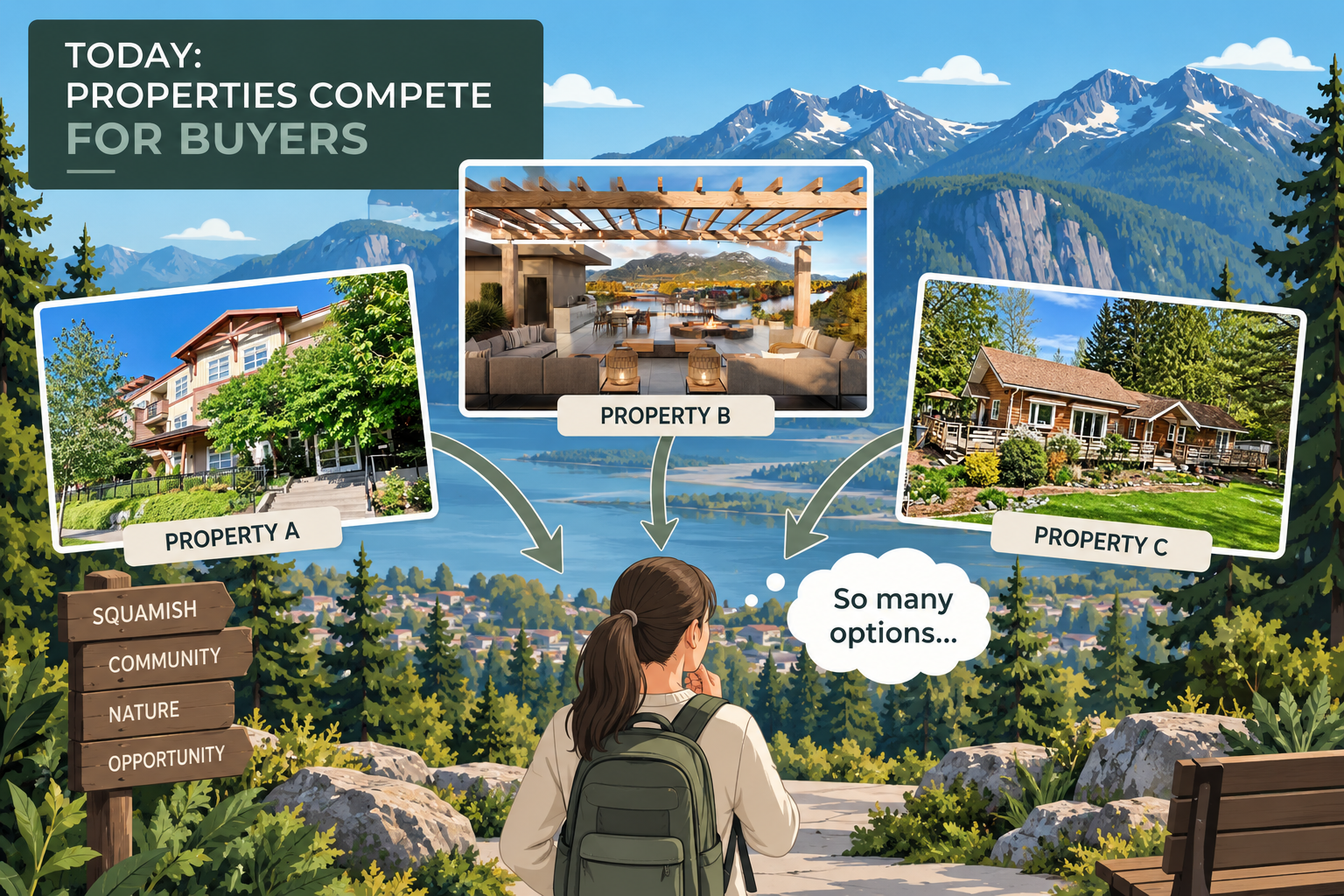
Sellers Are Competing for the Buyer
This is one of the biggest differences between a strong seller's market and the market we're experiencing now.
In a very strong market, several buyers may compete for one property.
Today, in many cases, several properties are competing for one buyer.
That completely changes the psychology.
The buyer can compare your house with another house.
Your townhouse with another townhouse.
Your renovation with another renovation.
Your location with another location.
And your price with everything else they can buy.
You aren't pricing your property in isolation.
You're positioning it against every reasonable alternative that buyer has.
What Should a Squamish Seller Expect Right Now?
Expect buyers to be selective.
Expect some showings from people who simply aren't the right buyer.
Expect buyers to favour properties they can comfortably live in without immediately spending significant additional money.
Expect them to compare your property aggressively with the competition.
Expect them to take their time.
Expect them to look for value.
And if you receive an offer, be prepared for the opening number to be lower than you'd like.
None of that means you have to give your property away.
It means you have to understand the market you're negotiating in.
Because ultimately, selling a property isn't about convincing buyers what you think your home should be worth.
It's about understanding what the buyers who are actually in the market are prepared to pay.
And right now, those buyers have choices.
If they're coming through your property but aren't writing offers, they're telling you something.
The job is to figure out exactly what that is—and then decide whether you're prepared to respond.
 The data relating to real estate on this website comes in part from the MLS® Reciprocity program of either the Greater Vancouver REALTORS® (GVR), the Fraser Valley Real Estate Board (FVREB) or the Chilliwack and District Real Estate Board (CADREB). Real estate listings held by participating real estate firms are marked with the MLS® logo and detailed information about the listing includes the name of the listing agent. This representation is based in whole or part on data generated by either the GVR, the FVREB or the CADREB which assumes no responsibility for its accuracy. The materials contained on this page may not be reproduced without the express written consent of either the GVR, the FVREB or the CADREB.