

If you’re thinking about doing a major renovation to your Squamish home just before putting it on the market, my advice right now is generally pretty simple:
This is probably not the time to do it.
A few years ago, I was much more inclined to recommend renovations before selling. In a rising market, putting money and effort into a property could produce a meaningful increase in what buyers were prepared to pay.
Today’s market is different.
Buyers are considerably more price-sensitive, renovation work is expensive, and we’re not in a market where I think a seller should automatically assume that spending $50,000 renovating a property is going to put $50,000—or more—back into their pocket when they sell.
That doesn’t mean renovations have no value.
A renovated property can absolutely be easier to sell. It can show better. It can attract buyers who don’t want to take on a project. And in some circumstances, doing some work before listing makes complete sense.
But there’s an important distinction:
Helping your property sell and making money on a renovation are not necessarily the same thing.
The Market Has Changed
This is really where the conversation starts.
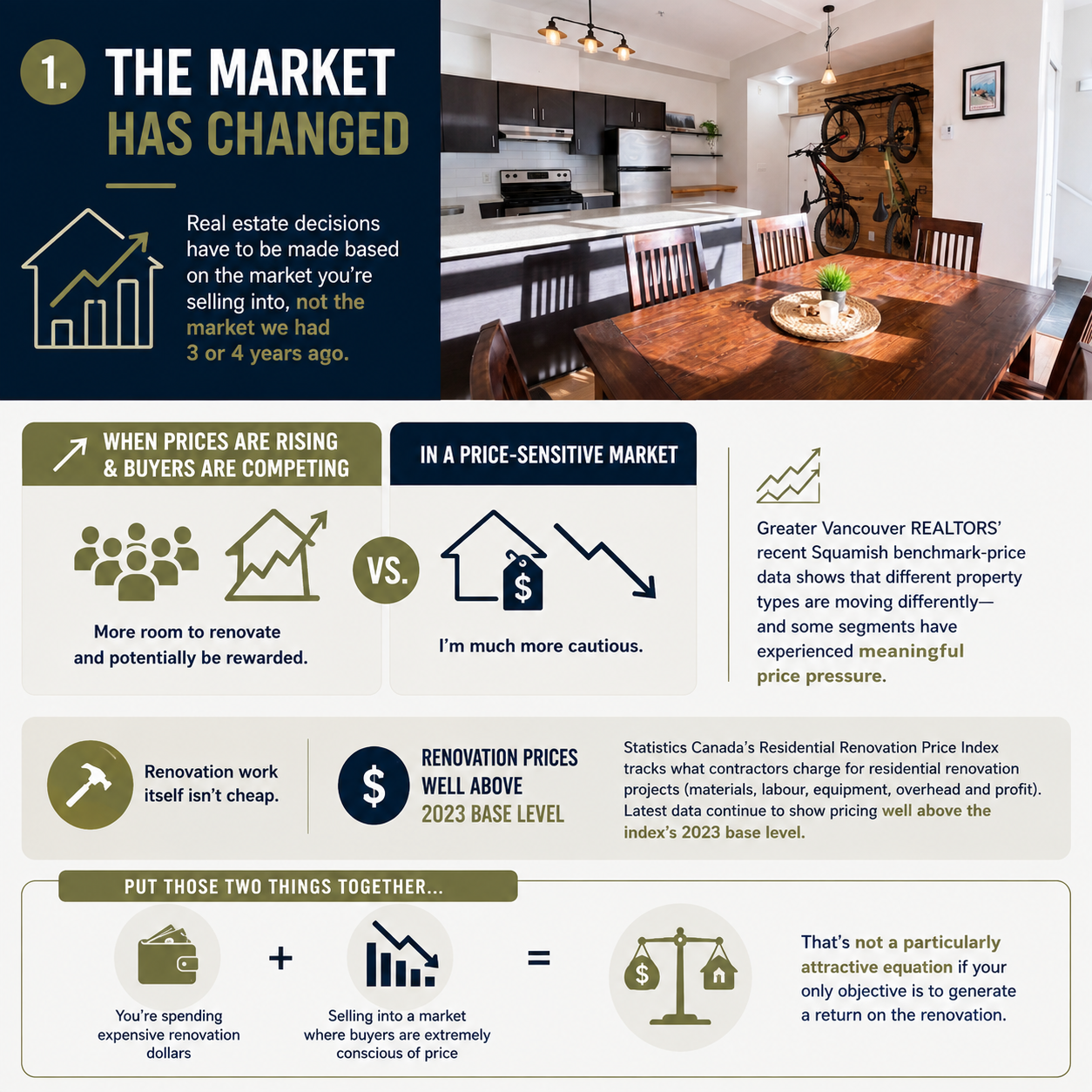
Real estate decisions have to be made based on the market you’re selling into, not the market we had three or four years ago.
When prices are moving rapidly upward and buyers are competing aggressively, there’s more room for a seller to renovate a property and potentially be rewarded for it.
In a price-sensitive market, I’m much more cautious.
Greater Vancouver REALTORS’ recent Squamish benchmark-price data illustrates why sellers need to think carefully rather than assuming the market will automatically reward additional spending. Different property types have been moving differently, and some segments have experienced meaningful price pressure.
At the same time, renovation work itself isn’t cheap.
Statistics Canada’s Residential Renovation Price Index tracks what contractors charge for residential renovation projects, including materials, labour, equipment, overhead and profit. The latest data continue to show renovation pricing well above the index’s 2023 base level.
Put those two things together and you can see the problem.
You’re spending expensive renovation dollars while trying to sell into a market where buyers are extremely conscious of price.
That’s not a particularly attractive equation if your only objective is to generate a return on the renovation.
A Renovation May Help You Sell Faster
This is where I want to make an important distinction.
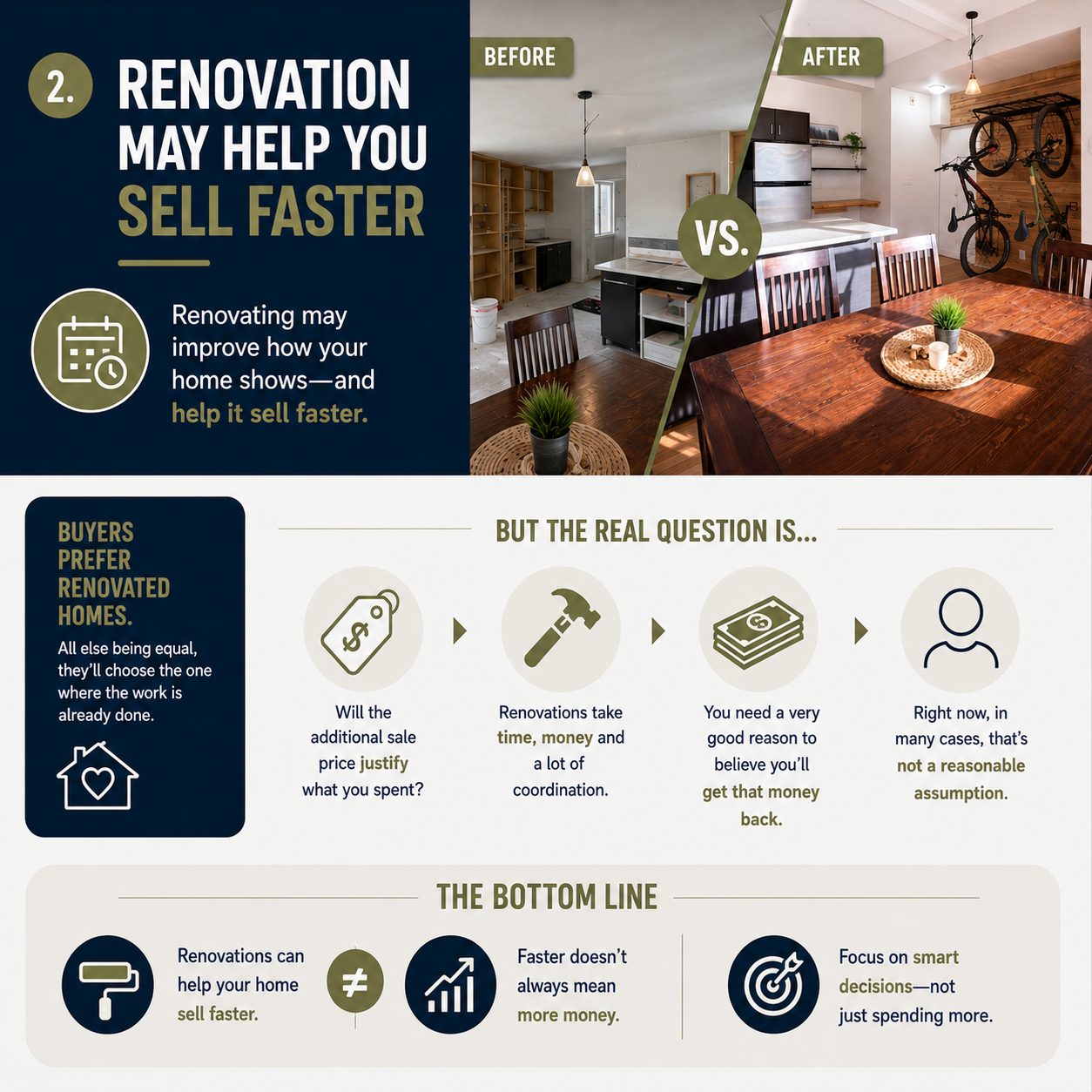
I’m not saying buyers don’t prefer renovated homes.
Of course they do.
Give a buyer two otherwise comparable properties at comparable prices and, generally speaking, they’re going to be attracted to the one where the work has already been done.
So renovating may improve the presentation of the property and potentially help it sell faster.
What I question in this market is whether the additional sale price will justify the money you’ve spent getting there.
If you’re going to spend months managing trades and put a substantial amount of money into a renovation immediately before selling, I want to have a very good reason to believe you’re going to get that money back.
Right now, in many cases, I don’t think that’s a reasonable assumption.
Don’t Renovate One Room in an Otherwise Dated House
This is one of the biggest mistakes I see sellers considering.
Imagine you have an older Squamish house that hasn’t really been updated.
The kitchen is dated. The bathrooms are dated. The flooring is older. The finishes throughout the house are from another era.
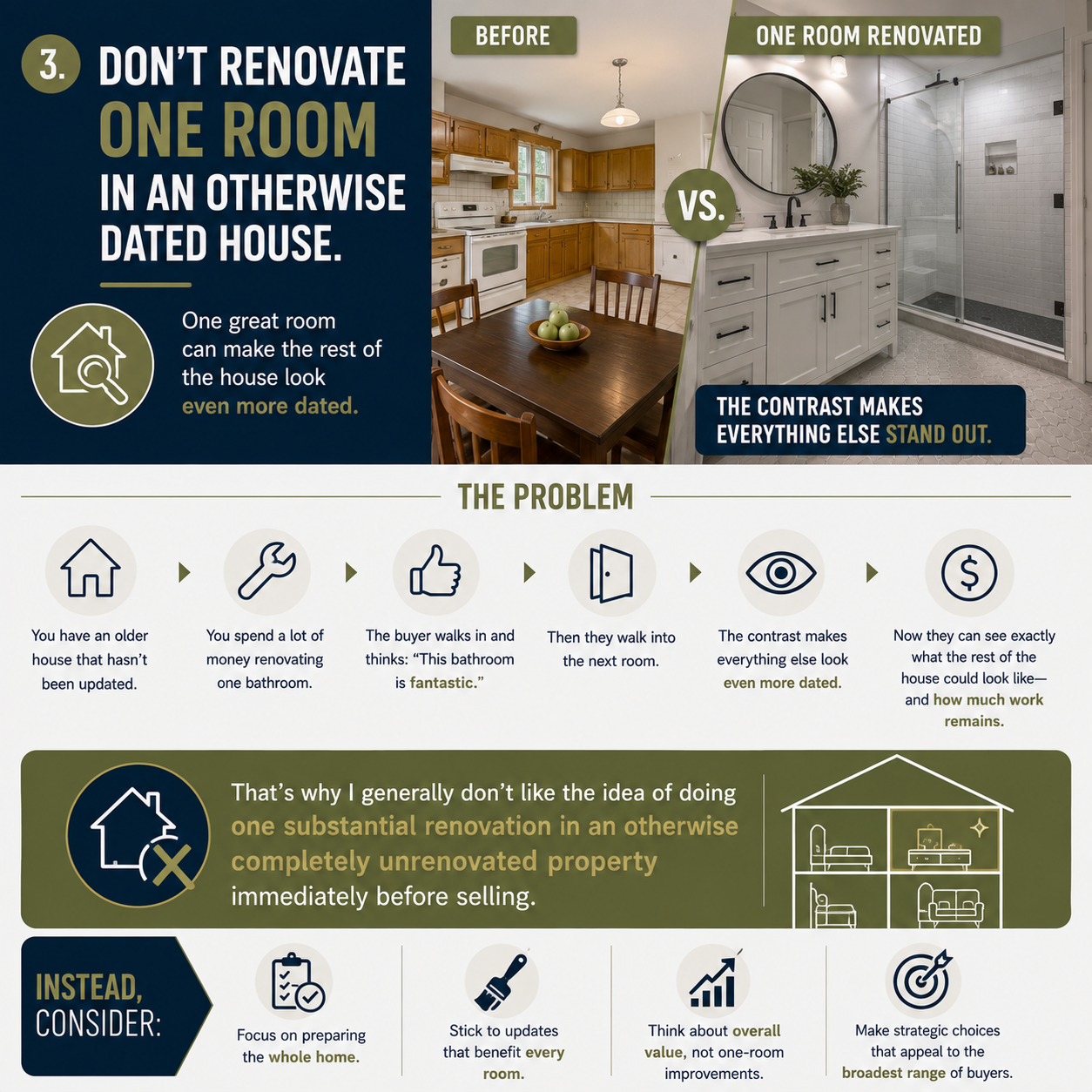
Then you spend a significant amount of money renovating one bathroom.
The buyer walks in and thinks:
This bathroom is fantastic.
Then they walk into the next room.
And suddenly the contrast makes everything else look even more dated.
Instead of eliminating the buyer’s perception that there’s work to do, you may actually have emphasized it.
They can now see exactly what the rest of the house could look like—and how much work remains to get it there.
That’s why I generally don’t like the idea of doing one substantial renovation in an otherwise completely unrenovated property immediately before selling.

You’re Renovating for Someone You Haven’t Met
There’s another problem.
You don’t know who is going to buy your house.
You might choose the kitchen cabinets you love.
You might choose the flooring you love.
You might spend a lot of money on a bathroom that looks exactly the way you think a bathroom should look.
And then the buyer walks through the door and doesn’t like any of it.
That’s the difficulty with undertaking a major renovation specifically for resale.
You’re spending your money based on your taste and hoping it matches the taste of a buyer you haven’t met yet.
If the buyer would have preferred different flooring, different cabinets or a different layout, they may not assign the same value to the renovation that you do.
The fact that you spent $40,000 doesn’t mean the buyer automatically sees $40,000 of additional value.
But What If the House Is Already 75% Renovated?
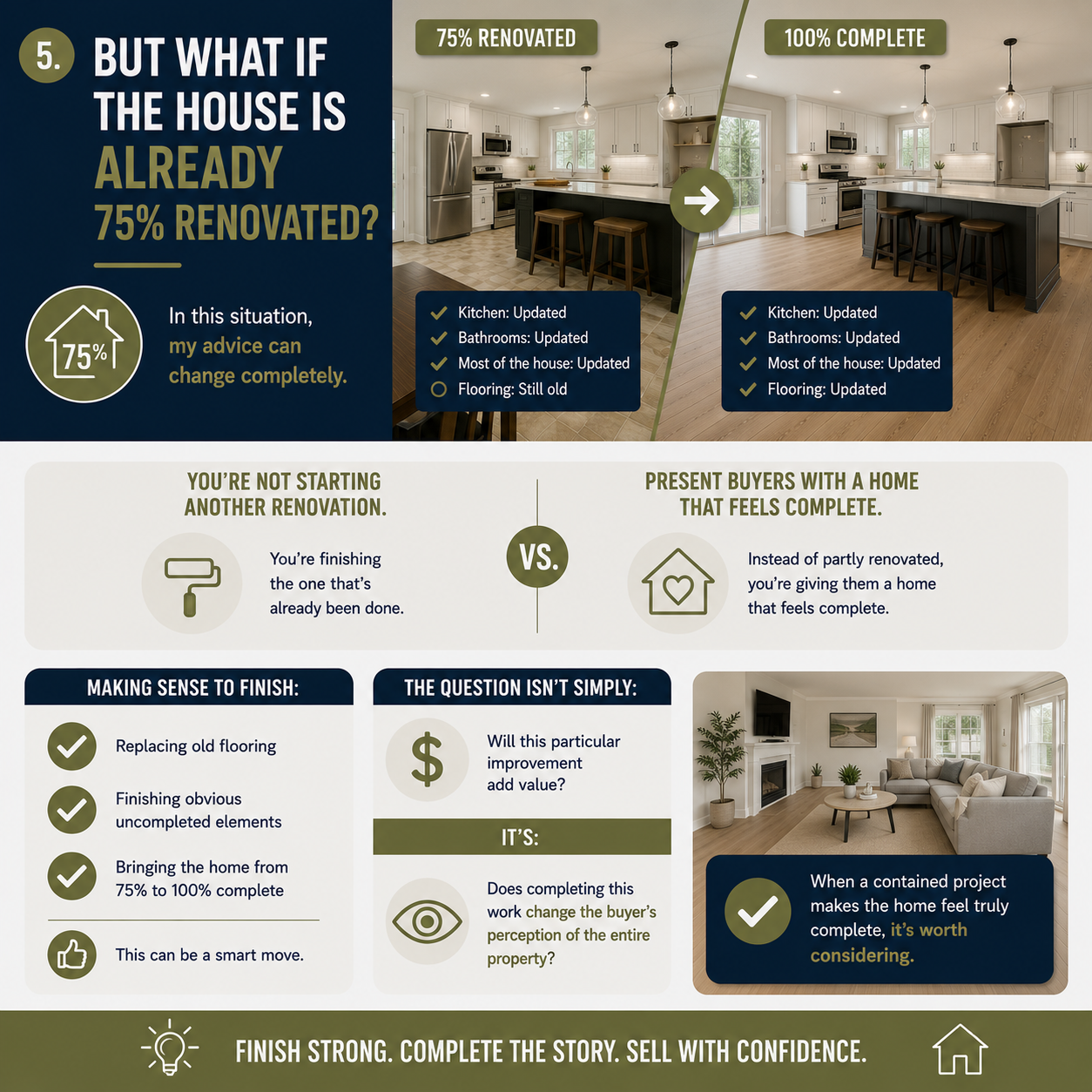
This is where my advice can change completely.
Suppose you’ve already renovated the kitchen.
You’ve already renovated the bathrooms.
You’ve updated most of the house.
But the old flooring is still there.
Now we’re having a very different conversation.
In that situation, replacing the flooring may make sense because you’re not starting another renovation.
You’re finishing the one that’s already been done.
Instead of presenting buyers with a house that’s partly renovated, you’re potentially giving them a home that feels complete.
That’s a much stronger proposition.
If a relatively contained project takes a house from feeling 75% finished to feeling completely finished, that’s something I would seriously consider.
The same principle could apply to other obvious unfinished elements.
The question isn’t simply:
Will this particular improvement add value?
It’s:
Does completing this work change the buyer’s perception of the entire property?
That’s a much better reason to spend money before selling.
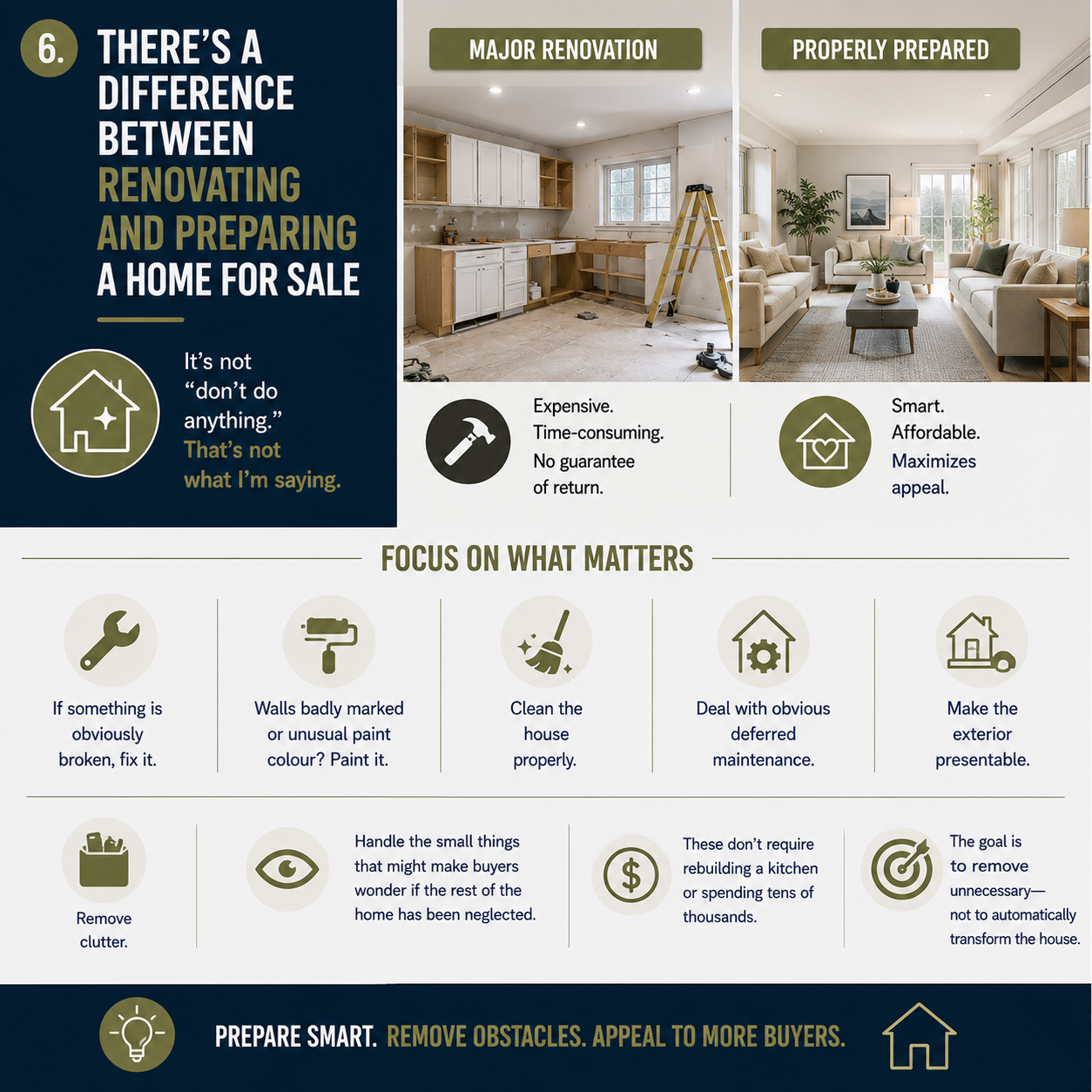
There’s a Difference Between Renovating and Preparing a Home for Sale
I also don’t want sellers to interpret this as:
Don’t do anything to your house.
That’s not what I’m saying.
There is a huge difference between undertaking a major renovation and properly preparing a property for sale.
If something is obviously broken, fix it.
If walls are badly marked or an unusual paint colour is distracting from the property, painting may make sense.
Clean the house properly.
Deal with obvious deferred maintenance.
Make the exterior presentable.
Remove clutter.
Take care of the relatively straightforward things that might cause a buyer to wonder whether the rest of the property has also been neglected.
Those decisions don’t necessarily require rebuilding a kitchen or spending tens of thousands of dollars.
The goal is to remove unnecessary objections without automatically assuming that you need to transform the house.

Sometimes the Best Renovation Is the One the Buyer Does
If your house is genuinely dated, there can be an advantage to simply acknowledging that.
Price the property appropriately for its condition.
Present it well.
And allow the next owner to decide what they want to do with it.
A buyer purchasing an older Squamish house may already be imagining a new kitchen, different flooring or a completely different layout.
They may actually prefer to buy the property for less and spend their own money creating what they want.
If you renovate first, you’re making all of those decisions for them—and asking them to pay you back for those decisions through the purchase price.
In the current market, I don’t think sellers should assume buyers will always do that.
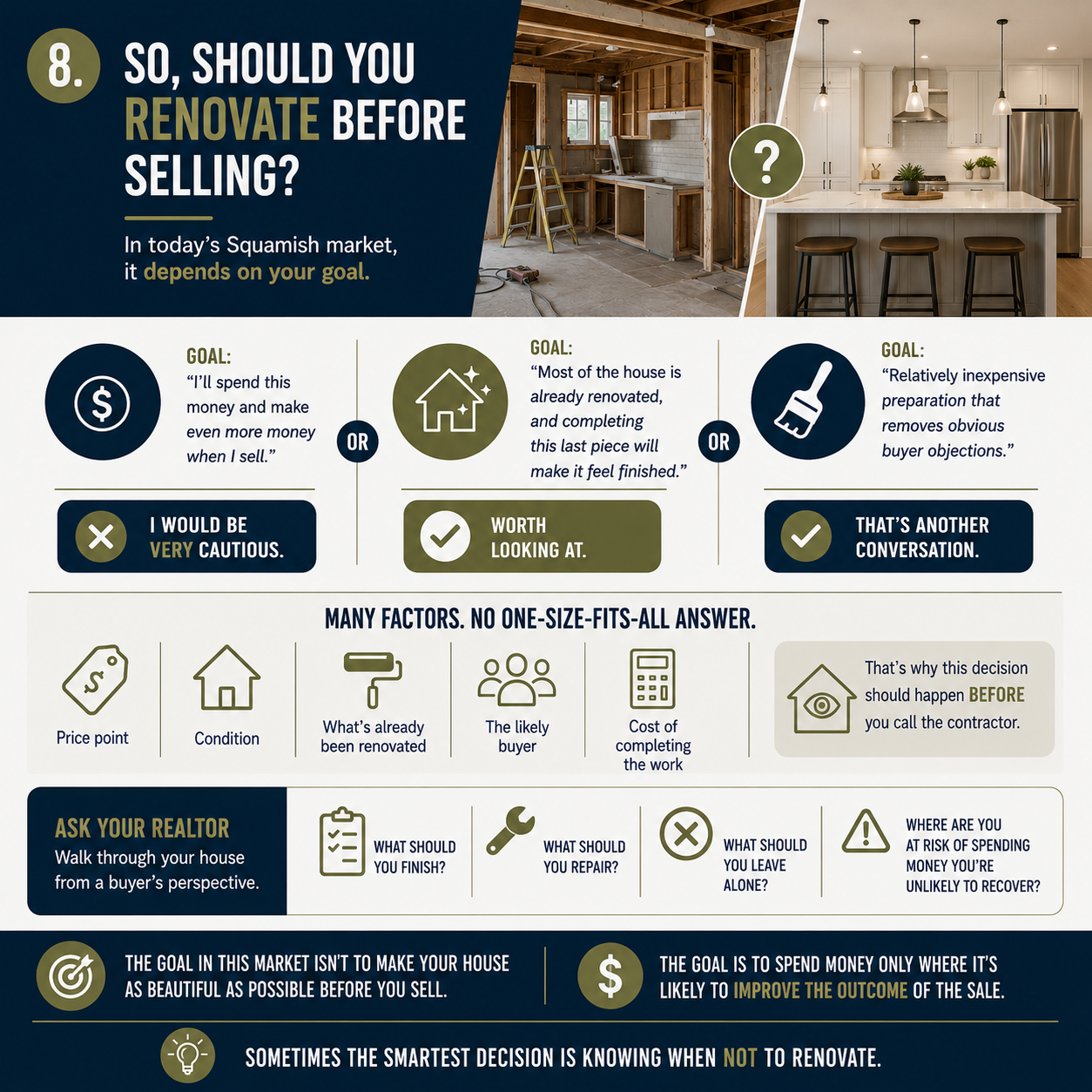
So, Should You Renovate Before Selling?
For most Squamish sellers right now, I wouldn’t recommend undertaking a major renovation purely because you’re planning to sell.
If the objective is:
“I’ll spend this money and make even more money when I sell,”
I’d be very cautious.
If the objective is:
“Most of the house is already renovated, and completing this last piece will make the entire property feel finished,”
then I think it’s worth looking at.
And if we’re talking about relatively inexpensive preparation that removes obvious buyer objections, that’s another conversation again.
Every property is different.
The price point matters. The condition matters. What has already been renovated matters. The likely buyer matters. And the cost of completing the work matters.
That’s why I think this decision should happen before you call the contractor.
Have your Realtor walk through the house and look at it from a buyer’s perspective.
What should you finish?
What should you repair?
What should you leave alone?
And where are you at risk of spending money that you’re unlikely to recover?
Because in this market, the goal isn’t to make your house as beautiful as possible before you sell it.
The goal is to spend money only where it’s likely to improve the outcome of the sale.
And sometimes the smartest decision is knowing when not to renovate.
 The data relating to real estate on this website comes in part from the MLS® Reciprocity program of either the Greater Vancouver REALTORS® (GVR), the Fraser Valley Real Estate Board (FVREB) or the Chilliwack and District Real Estate Board (CADREB). Real estate listings held by participating real estate firms are marked with the MLS® logo and detailed information about the listing includes the name of the listing agent. This representation is based in whole or part on data generated by either the GVR, the FVREB or the CADREB which assumes no responsibility for its accuracy. The materials contained on this page may not be reproduced without the express written consent of either the GVR, the FVREB or the CADREB.